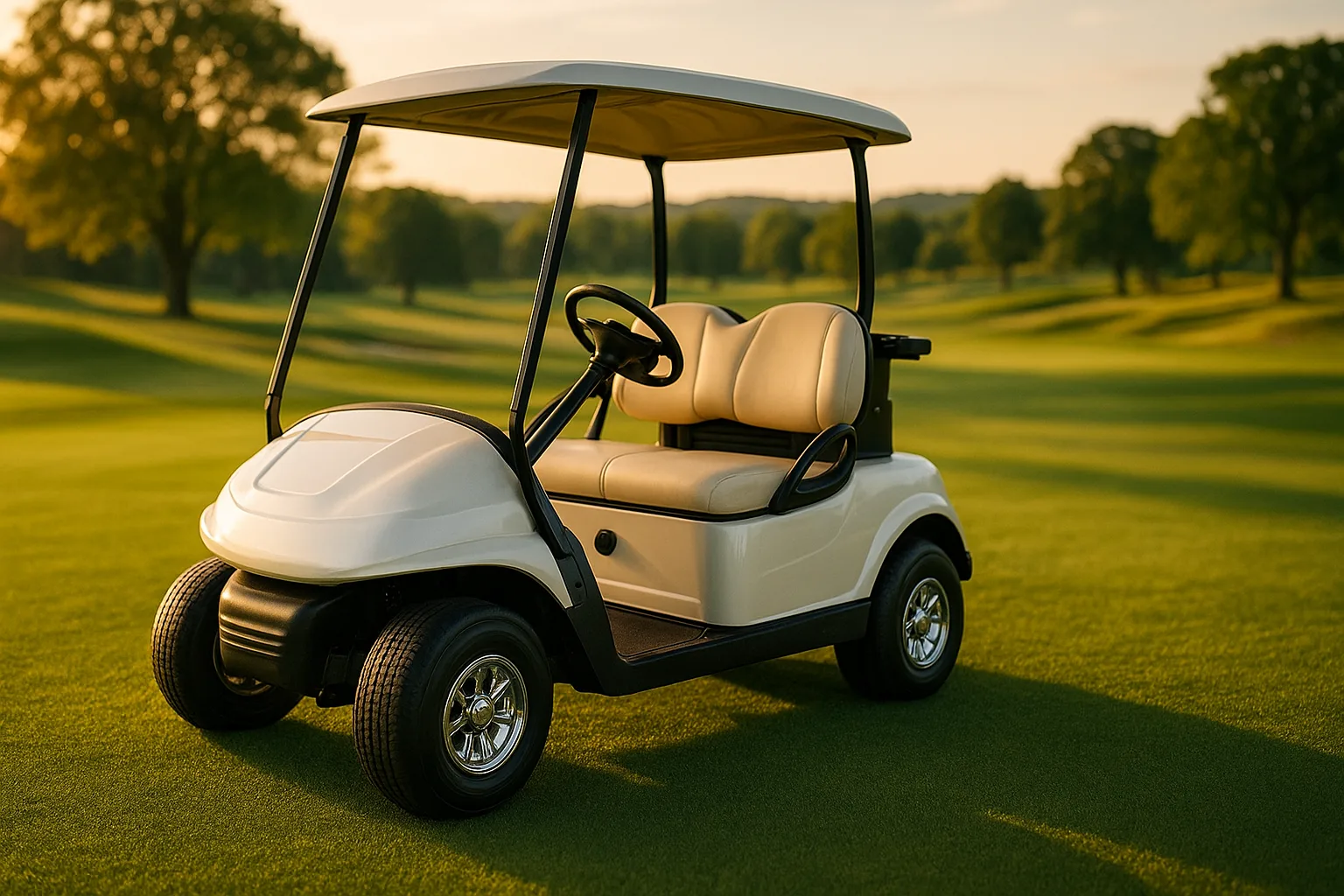
Average golf cart cost in 2026
Golf carts cost between $2,000 and $20,000+ depending on whether you're buying new or used, how many seats you need, and what features you want. New carts typically run $5,000 to $18,000, while used carts generally fall between $2,000 and $9,000. Street-legal models push that ceiling even higher, with some premium builds exceeding $22,000.
| Cart type | New price range | Used price range |
|---|---|---|
| Basic 2-seater | $5,000 – $9,000 | $2,000 – $4,500 |
| 4-passenger | $9,000 – $13,000 | $4,000 – $6,500 |
| 6-passenger | $10,000 – $16,000 | $5,000 – $9,000 |
| Street-legal LSV | $14,000 – $20,000+ | $8,000 – $12,000 |
| Premium/loaded build | $18,000 – $22,000+ | $10,000 – $15,000 |
The U.S. golf cart market is valued at approximately $2.41 billion in 2026, and electric carts now account for roughly 95% of new sales. Whether you're shopping for a neighborhood cruiser, a course cart, or a street-legal vehicle, understanding what drives price is the key to getting the best deal.
New vs. used golf cart costs
The biggest price decision you'll make is new versus used. New carts offer warranties, the latest battery technology, and full customization options. Used carts offer significantly lower entry prices, but battery condition can make or break the value.
| Factor | New cart | Used cart |
|---|---|---|
| Typical price range | $5,000 – $18,000 | $2,000 – $9,000 |
| Warranty | Yes (manufacturer) | Rarely |
| Battery condition | New | Unknown without inspection |
| Customization options | Full | Limited to existing build |
| Depreciation risk | High in years 1–3 | Lower (already depreciated) |
New carts lose the most value in the first one to three years, which is why 2- to 3-year-old used models offer some of the best value. A well-kept used cart can cost 40% less than a comparable new model while delivering similar performance.
The catch with used carts is the battery. Battery condition matters more than model year. A 4-year-old cart with a fresh lithium pack is often worth more than a 2-year-old cart with a failing lead-acid set. Always ask for the battery install date and test the charge before buying.
Well-kept golf carts retain 40% to 60% of their original value after 3 to 5 years. Buying used at this stage means you're getting most of the life at a fraction of the cost.
What affects golf cart prices
Several factors push golf cart prices up or down. Understanding these levers helps you decide which features are worth paying for and where you can save.
| Price factor | Estimated cost impact |
|---|---|
| Lithium battery upgrade (vs. lead-acid) | +$1,500 – $4,000 |
| Street-legal LSV package | +$3,000 – $6,000 |
| 6-seat vs. 4-seat configuration | +$1,000 – $3,000 |
| Lift kit | +$500 – $2,000 |
| Custom color/paint | +$300 – $1,500 |
| Audio system/touchscreen | +$300 – $1,500 |
| LED lighting package | +$200 – $800 |
| Factory-direct vs. dealer purchase | -$1,000 – $3,000 |
Power source and battery chemistry are the biggest cost drivers after seat count. Gas carts typically run $11,000 to $14,000 new, while electric carts run $12,000 to $15,000. Upgrading from a lead-acid pack to lithium adds $1,500 to $4,000 but significantly extends battery life and reduces long-term costs.
Buying factory-direct instead of through a dealer can save you $1,000 to $3,000 or more. Brands like Whisper, sold through Golfcarts.com, bypass the traditional dealer markup and offer 4-seat models starting in the mid-$7,000s, compared to the $10,000+ entry price at traditional dealers.
Gas vs. electric golf cart costs
Electric golf carts are slightly more expensive upfront but cost less to operate over time. Gas carts require ongoing fuel and more frequent maintenance, while electric carts benefit from cheaper charging costs and fewer moving parts.
| Cost factor | Gas cart | Electric cart |
|---|---|---|
| New purchase price | $11,000 – $14,000 | $12,000 – $15,000 |
| Fuel/energy cost | Higher (gasoline) | Lower (electricity) |
| Ongoing maintenance | Higher (oil, filters, spark plugs) | Lower (fewer moving parts) |
| Battery/engine replacement | Engine rebuild: $500 – $2,000+ | Battery pack: $800 – $2,000 |
| Long-term cost advantage | No | Yes |
For most buyers, electric is the better long-term investment. The roughly $1,000 to $2,000 upfront premium over gas is typically recovered through lower fuel and maintenance costs within a few years, which helps explain why electric carts now represent approximately 95% of new cart sales.
Gas carts do have advantages for buyers who need extended range without access to charging infrastructure, or who operate in very hilly terrain where consistent torque matters.
Lithium vs. lead-acid battery costs
Battery chemistry is one of the most important and often overlooked factors in golf cart pricing. Lithium packs cost more upfront but last significantly longer and require almost no maintenance.
| Battery type | Upfront premium | Lifespan | Maintenance |
|---|---|---|---|
| Lead-acid | Base price (no premium) | 4 – 6 years | Requires regular watering |
| Lithium-ion | +$1,500 – $4,000 | 8 – 12 years | Virtually maintenance-free |
Lithium batteries charge faster, hold their charge longer between uses, and don't require the regular water top-offs that lead-acid packs demand. For anyone planning to own their cart for three or more years, the lithium upgrade typically pays for itself through reduced replacement and maintenance costs.
If you're buying a used cart with lead-acid batteries, factor in replacement costs of $800 to $2,000 installed. A cart listed at $3,500 with failing batteries may actually cost you $5,000 to $5,500 all in.
Street-legal golf cart costs
Street-legal golf carts, classified as Low Speed Vehicles (LSVs), cost between $14,000 and $20,000+ new and $8,000 to $12,000 used. These carts meet federal safety standards that allow them to operate on public roads with speed limits of 35 mph or less.
| LSV feature requirement | Details |
|---|---|
| Speed capability | 20 to 25 mph |
| Lighting | Headlights, taillights, turn signals |
| Safety equipment | Seat belts, mirrors, windshield |
| Identification | VIN (vehicle identification number) |
| Powertrain | Usually lithium electric |
State and local regulations vary significantly, so street legality isn't universal. Some states require registration and insurance for LSVs. If you're buying an LSV specifically to drive on public roads, confirm your local requirements before purchasing.
Most LSV builds use lithium powertrains. Combined with the required safety package, this is why LSV pricing sits comfortably above standard cart pricing. The Club Car Onward LSV starts at $14,999 and the E-Z-GO Liberty is priced at $17,495.
Golf cart prices by brand
Major brands like Club Car, E-Z-GO, and Yamaha dominate the dealer channel, while factory-direct brands like Whisper offer significantly lower prices by cutting out the middleman. Here's how current model pricing stacks up.
| Brand and model | Configuration | Price range |
|---|---|---|
| E-Z-GO Valor | 2-seat/4-seat | $9,495 – $10,850 |
| Denago Nomad XL | 4-seat | $9,995 |
| Denago Rover XL | 4-seat | $10,695 – $10,995 |
| Denago Rover XL6 | 6-seat | $10,988 |
| Club Car Onward 4P | 4-passenger | $11,299 – $13,988 |
| Club Car Onward 6P | 6-passenger | $16,850 – $19,995 |
| Yamaha Umax | 4-seat | $16,800 |
| E-Z-GO Liberty (LSV) | Street-legal | $17,495 |
| Club Car Onward LSV | Street-legal | $14,999+ |
| Whisper W3 (factory-direct) | 4-seat entry | Mid-$7,000s |
| Whisper W5/FF4 (factory-direct) | 4-seat mid-range | $9,000 – $10,000 |
| Whisper 6-seat models (factory-direct) | 6-seat | $11,000 – $14,500 |
| Whisper Beast LE 4x4 (factory-direct) | Specialty 4x4 | Up to ~$15,000 |
Club Car is positioned as a premium brand with pricing to match. E-Z-GO's Valor models offer a more accessible entry point from a major manufacturer. Denago competes aggressively on price with feature-rich electric carts at the lower end of the mid-range. Whisper's factory-direct model undercuts all of them on 4-seat pricing.
Used golf cart buying guide
Used golf carts are the most affordable way into ownership, with prices starting around $2,000 for a basic 2-seater and reaching $9,000 for a 6-passenger model in good condition. The key to a smart used purchase is knowing what to inspect before you hand over any money.
| Inspection item | What to look for |
|---|---|
| Battery install date | Look for batteries installed within the last 2 to 3 years |
| Charge test | Fully charge and test driving range before purchase |
| Battery terminals | Check for corrosion or loose connections |
| Frame and body | Look for rust, cracks, or collision damage |
| Tires | Check tread depth and sidewall cracking |
| Brakes | Test stopping performance on a slope |
| Electronics | Test all lights, display, and accessories |
Battery replacement costs $800 to $2,000 installed, so a cart listed at an attractive price with old or failing batteries isn't necessarily a deal. Calculate the true cost by adding the purchase price plus any likely battery replacement before committing.
A fair price for a used golf cart depends heavily on age, battery condition, brand, and configuration. As a general rule, a well-maintained 3- to 5-year-old cart should be priced at 40% to 60% of its original MSRP. If a seller can't tell you when the batteries were installed, treat that as a red flag.
Avoid used carts where the seller doesn't know the battery age or won't allow a test drive. Hidden battery replacement costs are the most common reason buyers overpay on used carts.
Total cost of ownership
The sticker price is only part of what you'll spend. A true cost comparison needs to account for fuel or electricity, battery replacement, maintenance, and accessories over time. Here's a rough 5-year ownership estimate by cart type.
| Cost category | Gas cart (5 years) | Lead-acid electric (5 years) | Lithium electric (5 years) |
|---|---|---|---|
| Purchase price | ~$12,000 | ~$12,000 | ~$14,500 |
| Fuel/electricity | ~$1,500 – $2,500 | ~$300 – $600 | ~$300 – $600 |
| Battery replacement | N/A | ~$800 – $2,000 | Usually not needed |
| Maintenance (oil, filters, etc.) | ~$500 – $1,500 | ~$100 – $300 | ~$100 – $300 |
| Estimated 5-year total | ~$14,000 – $16,000 | ~$13,200 – $14,900 | ~$14,900 – $15,400 |
Lithium electric carts have the highest purchase price but the lowest ongoing costs. Gas carts may appear cheaper upfront in some configurations, but fuel and maintenance costs close the gap within a few years. Lead-acid electric carts sit in the middle on both fronts.
Accessories and customizations add cost as well. Lift kits run $500 to $2,000, audio systems add $300 to $1,500, and LED light packages typically cost $200 to $800. It's easy to add $2,000 to $5,000 in accessories to a base cart.
Financing options and ways to save
Most major dealers and manufacturers offer financing, and promotional rates can make higher-priced models significantly more accessible. Several brands offer 0% APR promotions that reduce total cost if you pay within the promotional period.
| Financing option | Details |
|---|---|
| Club Car 0% APR | 0% for up to 48 months; rebates up to $2,500 |
| Golfcarts.com/Whisper | 0% for up to 60 months; up to $1,400 off |
| Extended term financing | Up to 84 months available at some retailers |
| Bad/no credit options | In-house financing available at select dealers |
Beyond financing, there are several practical ways to pay less:
- Buy factory-direct. Brands like Whisper bypass dealer markup and can save you $1,000 to $3,000 compared to equivalent dealer-sold models.
- Shop end of season. Fall and winter typically bring more inventory and more motivated sellers, both at dealerships and in the private market.
- Get multiple quotes. Dealer prices aren't always fixed. A competing quote from another dealer or a factory-direct price sheet gives you negotiating leverage.
- Consider a 2- to 3-year-old used cart. The steepest depreciation is already done, so you get most of the life at 40% to 60% less than new.
- Skip the add-ons at the dealership. Lift kits and audio systems added at purchase are often marked up. Sourcing these aftermarket is almost always cheaper.
Frequently asked questions
What is the cheapest golf cart you can buy?
The least expensive new golf carts start around $5,000 to $7,000 for a basic 2-seat model. Factory-direct brands like Whisper offer 4-seat models starting in the mid-$7,000s. Used 2-seaters can be found for as little as $2,000, though battery condition is a major variable at that price point.
How much does a 4-passenger golf cart cost?
New 4-passenger carts cost between $9,000 and $13,000 on average. The E-Z-GO Valor starts around $9,495, the Denago Rover XL runs $10,695 to $10,995, and the Club Car Onward 4P starts at $11,299. Used 4-seat models typically run $4,000 to $6,500.
How much does a 6-passenger golf cart cost?
New 6-seat carts run $10,000 to $16,000 for most models, with premium builds like the Club Car Onward 6P reaching $16,850 to $19,995. Factory-direct 6-seat models from Whisper start around $11,000. Used 6-passenger carts typically range from $5,000 to $9,000.
Is a gas or electric golf cart cheaper?
Gas carts cost slightly less upfront at $11,000 to $14,000 new versus $12,000 to $15,000 for electric, but electric carts have lower fuel and maintenance costs. Over a 5-year ownership period, electric typically costs less in total. Electric also accounts for about 95% of new cart sales today.
Are lithium batteries worth the extra cost?
For most buyers, yes. Lithium packs add $1,500 to $4,000 at purchase but last 8 to 12 years versus 4 to 6 years for lead-acid. They charge faster, require no maintenance, and typically pay for themselves over the life of the cart. If you plan to keep your cart for 3 or more years, lithium is usually the better investment.
How much does a street-legal golf cart cost?
Street-legal LSV models cost $14,000 to $20,000+ new and $8,000 to $12,000 used. The Club Car Onward LSV starts at $14,999 and the E-Z-GO Liberty runs $17,495. These carts require headlights, taillights, turn signals, seat belts, mirrors, a windshield, and a VIN to qualify for road use.
How much does golf cart battery replacement cost?
Battery replacement costs $800 to $2,000 installed for a lead-acid pack, depending on the number of batteries and labor rates. Lithium replacement packs cost more but are rarely needed within the first 8 to 10 years. Always factor potential battery replacement into the price of any used cart you're considering.
Do golf carts hold their value?
Golf carts depreciate most sharply in the first one to three years, then tend to hold value reasonably well. A well-maintained cart retains roughly 40% to 60% of its original value after 3 to 5 years. Battery condition is the single biggest factor in used cart value retention.