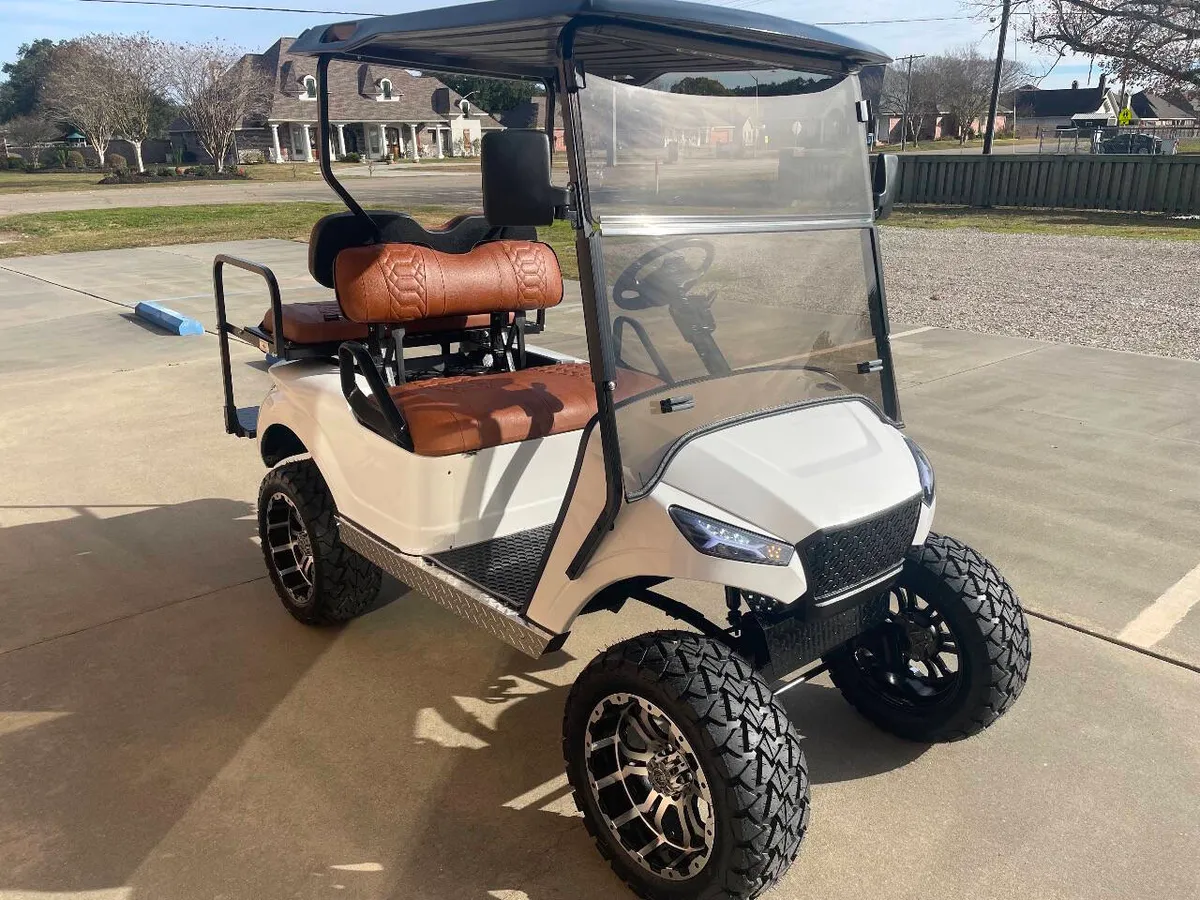
Are golf carts street legal in New York?
No. Standard golf carts are not street legal anywhere in New York State, and no local permit, town ordinance, or municipal decal can change that. The only legal alternative for driving a cart-style vehicle on public roads is a Low-Speed Vehicle (LSV), a federally certified class of motor vehicle that meets specific safety standards and can be registered through the New York DMV.
This distinction between golf carts and LSVs is the central legal issue every New York buyer needs to understand before purchasing. Getting it wrong can mean fines, vehicle impoundment, and exposure to liability without insurance coverage.
This guide was last reviewed in 2025. Golf cart and LSV regulations can change. Always verify current rules with the New York DMV and your local municipality before purchasing or operating a vehicle.
How New York classifies golf carts vs. LSVs
New York law draws a hard line between golf carts and Low-Speed Vehicles. The classification is not based on appearance or power source. It is based on whether the vehicle has a manufacturer-assigned 17-digit VIN and meets the federal safety standards defined in 49 CFR 571.500. New York's own limited-use vehicle rules are governed by 15 NYCRR 102.10.
| Feature | Golf cart | Low-Speed Vehicle (LSV) |
|---|---|---|
| 17-digit manufacturer VIN | No | Yes (required) |
| Federal safety certification (49 CFR 571.500) | No | Yes |
| Top speed | Typically under 20 mph | 20 – 25 mph |
| Maximum weight | Varies | Under 3,000 lbs |
| NY DMV registration eligible | No | Yes |
| Street legal in New York | No | Yes (on qualifying roads) |
| Insurance required | Not for private property use | Yes (liability + PIP) |
| Driver's license required | Not on private property | Yes |
One important point: it does not matter whether your golf cart runs on gas or electricity. An electric golf cart is still a golf cart under New York law if it lacks a manufacturer VIN and federal certification. The power source is irrelevant. The VIN and compliance certification are everything.
Where you can and cannot drive in New York
The rules differ significantly depending on whether you are operating a golf cart or a registered LSV. Understanding these boundaries before you drive is essential to staying on the right side of the law.
Golf carts
Golf carts are restricted to private property only. Legal locations include:
- Golf courses
- Private residential property
- Gated communities and HOA-governed roads (where the community permits it)
- Agricultural land and farm property
- Campgrounds and resort grounds (subject to facility rules)
No golf cart may travel on any public road in New York, including low-traffic neighborhood streets, regardless of what a local municipality may say. State law preempts any local rule on this point.
LSVs
Registered LSVs may operate on roads with posted speed limits of 35 mph or under. They may also cross intersections where the speed limit exceeds 35 mph, but they cannot travel along those higher-speed roads.
LSVs are prohibited from:
- Interstate highways
- Limited-access or controlled-access roads
- Any road posted above 35 mph
Local governments retain the authority to further restrict where LSVs may operate within their jurisdiction, beyond what state law already requires. Always check with your town or county before assuming an LSV is welcome on a specific road.
New York City-specific rules
New York City's default speed limit is 25 mph on most streets, which technically falls within the LSV's legal operating range. However, driving an LSV in New York City comes with significant practical complications.
LSVs top out at 25 mph, making them poorly suited for the volume, speed variability, and traffic density of city streets. Many NYC roads, particularly arterials and major corridors, are posted above 35 mph or carry traffic moving well in excess of an LSV's top speed. The New York City Department of Transportation (NYC DOT) may also impose additional restrictions beyond state requirements.
Even where NYC streets are technically within the 35 mph threshold, operating an LSV in dense urban traffic is a safety risk. If you are considering an LSV for use within the five boroughs, consult the NYC DOT and verify your specific route is appropriate before you drive.
Golf carts remain completely prohibited from all NYC public streets, the same as anywhere else in the state.
Required equipment for LSVs in New York
To be road-legal in New York, an LSV must meet the federal equipment standards set out in 49 CFR 571.500. Factory-certified LSVs from manufacturers like GEM, Tomberlin, and Star EV come pre-equipped with these features. If you are evaluating a used LSV, verify that all of the following are present and functional before purchasing.
| Required equipment | Notes |
|---|---|
| Headlamps | Front-facing, functional |
| Tail lamps | Rear-facing, functional |
| Stop/brake lamps | Activated by braking |
| Front and rear turn signals | Both sides, front and rear |
| Red rear reflectors | Passive reflective devices |
| Exterior mirrors | Driver-side exterior mirror required; interior mirror or passenger-side exterior mirror also required |
| Parking brake | Must hold vehicle stationary |
| Windshield | Must meet federal glazing standards |
| Seat belts | At every seating position |
| Horn | Audible at a reasonable distance |
| 17-digit VIN | Manufacturer-assigned; no conversion pathway exists |
Notably, bumper requirements and certain padded interior standards that apply to standard automobiles do not apply to LSVs. This is part of why LSVs look different from traditional cars while still being road-legal.
Registration and title process
LSVs must be titled and registered through the New York DMV before they can legally operate on public roads. Here is the step-by-step process:
- Obtain the manufacturer's certificate of origin (MCO) from your dealer when purchasing new. For a used LSV, you will need the existing title from the seller.
- Gather proof of identity as required by the DMV, including standard documents such as a driver's license or passport.
- Obtain proof of insurance before visiting the DMV. New York requires both liability coverage and personal injury protection (PIP) before registration is issued.
- Complete the DMV registration application. Visit a local DMV office or use the DMV's online resources at dmv.ny.gov.
- Pay the registration fee. Fees vary based on vehicle weight and registration period. Expect to pay approximately $30 to $80 for initial registration, though fees can vary.
| Registration step | What you need |
|---|---|
| Proof of ownership | MCO (new) or existing title (used) |
| Proof of identity | Driver's license, passport, or equivalent |
| Proof of insurance | Liability + PIP coverage confirmation |
| Registration application | Completed at a DMV office or online |
| Registration fee | Approximately $30 – $80 (varies by weight and period) |
Golf carts cannot be registered through the New York DMV under any circumstances. The DMV does not issue VINs to converted or homemade vehicles in this class. There is no conversion pathway that makes a golf cart street legal in New York.
Insurance requirements and costs
New York is a no-fault insurance state. LSVs must carry both minimum liability coverage and personal injury protection (PIP) before they can be registered or legally operated on public roads.
| Vehicle type | Insurance requirement | Estimated annual cost |
|---|---|---|
| LSV (registered, on-road) | Liability + PIP required | $200 – $600 per year |
| Golf cart (private property) | No mandatory auto insurance | $75 – $300 per year (standalone golf cart policy) |
For golf carts used on private property, mandatory auto insurance laws do not apply. However, you are not without risk. If someone is injured or property is damaged, your homeowner's or umbrella policy may provide some coverage, but many standard policies have exclusions or low limits for motorized vehicle incidents.
Ask your insurer specifically about:
- Whether your homeowner's policy covers golf cart liability on your property
- Whether a golf cart liability rider is available
- What situations are excluded (for example, any road use, even a brief crossing)
- Whether a standalone golf cart insurance policy makes more sense for your use case
Age and license requirements
A valid New York driver's license is required to operate an LSV on public roads. Junior learner's permits begin at age 16 in New York, making 16 the practical minimum age for LSV operation, though junior license restrictions such as supervised driving requirements still apply.
All standard New York traffic laws apply to LSV operators, including speed limits, stop sign and traffic signal compliance, and right-of-way rules. Driving an LSV is legally equivalent to driving any other registered motor vehicle.
On private property, there is no state-mandated minimum age for golf cart operation, but property owners, HOAs, and facility operators may set their own rules.
Private property and special use cases
Many New York residents want golf carts for use cases that have nothing to do with public roads. These are generally legal, subject to the rules of the property or organization governing the space.
| Use case | Golf cart permitted? | Key considerations |
|---|---|---|
| Golf courses | Yes | Governed by course rules |
| Private residential property | Yes | Verify homeowner's insurance coverage |
| Gated communities / HOA roads | Depends on HOA rules | HOA may permit or restrict; roads must be private |
| Campgrounds and resorts | Depends on facility rules | Many campgrounds allow golf carts; check with management |
| Agricultural / farm property | Yes | For on-property use only; cannot use public roads to access fields |
| Commercial operations (golf courses, resorts) | Yes, on private grounds | May require commercial liability coverage; consult insurer |
If you live in a gated or planned community, check your HOA's governing documents. Some communities treat their internal roads as private and permit golf cart use with HOA-issued rules around speed, hours of operation, and minimum operator age.
LSV brands available in New York and what they cost
If you want a cart-style vehicle that is legally operable on New York public roads, you need a factory-certified LSV. These vehicles come with the required 17-digit VIN, meet 49 CFR 571.500 safety standards, and can go directly through the DMV registration process.
| Brand | Example models | New price range | Used price range |
|---|---|---|---|
| GEM (Global Electric Motorcars) | GEM e2, e4, e6 | $8,000 – $15,000+ | $3,000 – $8,000 |
| Tomberlin | Emerge, E-Merge Elite | $9,000 – $14,000 | $4,000 – $9,000 |
| Star EV | Sirius, Classic, Capella | $8,500 – $13,000 | $3,500 – $7,500 |
Used LSVs can offer significant savings, but always verify that the 17-digit VIN is intact, the vehicle has a clean title, and all required safety equipment is present and functional before purchasing. A missing or tampered VIN creates a registration dead-end that cannot be resolved through the New York DMV.
Fines and penalties for illegal golf cart use
Operating a golf cart on a New York public road exposes you to multiple legal risks beyond a simple traffic citation. The table below outlines the most common violations and their potential consequences.
| Violation | Potential consequence |
|---|---|
| Operating an unregistered vehicle on a public road | Fines typically starting at $75 – $300; repeat violations carry higher penalties |
| Operating without required insurance | Fines, license suspension, and civil liability exposure |
| Driving while impaired (DUI/DWAI) | Full DUI/DWAI charges apply to LSV operators; potential charges for golf cart operators in some circumstances |
| Vehicle impoundment | Possible if law enforcement determines the vehicle is illegally operated on a public road |
On the DUI question specifically: LSVs are registered motor vehicles, so all New York DUI and DWAI laws apply without exception to anyone operating one. For golf carts operated illegally on public roads, law enforcement may still pursue impaired driving charges depending on the circumstances. Do not assume an unregistered vehicle creates a legal shield.
Frequently asked questions
Can I convert a golf cart to make it street legal in New York?
No. The New York DMV does not issue VINs to converted or homemade vehicles in this class. Without a manufacturer-assigned 17-digit VIN, there is no pathway to registration. The only legal option is purchasing a factory-certified LSV.
Can my town or municipality allow golf carts on local roads?
No. Local municipalities cannot override state law on this point. While municipalities can further restrict LSV access beyond state rules, they cannot grant golf carts permission to use public roads.
Can I drive an LSV in New York City?
Technically yes, on streets posted at 35 mph or under, but practical and regulatory complications make it inadvisable for most people. NYC streets vary widely in speed and traffic density, and the NYC DOT may impose additional restrictions. Consult the NYC DOT before attempting to operate an LSV within the five boroughs.
Does my LSV need a state inspection in New York?
Yes. Registered LSVs are subject to New York State vehicle inspection requirements, the same as other registered motor vehicles. Check with your DMV or a licensed inspection station for current requirements.
What happens if I drive a golf cart on a public road in New York?
You can face fines for operating an unregistered, uninsured vehicle, possible impoundment, and civil liability if an accident occurs. No insurance will cover the incident if the vehicle was being illegally operated.
Can you get a DUI on a golf cart in New York?
Potentially yes. LSV operators are subject to full DUI and DWAI laws as operators of registered motor vehicles. For illegal golf cart use on public roads, law enforcement may still pursue impaired driving charges in some circumstances. Multiple legal sources support this interpretation.
Do I need insurance for a golf cart in New York?
Mandatory auto insurance laws do not apply to golf carts used on private property. However, your standard homeowner's policy may not fully cover incidents involving a golf cart. A standalone golf cart insurance policy or a liability rider is worth considering. For LSVs, liability and PIP coverage are legally required.
Is an electric golf cart treated differently than a gas golf cart under New York law?
No. The power source does not affect the legal classification. What matters is whether the vehicle has a manufacturer-issued 17-digit VIN and meets federal safety standards. An electric golf cart without those credentials is still a golf cart under New York law.
Official resources
- New York DMV (dmv.ny.gov) - registration, titling, and vehicle requirements
- New York State Legislature (nysenate.gov) - vehicle and traffic law
- 15 NYCRR 102.10 - New York limited-use vehicle regulations
- 49 CFR 571.500 - Federal Motor Vehicle Safety Standard for Low-Speed Vehicles
- Your local municipality or county transportation office for jurisdiction-specific LSV road access rules