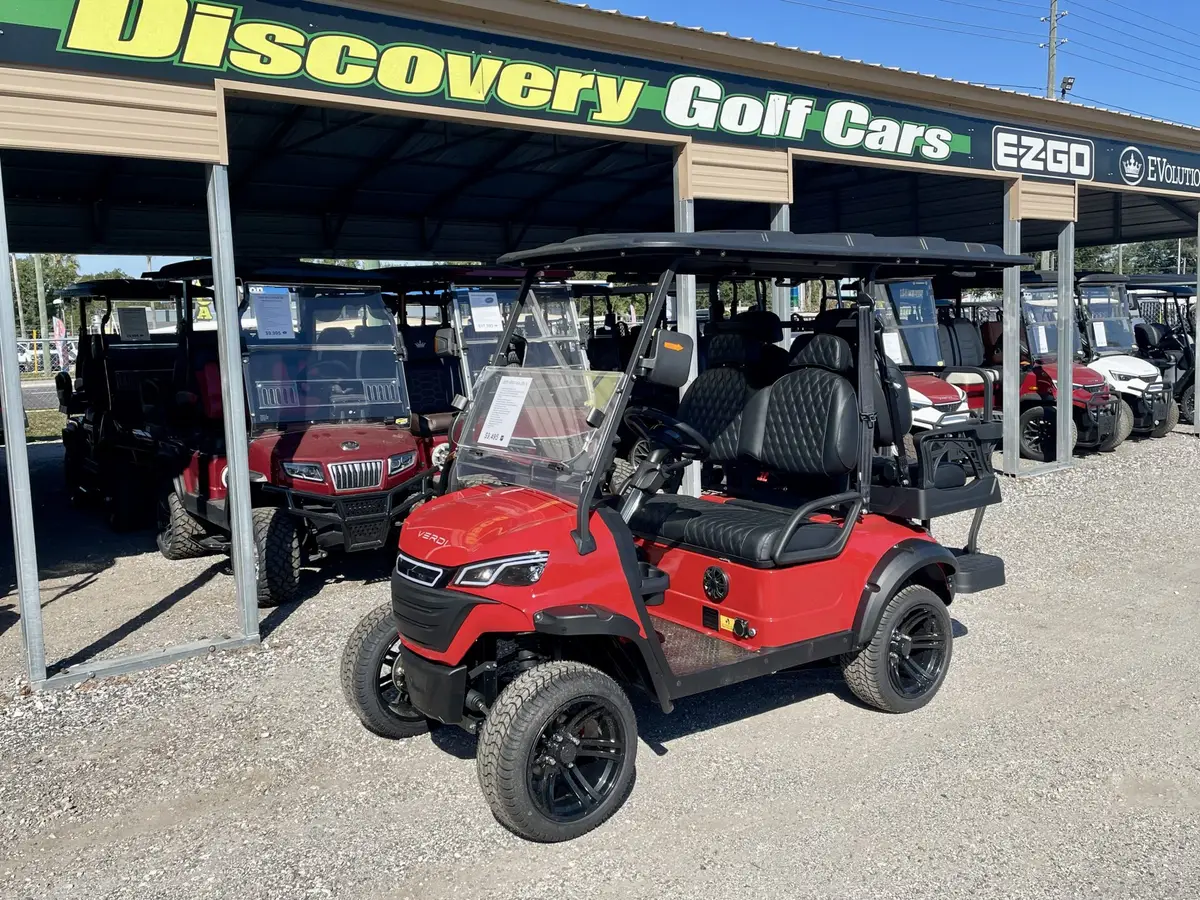
How golf cart financing works
Golf cart financing works similarly to an auto loan: a lender advances the purchase price, and you repay it in fixed monthly installments over an agreed term, with interest. Most buyers can get approved through a dealership, a specialized powersports lender, or a credit union, often within the same day.
Golf carts typically cost between $5,000 and $10,000, with base models falling below $5,000 and luxury or street-legal models exceeding $10,000. For many buyers, financing spreads that cost into manageable monthly payments rather than requiring a large lump sum upfront. If you want to understand the full pricing landscape before committing to a loan, see our breakdown of how much a golf cart costs.
| Golf cart type | Typical price range |
|---|---|
| Base / entry-level | Under $5,000 |
| Standard new or used | $5,000 – $10,000 |
| Luxury or street-legal (LSV) | $10,000+ |
When you finance, the lender may cover more than just the cart's sticker price. Lenders like Eglin Federal Credit Union roll in permanently installed accessories, tax, tag, title, dealer fees, and even an extended warranty (up to $500) into the financed amount, financing up to 95% of the total purchase price.
Types of golf cart lenders
Several types of lenders offer golf cart financing, each with different rates, terms, and eligibility rules. Your best option depends on your credit profile, the type of cart you're buying, and whether you want to apply through a dealer or independently.
| Lender type | Examples | Best for | Rate range |
|---|---|---|---|
| Powersports lenders | RoadRunner (Octane), Sheffield, FreedomRoad | Most buyers; flexible credit | 1.99% – 6.99%+ |
| Manufacturer financing | Yamaha Financial, E-Z-GO via Aqua / Sheffield | Buyers of new brand-specific carts | 0% – 5.99% |
| Credit unions | Eglin FCU | Street-legal / LSV buyers | 6.00%+ APR |
| Credit card programs | Yard Card | Small purchases or short-term payoff | 15.99%+ |
| Dealer-arranged financing | Various | Convenience at point of sale | Varies by lender |
Powersports lenders
Specialized powersports lenders are the most widely used option for golf cart loans. RoadRunner Financial (part of Octane) offers rates starting as low as 1.99% on promotional financing and a standard rate of 6.99%, with loan terms from 24 to 72 months and a minimum FICO score of 550. Sheffield Financial has no stated minimum credit score and offers terms from 36 to 60 months. FreedomRoad is notable for having no prepayment penalties.
Manufacturer financing
Brands like E-Z-GO and Yamaha offer financing directly through their dealer networks. E-Z-GO partners with both Aqua Finance and Sheffield to offer promotional rates including 0% for 36 months for qualified buyers, with longer-term options up to 84 months. Yamaha Financial offers an installment program with no stated minimum credit score, plus a branded credit card starting at 15.99% APR, which is better suited to buyers who plan to pay off their balance quickly.
Credit unions
Credit unions like Eglin FCU are especially useful for street-legal golf cart buyers. Eglin FCU offers rates starting at 6.00% APR on terms up to 60 months, requires a minimum 5% down payment, and will also refinance a recently purchased cart if you financed elsewhere within the last 180 days.
Golf cart loan interest rates
Interest rates on golf cart loans depend on your credit score, the lender type, the loan term, and whether the cart is new or used. Rates currently range from 0% on manufacturer promotions to 15.99% or higher on credit card products.
| Lender / program | Rate | Term |
|---|---|---|
| E-Z-GO / Aqua Finance (promotional) | 0% | 36 months |
| E-Z-GO / Sheffield (promotional) | 0% | 36 months |
| RoadRunner Financial (promotional) | 1.99% | Varies |
| E-Z-GO / Aqua Finance | 2.99% | 36 months |
| E-Z-GO / Aqua Finance | 3.99% | 48 months |
| E-Z-GO / Aqua Finance | 4.99% | 60 months |
| E-Z-GO / Aqua Finance | 5.99% | 84 months |
| Eglin FCU | 6.00%+ APR | Up to 60 months |
| RoadRunner Financial (standard) | 6.99%+ | 24 – 72 months |
| Yamaha Financial credit card | 15.99%+ | Revolving |
Promotional rates like 0% or 1.99% typically require strong credit (generally 660+ FICO) and apply only to new carts purchased through brand-authorized dealers. If your credit score falls below that threshold, expect a higher rate even if you are approved.
A 60-month loan on a $20,000 street-legal cart at 8.90% APR works out to approximately $554.81 per month over 42 months, based on Eglin FCU's published example. Shorter terms reduce total interest paid but increase monthly payments.
Total cost comparison: loan term vs. interest paid
Choosing a shorter loan term saves significant money in interest over time. Here's how the numbers compare on an $8,000 cart financed at 6.99% APR:
| Loan term | Monthly payment | Total interest paid | Total cost |
|---|---|---|---|
| 36 months | ~$247 | ~$892 | ~$8,892 |
| 60 months | ~$158 | ~$1,480 | ~$9,480 |
| 72 months | ~$136 | ~$1,792 | ~$9,792 |
A 36-month loan costs nearly $900 less in interest than a 72-month loan on the same cart. If you can manage the higher monthly payment, the shorter term is almost always the smarter financial choice.
Credit score requirements
Most golf cart lenders approve buyers across a wide range of credit scores, but your score directly affects the interest rate you receive. A score of 660 or higher qualifies you for prime rates. Scores below that may still get approved, but at a higher rate.
| Credit score range | Approval likelihood | Rate impact |
|---|---|---|
| 660+ (prime) | High | Best available rates |
| 550 – 659 (near-prime) | Moderate | Higher rates; approval likely |
| Below 550 | Limited | Few lender options; high rates |
| Thin / no credit history | Case-by-case | Varies; co-signer may help |
RoadRunner Financial has a published minimum of 550 FICO. Sheffield Financial has no stated minimum and works with a broader range of credit profiles. If your score is below 550, your best options are Sheffield, a co-signer arrangement, or improving your score before applying.
Steps to improve your score before applying
If you have 3 to 6 months before you need to buy, a few targeted actions can push your score into a better tier:
- Pay down revolving credit card balances to below 30% of your credit limit
- Dispute any errors on your credit report through all three bureaus
- Avoid opening new lines of credit in the months before applying
- Bring any past-due accounts current and keep them that way
- Ask a family member with strong credit to add you as an authorized user on their card
Even a modest improvement from 580 to 620 can meaningfully lower the rate you're offered, reducing total interest paid over the life of the loan.
New vs. used golf cart financing
Both new and used golf carts can be financed, but lenders treat them differently. Used carts typically come with higher rates, shorter maximum terms, and stricter age limits. New carts are also the only ones eligible for promotional financing like 0% or sub-2% rates.
| Factor | New cart | Used cart |
|---|---|---|
| Promotional rates available | Yes (0% – 2.99%) | No |
| Maximum loan term | Up to 84 months | Shorter; varies by lender |
| Age restrictions | None | Often up to 3 years old |
| Interest rates | Lower | Higher |
| Lender options | Wide | More limited |
Eglin FCU, for example, limits used cart financing to models no more than 3 years old. If you're looking at an older used cart, you may need to use a personal loan, a home equity line, or a lender with no stated age restrictions. Always confirm the lender's age cutoff before making an offer on a used cart.
Street-legal golf cart financing
Street-legal golf carts, formally classified as low-speed vehicles (LSVs), are treated more like automobiles by lenders and may qualify for different loan programs. LSVs are designed for on-road use at speeds up to 35 mph and are subject to additional state registration and equipment requirements.
| Feature | Standard golf cart | Street-legal LSV |
|---|---|---|
| Max speed | Under 25 mph | Up to 35 mph |
| On-road use | Limited / private property | Yes, on qualified roads |
| Lender classification | Powersports / recreation | Motor vehicle / LSV |
| Financing options | Powersports lenders | Credit unions, auto lenders |
| Refinancing eligible | Limited | Yes (e.g., within 180 days at Eglin FCU) |
Some lenders, including Eglin FCU, restrict LSV loans to dealer sales only and prohibit commercial or industrial use. If you purchased a street-legal cart recently and didn't secure a competitive rate, you may be able to refinance within 180 days of the purchase through a credit union that works with LSVs.
Street-legal golf cart regulations vary by state. Before financing an LSV, confirm that it meets your state's registration requirements and that the roads you plan to drive it on allow LSV traffic. Some states cap allowable road speed limits at 35 mph for LSV use.
What your loan can cover
Golf cart loans can cover more than just the base price of the cart. Many lenders allow you to roll several additional costs into the financed amount, reducing the cash you need at signing.
Depending on the lender, the financed amount may include:
- The cart's purchase price (up to 95% of the total)
- Sales tax, registration, and title fees
- Dealer documentation fees
- Permanently installed accessories and upgrades
- Extended warranty (Eglin FCU covers up to $500)
Removable accessories such as coolers, covers, or cargo attachments generally cannot be financed and must be paid for separately. Permanently installed items, such as custom wheels, lift kits, or rear seats, are more likely to qualify. If you're considering significant modifications, our guide to custom golf cart bodies and design ideas covers what's involved in planning a build.
GAP insurance (Guaranteed Asset Protection) covers the difference between what you owe on your loan and the cart's depreciated value if it's totaled or stolen. Because golf carts depreciate quickly, GAP insurance is worth considering, especially if you're financing more than 80% of the purchase price.
How to apply for golf cart financing
The application process is straightforward and, with most lenders, starts without any impact to your credit score. Here's how it typically works:
- Get prequalified. Lenders like RoadRunner Financial use a soft credit pull for prequalification, which does not affect your credit score. This shows you estimated rates and terms before you commit.
- Choose your cart and lender. Compare rates from your dealer's financing partners alongside independent lenders such as a credit union or powersports lender.
- Submit a full application. At this stage, the lender performs a hard inquiry, which may temporarily lower your credit score by a few points.
- Review and sign the loan documents. Confirm the rate, term, monthly payment, and whether there are any prepayment penalties before signing.
- Make your down payment. Most lenders require at least 5% down. A larger down payment reduces your monthly payment and total interest paid.
Many dealers arrange financing directly with lending partners, so you can complete the entire process in one visit. Shopping your own financing separately before going to the dealer, however, can help you negotiate from a stronger position. Once your cart is financed, it's also worth reviewing your golf cart insurance options to make sure your investment is properly protected.
Frequently asked questions
Can you finance a used golf cart?
Yes, most powersports lenders finance used golf carts. The key restriction to watch is the cart's age: lenders like Eglin FCU limit used cart loans to models no more than 3 years old. Older used carts may require a personal loan or a lender with no stated age cutoff.
What credit score do you need to finance a golf cart?
RoadRunner Financial requires a minimum 550 FICO score. Sheffield Financial has no published minimum. For the best rates, you generally need a score of 660 or higher. Below 550, options are limited but not necessarily zero, especially with a co-signer or a larger down payment.
How long can you finance a golf cart?
Loan terms range from 24 to 84 months depending on the lender. RoadRunner offers 24 to 72 months, Sheffield offers 36 to 60 months, E-Z-GO through Aqua Finance offers up to 84 months, and Eglin FCU goes up to 60 months. Longer terms lower your monthly payment but increase total interest paid.
What is the average interest rate on a golf cart loan?
Rates range from 0% on promotional manufacturer financing (for qualified buyers) to 6.99% or higher for standard powersports loans. Credit card financing through programs like Yamaha Financial starts at 15.99%. Your credit score and the lender you choose are the biggest factors in the rate you receive.
Does applying for golf cart financing hurt your credit score?
Prequalification typically uses a soft inquiry and does not affect your score. The formal application triggers a hard inquiry, which may temporarily reduce your score by a few points. If you apply with multiple lenders within a short window (usually 14 to 45 days), credit bureaus often treat them as a single inquiry for scoring purposes.
What is the minimum down payment for a golf cart loan?
Eglin FCU requires a minimum of 5% down and finances up to 95% of the total purchase price. Other lenders may have different requirements depending on your credit profile. A larger down payment reduces both your monthly payment and the total interest you'll pay over the life of the loan.
Can you refinance a golf cart loan?
Yes, particularly for street-legal models. Eglin FCU, for example, allows refinancing on recently purchased LSVs if the original purchase was within the last 180 days. If you financed at a high rate through a dealer, refinancing with a credit union or competing lender could lower your monthly payment and reduce your total interest cost.
What is the best loan term for a golf cart?
The 36 to 60-month range is generally the sweet spot for most buyers. It balances a manageable monthly payment with a reasonable total interest cost. The 60-month term is reported as the most popular choice among RoadRunner borrowers. Avoid very long terms (72 to 84 months) unless the lower payment is genuinely necessary for your budget.