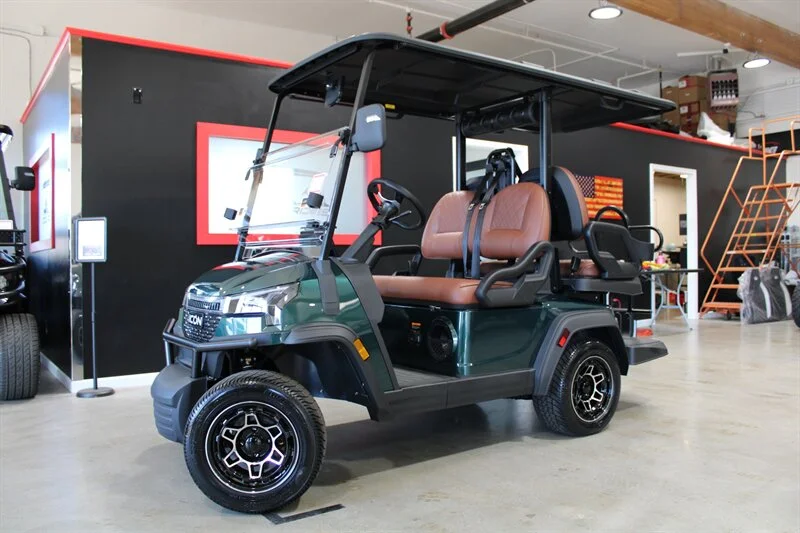
Are golf carts street legal in South Carolina?
Yes, golf carts are street legal in South Carolina statewide under a permit system managed by the SC Department of Motor Vehicles. Unlike most states where legality depends on individual city or county ordinances, South Carolina operates a uniform statewide framework governed by Section 56-2-90 (updated May 22, 2025, from the former Section 56-2-105). Any resident with a valid driver's license, proof of ownership, and liability insurance can legally operate a permitted golf cart on qualifying public roads.
| Key detail | Requirement or rule |
|---|---|
| Governing statute | Section 56-2-90 (effective May 22, 2025) |
| Permit fee | $5 |
| Permit validity | 5 years or until address change |
| Minimum driver age | 16 years old with valid driver's license |
| Maximum road speed limit | 35 mph posted |
| Golf cart top speed | Under 20 mph |
| Four-mile radius rule | Measured from registration address |
| Nighttime operation | Allowed only where local ordinance permits |
South Carolina's system uses a permit decal rather than a standard license plate. That decal is specific to golf carts and does not apply to Low Speed Vehicles (LSVs), which are titled and registered separately as motor vehicles. Understanding which category your cart falls into is the most important first step before hitting any public road.
Golf cart vs. low speed vehicle: what's the difference?
The single most common source of confusion in South Carolina golf cart law is the distinction between a golf cart and a Low Speed Vehicle (LSV). These are two separate legal categories with different registration requirements, road access rules, and equipment standards.
| Feature | Golf cart | Low speed vehicle (LSV) |
|---|---|---|
| Top speed | Under 20 mph | 20 – 25 mph |
| Registration | DMV permit decal | Standard title and license plate |
| VIN required | No | Yes, manufacturer-assigned 17-digit VIN |
| Federal safety standard | Not required | Must meet 49 CFR 571.500 |
| Four-mile radius restriction | Yes | No |
| Maximum road speed limit | 35 mph posted | 35 mph posted |
| Example brands | Standard Club Car, E-Z-GO | E-Z-GO Liberty, Club Car LSV, Tomberlin |
LSVs must meet federal safety standards under 49 CFR 571.500 and arrive from the factory equipped with headlamps, stop lamps, turn signals, tail lamps, reflex reflectors, rearview mirrors, a windshield, seat belts at every seating position, a parking brake, and a 17-digit VIN. These are not aftermarket additions; they are factory-certified features that define the classification.
The biggest practical advantage of an LSV is freedom from the four-mile radius rule. Golf cart operators are restricted to roads within four miles of their registration address, while LSV operators can travel on any qualifying public road regardless of distance from home.
You cannot convert a standard golf cart into an LSV through aftermarket modifications. South Carolina will not title or register a retrofitted cart as an LSV. LSV status requires a manufacturer-assigned 17-digit VIN and factory federal safety certification. No amount of added equipment changes the legal classification.
How to register a golf cart in South Carolina
Registering a golf cart in South Carolina requires completing Form GC-2 (Golf Cart Permit Registration) through the SC DMV. The process is straightforward, but you must have all required documents in hand before submitting. The permit fee is $5, and the resulting decal is valid for five years or until your address changes, whichever comes first.
| Requirement | Details |
|---|---|
| Form | GC-2, Golf Cart Permit Registration |
| Proof of ownership | Bill of sale, Manufacturer's Certificate of Origin (MCO), or equivalent |
| Insurance | Proof of liability insurance required |
| Driver's license | Valid South Carolina driver's license number |
| Fee | $5 |
| Permit validity | 5 years or until address change |
Once permitted, you must carry your registration certificate and proof of insurance whenever you operate the cart on a public road. The permit decal takes the place of a license plate for golf carts. LSVs, by contrast, go through standard motor vehicle titling and receive regular license plates.
Buying a used golf cart? Make sure the seller provides a bill of sale or the original Manufacturer's Certificate of Origin. Without acceptable proof of ownership, the SC DMV will not issue your permit decal. Verify documentation before completing any purchase.
Where you can and cannot drive
South Carolina law permits golf carts on public roads and secondary highways where the posted speed limit is 35 mph or less. You may cross roads with higher posted speed limits at intersections, but you cannot travel along those roads. Interstates, freeways, and controlled-access highways are off-limits entirely.
| Road type | Golf cart allowed? |
|---|---|
| Roads with posted speed limit of 35 mph or less | Yes |
| Crossing a higher-speed road at an intersection | Yes |
| Traveling along roads with speed limits above 35 mph | No |
| Interstates, freeways, controlled-access highways | No |
| Roads on islands not accessible by automobile bridge | Yes (four-mile rule does not apply) |
The four-mile radius rule
Golf cart operators are restricted to roads within a four-mile radius of their registration address. If your address is within a gated community, the four-mile radius is measured from the nearest gated community entrance rather than your home address.
This restriction does not apply to LSVs. It also does not apply on islands that are not accessible by automobile bridge. Daufuskie Island is the most commonly cited example: because it has no automobile bridge connection to the mainland, the four-mile radius rule is waived for carts operated there.
Local road restrictions
Even within the statewide framework, individual municipalities can impose additional restrictions. Isle of Palms, for example, prohibits golf carts on SC-703 (Palm Boulevard) and bans both golf carts and LSVs on SC-517 (the IOP Connector). Always check local rules for the specific city or town where you plan to drive.
Nighttime driving rules
The most significant change from the 2025 legislative update (HB 3292, effective May 22, 2025) is the expansion of nighttime driving authority. Under the old law, nighttime golf cart operation was only permitted in municipalities located in counties with a population between 150,000 and 250,000 that had jurisdiction over a barrier island. That restriction no longer applies.
| Nighttime rule | Pre-May 2025 | Post-May 2025 (HB 3292) |
|---|---|---|
| Which municipalities could allow nighttime driving | Limited to specific barrier island counties (pop. 150,000–250,000) | Any municipality statewide |
| Default without local ordinance | Daylight hours only | Daylight hours only |
| Required equipment for nighttime | Headlights, taillights, brake lights (minimum) | Headlights, taillights, brake lights (minimum) |
The default rule is still daylight-only operation unless your local municipality has passed an ordinance explicitly allowing nighttime driving. Cities and counties that adopt such ordinances can define specific hours, locations, and equipment requirements within the state framework.
Clemson has adopted a nighttime ordinance with no curfew, requiring working headlights, taillights, and turn signals. Isle of Palms has not adopted a nighttime ordinance, so golf carts there are prohibited after dark. Check with your specific city hall or municipal website to confirm whether a nighttime ordinance is in effect where you plan to drive.
No statewide tracker currently exists showing which municipalities have adopted nighttime ordinances under HB 3292. Until one is published, contact your local city or county government directly to get a confirmed answer before driving after dark.
Age and license requirements
South Carolina requires golf cart operators on public roads to be at least 16 years old and hold a valid driver's license. A learner's permit does not satisfy this requirement. These rules apply to both golf cart and LSV operators on any public road.
| Requirement | Rule |
|---|---|
| Minimum age | 16 years old |
| License type required | Valid driver's license (not a learner's permit) |
| Applies to | Both golf cart and LSV operators on public roads |
Seat belt requirements
Children under 12 must wear a fastened seat belt when a golf cart is operated on a public road. This is a statewide requirement, not a local option. Adults are not required by state law to wear seat belts while riding in a golf cart, though individual communities or HOAs may have their own rules.
DUI and traffic law enforcement
South Carolina treats golf carts as vehicles under traffic law when they are operated on public roads. That means DUI laws apply fully to golf cart and LSV operators. Law enforcement in beach communities and college towns actively enforces impaired driving against cart operators, and violations can result in impoundment, fines, and misdemeanor charges.
| Enforcement area | Applies to golf carts? |
|---|---|
| DUI laws | Yes |
| Open container laws | Yes |
| Parking fees and regulations | Yes (varies by city) |
| Impoundment for violations | Yes |
In Clemson, golf carts are subject to the same parking fees as other vehicles and cannot be used as taxis. During football season, when cart use peaks, enforcement is particularly active. Do not assume that driving a golf cart exempts you from the standard rules of the road.
Local rules by city and community
South Carolina's statewide framework sets the floor, but cities and counties can layer additional rules on top. Here is how the law plays out in the most popular golf cart communities across the state.
| Location | Key local rules |
|---|---|
| Isle of Palms | Golf carts prohibited on SC-703 (Palm Blvd); both carts and LSVs prohibited on SC-517 (IOP Connector); no nighttime ordinance adopted; designated cart parking at 9th Ocean Blvd, 28th and 31st Avenues |
| Clemson | Nighttime ordinance adopted (no curfew, lights required); parking fees apply; cart-as-taxi prohibited |
| Myrtle Beach | State rules apply; city provides local guidance on its website |
| Hilton Head Island | State rules apply; widely used throughout the island |
| Daufuskie Island | Island exception applies; no automobile bridge access means the four-mile radius rule does not apply |
| Kiawah Island / Sea Islands | State rules apply; popular for private community use |
If you live in a planned community or HOA, expect an additional layer of rules on top of state and local law. Many Lowcountry resort and retirement communities have their own cart policies covering speed limits within the community, designated paths, and parking. Check with your HOA directly before assuming state law is the only standard that applies.
2025 law changes: what HB 3292 means for you
House Bill 3292, effective May 22, 2025, made two primary changes to South Carolina golf cart law. First, it renumbered the governing statute from Section 56-2-105 to Section 56-2-90. Second, and more substantively, it expanded nighttime driving authority from a narrow set of barrier island municipalities to all municipalities statewide.
| Change | Before HB 3292 | After HB 3292 (May 22, 2025) |
|---|---|---|
| Governing statute | Section 56-2-105 | Section 56-2-90 |
| Nighttime driving authority | Only specific barrier island counties (pop. 150,000–250,000) | Any municipality statewide by ordinance |
| Core registration and permit rules | Unchanged | Unchanged |
| Four-mile radius rule | Unchanged | Unchanged |
| Local ordinance power | Limited | Expanded to set hours, methods, and locations |
The core mechanics of the law, including the permit process, the four-mile radius, the 35 mph road limit, and age requirements, were not changed by HB 3292. If you already hold a valid permit, you do not need to re-register. The practical impact is almost entirely about nighttime driving access at the local level.
Frequently asked questions
Do I need a license plate for my golf cart in South Carolina?
No. Golf carts receive a DMV permit decal, not a standard license plate. LSVs, which are classified as motor vehicles, are titled and receive regular license plates.
Can my teenager drive a golf cart on public roads?
Only if they are 16 or older and hold a valid driver's license. A learner's permit does not qualify. Anyone under 16 is prohibited from operating a golf cart on public roads regardless of supervision.
Can you get a DUI on a golf cart in South Carolina?
Yes. South Carolina applies DUI and open container laws to golf cart operators on public roads. Enforcement is active in beach communities and college towns, and the consequences are the same as for any motor vehicle: impoundment, fines, and potential misdemeanor charges.
Can I drive my golf cart at night?
Only if your municipality has passed an ordinance allowing it under HB 3292. Without a local ordinance, the default is daylight-only operation. Check with your specific city or county to confirm whether a nighttime ordinance is in effect.
What documents do I need to carry while driving?
You must carry your golf cart registration certificate, proof of liability insurance, and your valid driver's license whenever you operate on a public road.
Does the four-mile rule apply everywhere in South Carolina?
It applies to all golf cart operators except those driving on islands not accessible by automobile bridge, such as Daufuskie Island. LSVs are not subject to the four-mile restriction.
How much does it cost to register a golf cart in South Carolina?
The DMV permit fee is $5. The permit is valid for five years or until your address changes, whichever comes first.
Is liability insurance required?
Yes. Proof of liability insurance is required before the DMV will issue a golf cart permit, and you must carry that proof while operating on public roads. No specific minimum coverage amount is defined by statute, so consult an insurance provider for appropriate coverage levels.
Can I modify my golf cart to qualify as an LSV?
No. South Carolina will not recognize a retrofitted golf cart as an LSV. LSV status requires a manufacturer-assigned 17-digit VIN and factory-certified compliance with federal safety standard 49 CFR 571.500. Aftermarket modifications cannot achieve that classification.