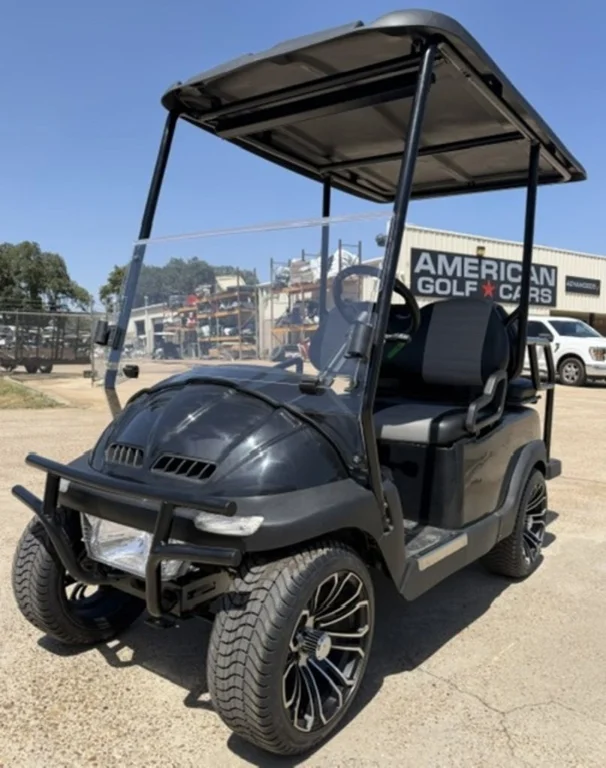
Are golf carts street legal in Rhode Island?
Golf carts are not street legal anywhere in Rhode Island. There is no permit pathway, no local ordinance exception, no DMV registration process, and no conversion method that changes this. If you drive a true golf cart on a Rhode Island public road, you are operating an unregistered, uninsured vehicle in violation of state law.
However, Rhode Island passed legislation in 2023 (implemented in 2024) that created a statewide framework for low-speed vehicles (LSVs), a federally defined class of four-wheeled vehicles that look similar to golf carts but are manufacturer-certified to federal safety standards. LSVs can be titled, registered, and driven on public roads with posted speed limits of 35 mph or less. Understanding the difference between a golf cart and an LSV is the key to understanding Rhode Island's road-use rules.
| Vehicle type | Street legal in Rhode Island? | Registration available? | Typical price range |
|---|---|---|---|
| Golf cart | No | No | $3,000 – $15,000 |
| Low-speed vehicle (LSV) | Yes (35 mph roads or below) | Yes, through RI DMV | $10,000 – $20,000+ |
How Rhode Island classifies golf carts vs. LSVs
The distinction between a golf cart and an LSV is not cosmetic; it is a legal and engineering distinction rooted in federal standards. Getting this wrong can be expensive.
Golf carts
A golf cart is designed for use on a golf course. It has a top speed under 20 mph, does not carry a 17-digit Vehicle Identification Number (VIN), and has not been certified to any federal motor vehicle safety standard. No matter how many accessories you add, a golf cart remains a golf cart in the eyes of Rhode Island law and has no path to public road use.
Low-speed vehicles (LSVs)
An LSV is a four-wheeled vehicle with a top speed between 20 and 25 mph that has been factory-certified to federal safety standards under 49 CFR 571.500. It carries a 17-digit VIN assigned under 49 CFR Part 565. This federal certification happens at the manufacturer level, not after the fact. Common purpose-built LSV brands include GEM, Arcimoto, and Tropos Motors.
| Feature | Golf cart | LSV |
|---|---|---|
| Top speed | Under 20 mph | 20 to 25 mph |
| 17-digit VIN | No | Yes (49 CFR Part 565) |
| Federal safety certification | No | Yes (49 CFR 571.500) |
| RI DMV registration | Not available | Available |
| Public road access | None | Roads 35 mph or below |
If a vehicle looks like a golf cart but was factory-built and certified as an LSV, it is eligible for registration and road use in Rhode Island. The key question is always: does it have a 17-digit VIN and federal certification from the manufacturer?
Rhode Island's 2023 LSV legislation explained
Before 2023, Rhode Island had no statewide framework for LSVs on public roads. The only narrow exception existed under RIGL Chapter 31-19.4, which allowed limited LSV use on Prudence Island with operating hours restricted to 6:00 AM to 6:00 PM.
The 2023 legislation, codified as RIGL Chapter 31-19.6 and implemented in 2024, changed everything. It created a uniform statewide registration and road-use framework that applies to any properly certified LSV, not just island residents. Cities and towns retain authority to ban LSVs from specific streets, so local restrictions can still apply on top of the statewide rules.
Prudence Island residents now benefit from the broader statewide framework. Whether the old island-specific hour restrictions remain in effect as a local rule is worth confirming directly with the town of Portsmouth, which administers Prudence Island.
Where LSVs can and cannot operate
Rhode Island's statewide LSV law sets clear geographic boundaries for where registered LSVs may travel. The table below summarizes the key access rules at a glance.
| Road type | LSV access |
|---|---|
| Roads with posted limit of 35 mph or below | Yes, permitted |
| Crossing intersections where speed limit exceeds 35 mph | Yes, crossing only (not traveling on) |
| Roads with posted limit above 35 mph | No |
| Interstate highways and freeways | No |
| Controlled-access roads | No |
| Streets banned locally by city or town | No |
Always check with your local municipality before operating an LSV in a new area. Cities and towns have the authority under RIGL Chapter 31-19.6 to restrict or prohibit LSV use on specific roads even if state law would otherwise permit it.
LSV equipment requirements
Every LSV operated on Rhode Island public roads must meet the full federal equipment requirements under 49 CFR 571.500. These are not optional add-ons; they are mandatory at the factory-build level and are part of what distinguishes a true LSV from a modified golf cart.
- Headlamps
- Stop lamps (brake lights)
- Turn signal lamps
- Tail lamps
- Reflex reflectors
- Rearview mirrors
- Windshield
- Seat belts at every designated seating position
- Parking brake
- 17-digit VIN
A vehicle missing any of these items does not qualify as an LSV and cannot be registered for road use in Rhode Island, regardless of its speed capability.
Registration and title process
Registering an LSV in Rhode Island follows the same general process as registering a passenger vehicle through the Rhode Island Division of Motor Vehicles (DMV). Golf carts cannot be titled, registered, or issued license plates under any circumstance.
| Item required | New LSV | Used LSV |
|---|---|---|
| Proof of ownership | Manufacturer's Certificate of Origin | Existing title |
| Proof of insurance | Required | Required |
| 17-digit VIN | Required | Required |
| Federal safety certification | Required (factory-issued) | Required (factory-issued) |
Registration fees for LSVs at the RI DMV are generally consistent with standard motor vehicle fees. For current fee schedules, visit dmv.ri.gov directly, as fees are subject to change.
Insurance requirements
LSVs must carry at least Rhode Island's state minimum liability insurance to operate on public roads. Current RI minimums require drivers to carry:
- $25,000 bodily injury per person
- $50,000 bodily injury per accident
- $25,000 property damage per accident
Golf carts are not registered motor vehicles and are therefore not subject to mandatory auto insurance requirements. That said, anyone operating a golf cart on private property should verify whether their homeowner's policy or umbrella policy covers golf cart liability. Many standard homeowner's policies include limited golf cart coverage, but endorsements are often needed for broader protection. For a fuller overview of your options, see our guide to golf cart insurance coverage.
Do not assume your homeowner's insurance covers golf cart use off your immediate property. Contact your insurer to confirm coverage limits and whether a separate endorsement is needed for use on community roads, resort paths, or golf courses.
Age and driver's license requirements
A valid Rhode Island driver's license is required to operate an LSV on public roads. Rhode Island issues learner's permits starting at age 16, making 16 the practical minimum age for supervised driving, though a full license is typically required for independent public road operation of an LSV.
Because golf carts have no legal public road access in Rhode Island, there is no minimum age requirement tied to public road operation for golf carts. Private property rules, including those set by golf courses, HOAs, or resort operators, govern golf cart use in those settings.
Private property and golf course use
Golf carts are entirely legal to operate on private property, including golf courses, farms, resorts, and private communities. Rhode Island law restricts road access, not private land use, so property owners and managers set their own rules in these environments.
For golf course operators and resort managers, standard considerations include:
- Requiring operators to be a minimum age (often 16 or 18) as a facility policy
- Carrying appropriate commercial liability insurance for fleet golf carts
- Ensuring paths and crossings do not intersect public roads in ways that create liability
If your facility's private roads connect to or cross public roads, consult a Rhode Island attorney about liability exposure and signage requirements.
HOA and planned community considerations
Rhode Island has numerous coastal communities, retirement neighborhoods, and gated developments where residents want to use golf carts on internal roads. If those roads are entirely private and not dedicated public ways, the statewide prohibition on golf carts does not apply, and the HOA or community association can set its own operating rules.
However, if internal community roads are public ways (which is common even in planned developments), golf carts remain prohibited, and LSVs would need to be registered under RIGL Chapter 31-19.6 to be used legally. HOA boards considering a golf cart or LSV policy should:
- Confirm whether internal roads are public or private ways through the municipal assessor or plat records
- Consult legal counsel before adopting community golf cart rules
- Consider whether community roads meet the 35 mph or below threshold for LSV eligibility
- Review association insurance coverage for vehicle-related incidents on community property
Penalties for unlawful operation
Driving a golf cart on a Rhode Island public road can result in multiple simultaneous violations. There is no specific "golf cart on road" citation; instead, officers apply existing statutes to the situation.
| Violation | Applicable law | Potential consequence |
|---|---|---|
| Operating an unregistered vehicle | RIGL Title 31 | Fine and vehicle impoundment |
| Operating an uninsured vehicle | RIGL Title 31 | Fine and license suspension |
| Operating while impaired | RIGL 31-27-2 | DUI charges, fines, license suspension |
A single traffic stop involving a golf cart on a public road could result in an unregistered vehicle citation, an uninsured motorist charge, and, if alcohol is involved, a DUI charge under RIGL 31-27-2. These violations stack, and the combined fines, court costs, and insurance consequences can be significant.
DUI laws and golf carts
LSVs are registered motor vehicles, so Rhode Island DUI law under RIGL 31-27-2 applies in full. Impaired operation of a registered LSV on public roads carries the same legal consequences as impaired operation of a car or truck.
For golf carts on public roads, the situation is arguably worse. A golf cart on a public road is already an unlawful vehicle, so operating one while impaired creates both a DUI exposure and unregistered/uninsured vehicle violations simultaneously.
Even on private property, operating a golf cart while heavily impaired can create civil liability if an accident occurs, particularly on shared community property where others are present.
Can you convert a golf cart to be street legal?
No. There is no process in Rhode Island, or at the federal level, to convert a standard golf cart into a street-legal LSV after manufacture. Federal certification under 49 CFR 571.500 must occur at the factory. No state agency, private shop, or individual modification can retroactively certify a golf cart, and the Rhode Island DMV has no VIN assignment process for this purpose.
Buyers who want a vehicle that looks like a golf cart but can be legally driven on public roads should purchase a purpose-built LSV from a manufacturer whose vehicles come with federal certification and a 17-digit VIN from the factory. Attempting to modify and register a golf cart is not a shortcut; it is a dead end.
Purchasing an LSV in Rhode Island
If you want a street-legal low-speed vehicle in Rhode Island, buying a factory-built LSV is the only path. Here is what to know before purchasing.
Price ranges
| Vehicle type | Typical price range |
|---|---|
| New factory-built LSV | $10,000 – $20,000+ |
| Used factory-built LSV | $6,000 – $14,000 |
| New golf cart (for private use) | $5,000 – $15,000 |
| Used golf cart (for private use) | $3,000 – $8,000 |
What to verify at purchase
- Confirm the vehicle has a 17-digit VIN on the frame or dashboard
- Ask the dealer or seller for documentation of federal safety certification (49 CFR 571.500 compliance)
- For new vehicles, obtain the Manufacturer's Certificate of Origin
- For used vehicles, confirm the existing title is clean and in the seller's name
- Verify the vehicle's top speed falls within the 20 to 25 mph LSV range
Electric vs. gas LSVs
Rhode Island's LSV law applies equally to electric and gas-powered low-speed vehicles. Electric LSVs have become increasingly common and may qualify for federal tax incentives under the Inflation Reduction Act, depending on the vehicle and buyer eligibility. Consult a tax professional to determine whether a specific electric LSV purchase qualifies for any federal or Rhode Island state credits before buying. If you are weighing your options, our guide to the best electric golf carts covers key features and comparisons worth reviewing.
When shopping for an LSV, always ask for the window sticker or documentation showing the vehicle is classified as a "low-speed vehicle" under federal law. Dealers who cannot produce this documentation may be selling a golf cart, not a registerable LSV.
How Rhode Island compares to neighboring states
Readers near the Connecticut or Massachusetts border may wonder whether the rules differ nearby. Both neighboring states also prohibit true golf carts from public roads but allow registered LSVs under comparable frameworks. Each state sets its own road speed thresholds and local override authority, so a registered LSV from Rhode Island is not automatically authorized to operate in Connecticut or Massachusetts without meeting those states' individual requirements. If you live near a state border, verify each state's current rules before crossing. You can also review our breakdown of Massachusetts golf cart laws for a side-by-side sense of how the neighboring framework compares.
Frequently asked questions
Are golf carts legal on Rhode Island beaches or state park roads?
Rhode Island's prohibition on golf carts covers public roads generally, which includes roads within state parks if they are public ways. Beach access roads managed by the state are similarly off-limits to golf carts. Some state parks may permit specific authorized vehicles on designated paths; contact the Rhode Island Department of Environmental Management (DEM) directly for rules at a specific location.
Can a business rent LSVs to customers in Rhode Island?
The statewide LSV law does not specifically carve out rental operations, but a rental LSV would need to be titled and registered like any other LSV. Commercial operators should obtain commercial auto insurance and confirm registration requirements with the RI DMV. Legal counsel familiar with Rhode Island motor vehicle law is advisable before launching an LSV rental operation.
What is the current status of Prudence Island's old golf cart rules?
The 2024 statewide LSV framework superseded the narrow Prudence Island provision under RIGL Chapter 31-19.4 as the governing statewide rule. Prudence Island residents now operate under RIGL Chapter 31-19.6. Whether the old 6:00 AM to 6:00 PM hour restriction remains as a local rule is best confirmed directly with the town of Portsmouth or the Prudence Island Conservancy.
Can a 16-year-old drive an LSV on public roads in Rhode Island?
Rhode Island issues learner's permits at age 16, but a valid Rhode Island driver's license (not just a learner's permit) is required to operate an LSV on public roads. A full license is typically issued at age 17 after the supervised driving period is completed.
Where can I find official Rhode Island LSV rules?
The primary sources are dmv.ri.gov for registration and titling information and rilegislature.gov to read the full text of RIGL Chapter 31-19.6. For federal LSV safety standards, the relevant regulations are published at ecfr.gov under 49 CFR 571.500 and 49 CFR Part 565.
Rhode Island law in this area changed significantly in 2023 and 2024. Always verify current rules with the RI DMV and rilegislature.gov before making a purchase or operating decision. This article reflects the law as understood at time of publication and is not legal advice.