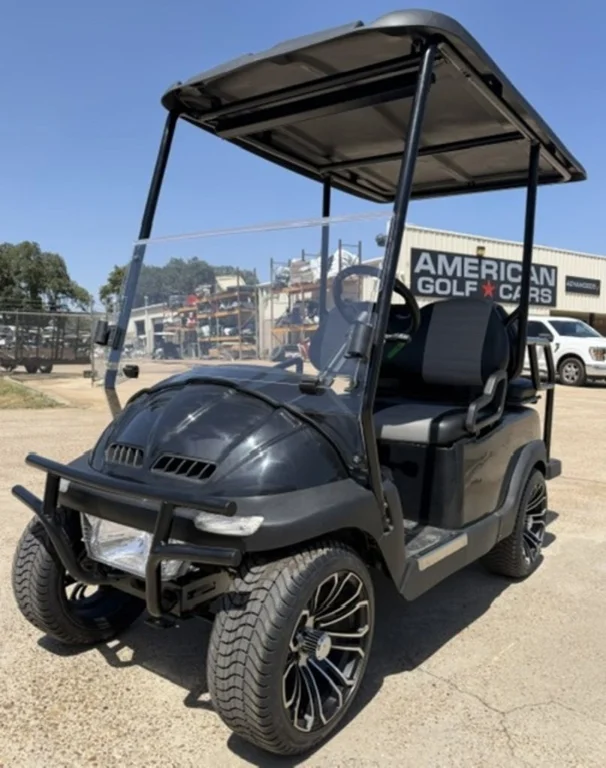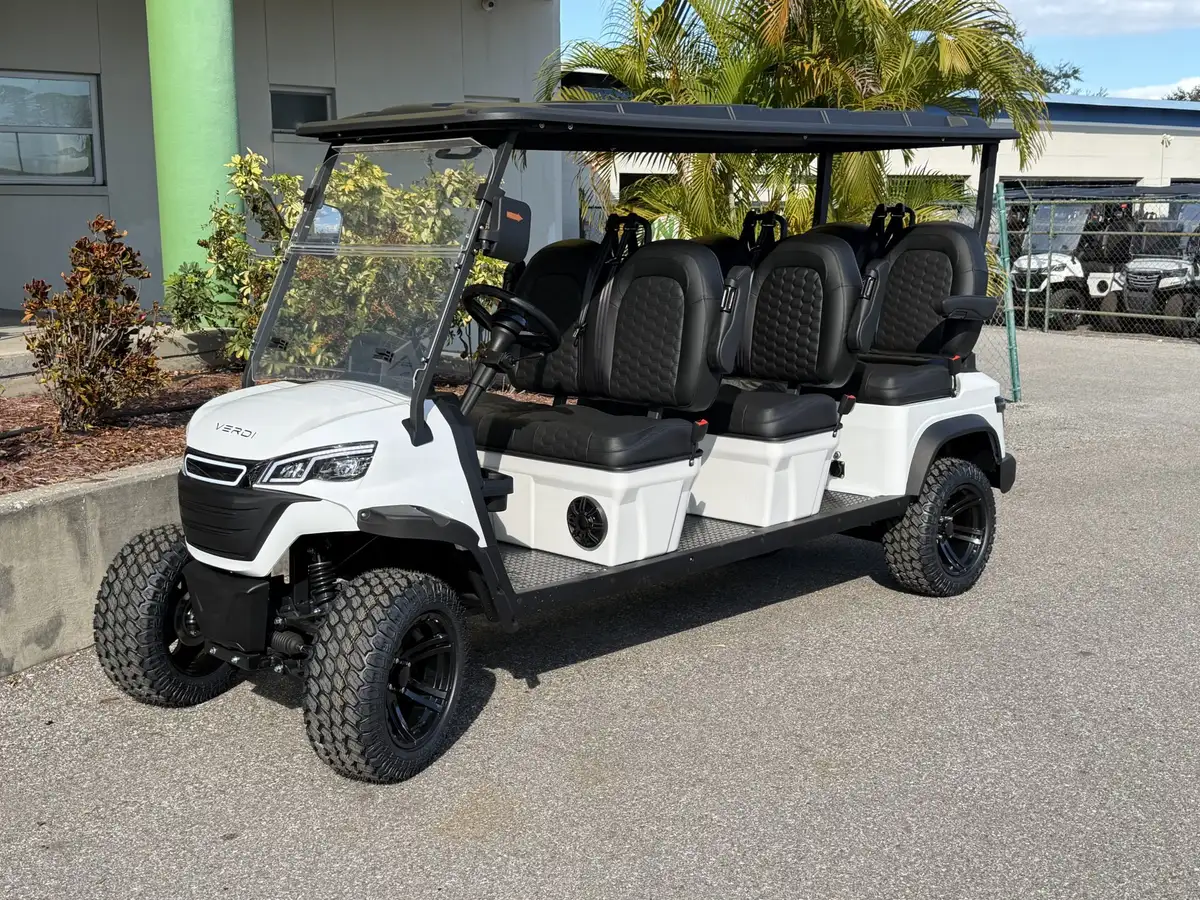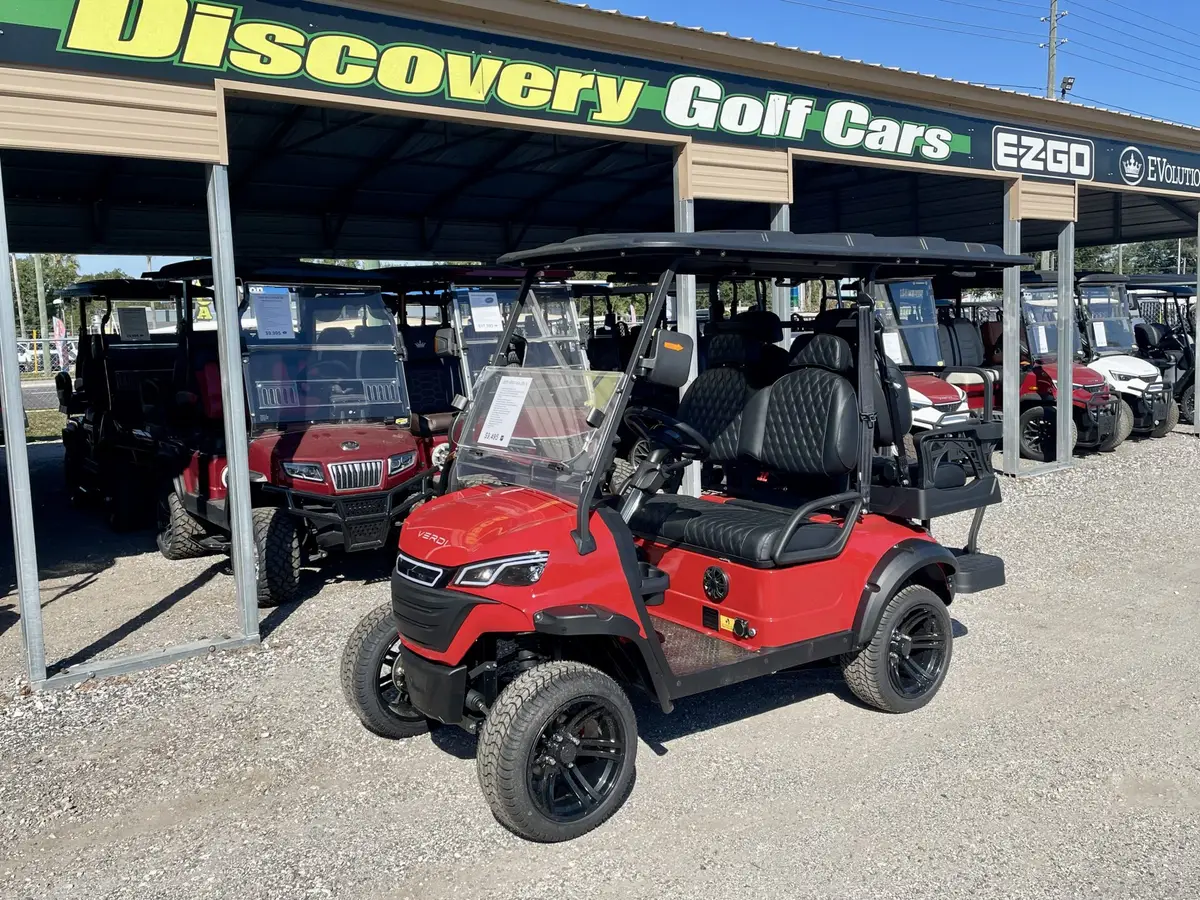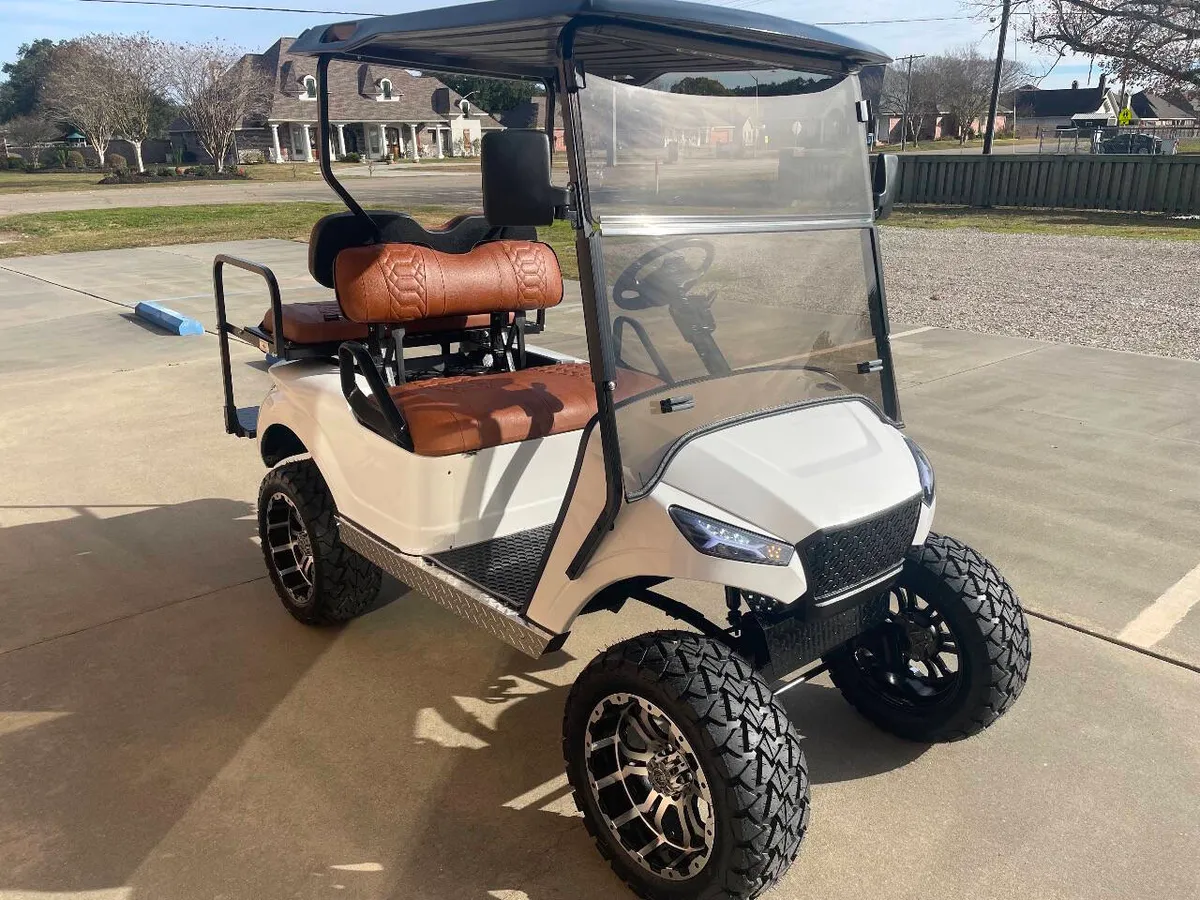
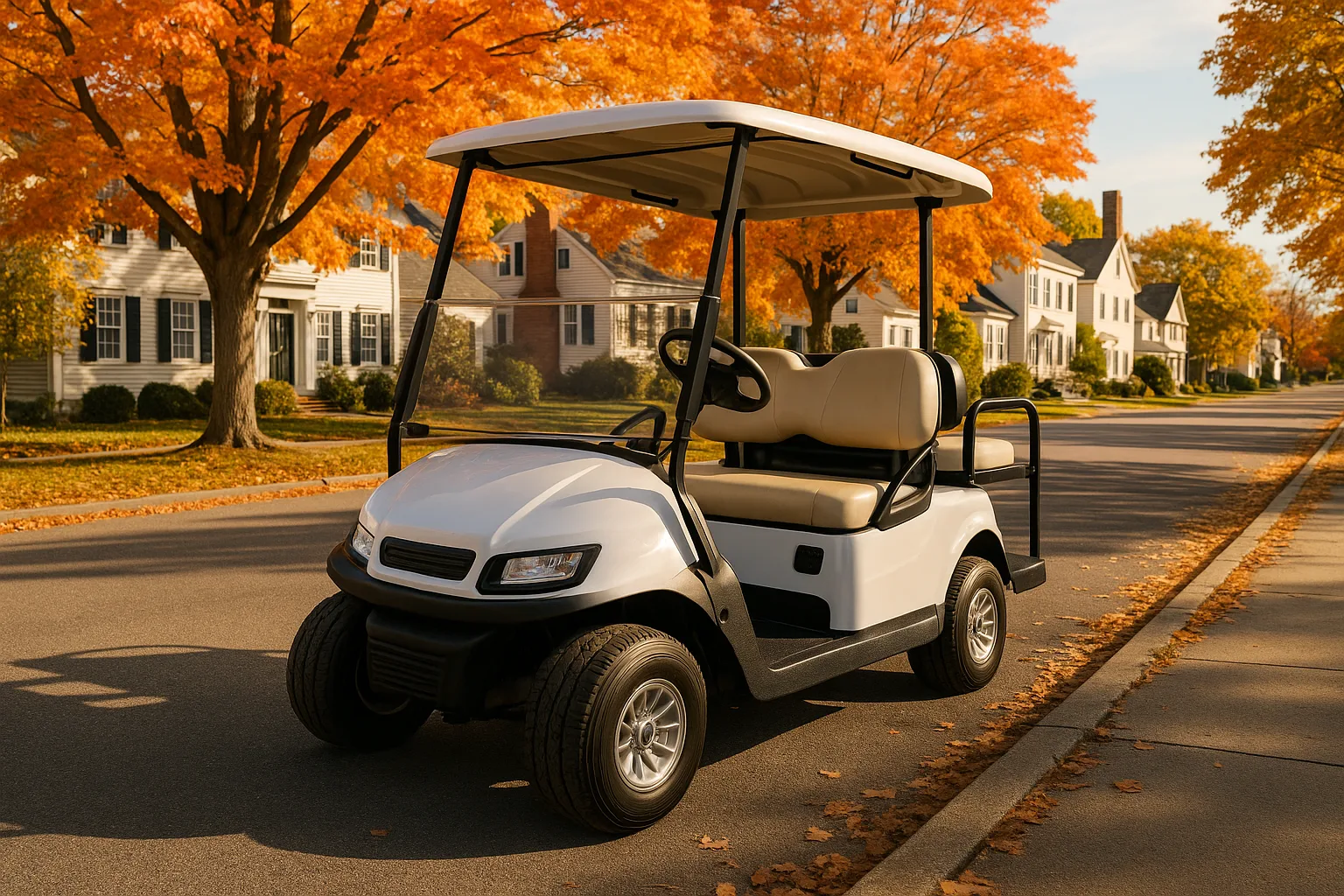
Are golf carts street legal in Massachusetts?
No. Standard golf carts are not street legal in Massachusetts under any circumstance. No town bylaw, no local ordinance, and no conversion process changes this. Massachusetts law is among the strictest in the country on this issue: if a vehicle does not meet federal Low-Speed Vehicle (LSV) standards and carry a manufacturer-assigned VIN, it cannot be registered for road use and cannot legally operate on any public road in the state.
The only street-legal alternative is a manufacturer-built Low-Speed Vehicle registered through the Massachusetts Registry of Motor Vehicles (RMV). This article breaks down exactly what that means, where golf carts are permitted, and what it costs to pursue the legal path. For a broader look at how other states handle these rules, see our guide to golf cart laws by state.
| Vehicle type | Street legal in MA? | Registration required? | Where permitted |
|---|---|---|---|
| Standard golf cart | No | No (road use not permitted) | Private property, golf courses, designated off-road areas |
| Low-Speed Vehicle (LSV) | Yes | Yes, through the RMV | Roads with posted speed limits of 30 mph or less |
How Massachusetts classifies golf carts and LSVs
Massachusetts draws a hard legal line between golf carts and Low-Speed Vehicles under MGL Chapter 90, Sections 1F and 1G. Understanding this distinction is the foundation for everything else in this article.
Standard golf carts
A standard golf cart is a slow, lightweight vehicle designed for use on golf courses and private property. Under Massachusetts law, these vehicles:
- Have a top speed under 20 mph
- Do not carry a 17-digit Vehicle Identification Number (VIN)
- Do not meet Federal Motor Vehicle Safety Standards
- Cannot be registered with the RMV for road use
- Cannot legally operate on any public road or public way, even to cross a single street
Low-Speed Vehicles (LSVs)
An LSV is a distinct vehicle category defined under federal law (49 CFR 571.500) and recognized by Massachusetts under MGL Chapter 90, Section 1G. To qualify, a vehicle must:
- Have four wheels
- Have a top speed between 20 and 25 mph
- Meet all applicable Federal Motor Vehicle Safety Standards
- Carry a manufacturer-assigned 17-digit VIN
LSVs are treated like any other motor vehicle for registration, titling, inspection, and insurance purposes. Massachusetts does not allow municipalities to create local ordinances permitting golf carts on public roads, which distinguishes the state from many others that allow town-by-town exceptions.
Even if your town or neighborhood seems to tolerate golf carts on local roads, there is no legal basis for it in Massachusetts. Operating a standard golf cart on a public road is illegal statewide, regardless of local custom or informal permission.
Where you can and cannot use a golf cart in Massachusetts
Massachusetts law is clear about where golf carts are and are not permitted. The rules apply statewide with no municipal exceptions.
| Location | Golf cart permitted? | Notes |
|---|---|---|
| Private property (your land) | Yes | No registration required for private use |
| Golf courses | Yes | Course-managed use only |
| Designated off-road areas | Yes (with possible registration) | May require registration through the Massachusetts Environmental Police |
| Public roads (any speed limit) | No | Illegal under MGL Chapter 90 |
| Crossing a public road | No | Still considered operation on a public way |
| Highways or roads above 30 mph | No (even for LSVs) | LSVs restricted to roads posted at 30 mph or less |
Off-road and recreational use
If you plan to use a golf cart beyond your own private property for off-road or recreational purposes, you may need to register it as a recreational vehicle through the Massachusetts Environmental Police. Liability insurance is likely required for this registration. Contact the Massachusetts Environmental Police directly at mass.gov to confirm current requirements, as this process is not fully documented in publicly available official sources.
Private communities, campgrounds, and resort properties
Golf carts used entirely within private campgrounds, gated communities, or resort properties are generally permitted because the roads within those properties are privately owned. However, the moment a cart crosses onto a public road, state law applies. If you live in a private community or use a campground, verify with the property manager whether their internal roads are truly private and not classified as public ways under Massachusetts law.
Nantucket and Martha's Vineyard
These islands are known for their alternative vehicle culture, but the same Massachusetts statewide restrictions apply. There are no island-specific exemptions for golf carts on public roads. LSV registration through the RMV remains the only legal path to road use on the islands, just as it is on the mainland.
Low-Speed Vehicles: the legal alternative
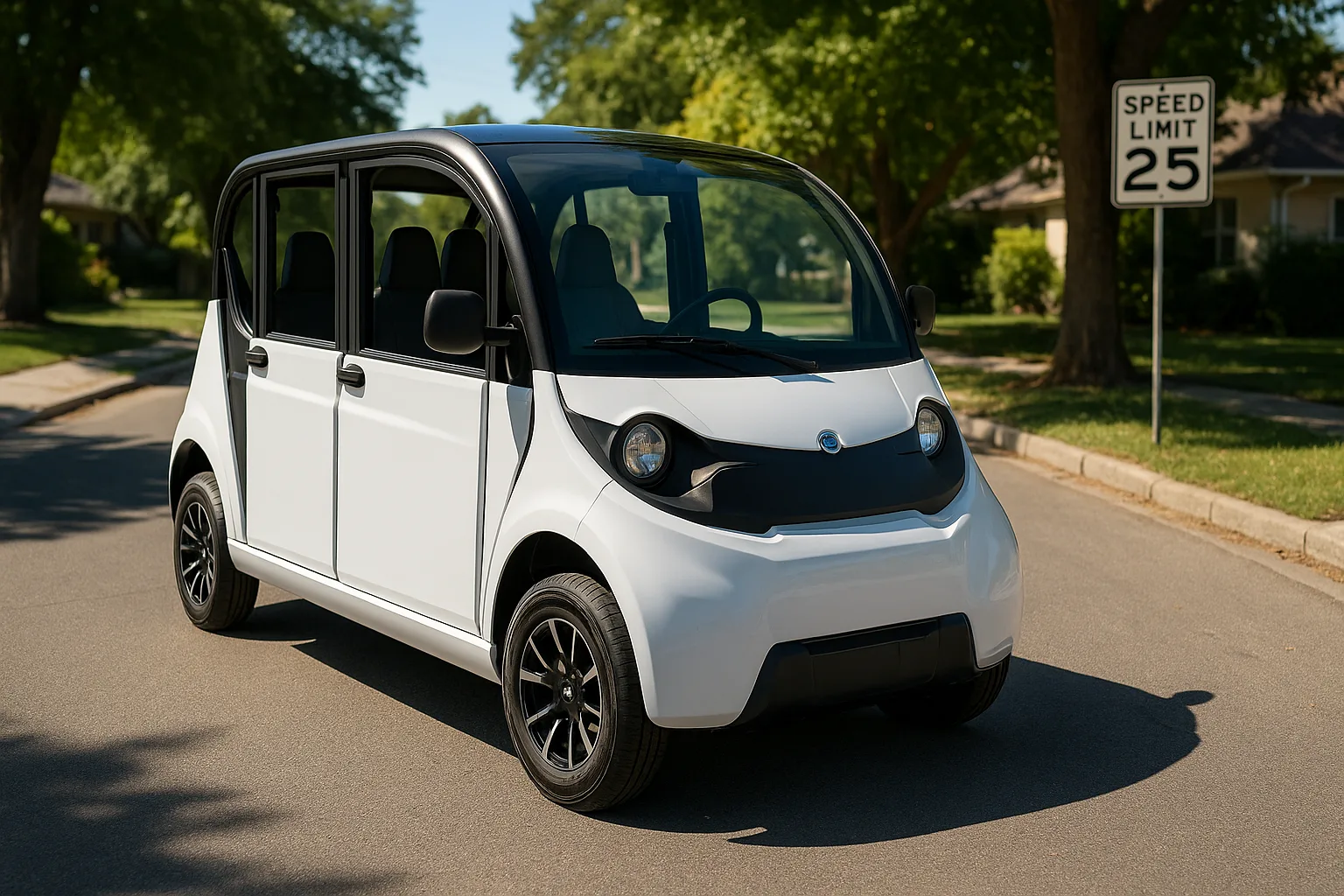
If you want to drive a golf-cart-style vehicle on Massachusetts public roads, you need a manufacturer-built LSV. These are purpose-built vehicles that arrive from the factory with a VIN and all required safety equipment already installed.
Required safety equipment
Under 49 CFR 571.500 and Massachusetts registration requirements, an LSV must be equipped with:
- Headlights
- Taillights
- Brake lights
- Turn signals
- Reflectors
- Windshield
- Rearview mirrors
- Seat belts for all seating positions
- Parking brake
- Manufacturer-assigned 17-digit VIN
LSVs must also pass the Massachusetts state vehicle inspection, the same annual inspection required for all registered passenger vehicles.
LSV models and price ranges
Several major manufacturers produce street-legal LSVs that look and function similarly to golf carts. These are not conversions; they are factory-built vehicles in a separate legal category. If you are comparing options before purchasing, our golf cart buying guide covers what to inspect and evaluate across vehicle types.
| Manufacturer / model | Typical price range | Notes |
|---|---|---|
| Polaris GEM | $12,000 – $18,000+ | Most widely available LSV; multiple configurations |
| Club Car Current | $14,000 – $20,000+ | Electric LSV with full street-legal equipment from factory |
| Yamaha Drive2 LSV | $13,000 – $22,000+ | Available through Yamaha dealers; gas and electric versions |
Prices vary by configuration, seating capacity, and dealer location. Expect to pay more for lifted models, custom finishes, or expanded cargo capacity. Always confirm that the specific unit you are purchasing carries the LSV designation and a factory VIN before completing any purchase. For a general sense of what these vehicles cost across categories, see how much a golf cart costs.
Buying a used LSV? Request the title and verify the VIN before purchase. A vehicle sold as an "LSV" without a manufacturer-assigned 17-digit VIN cannot be registered with the Massachusetts RMV for road use.
Registration, titling, and inspection
LSVs follow the same registration and titling process as any other motor vehicle in Massachusetts. Standard golf carts have no pathway to RMV registration for road use.
What you need to register an LSV with the Massachusetts RMV
- Manufacturer's Certificate of Origin (for new vehicles) or a valid title (for used vehicles)
- Proof of Massachusetts auto insurance meeting state minimum coverage requirements
- Valid Massachusetts driver's license
- Payment for applicable registration fees
Registration and inspection fees
| Fee type | Estimated cost | Notes |
|---|---|---|
| Massachusetts RMV registration (passenger/LSV) | $60 per year (approximate) | Verify current fee schedule at mass.gov/rmv |
| Massachusetts state vehicle inspection | $35 | Annual inspection required for all registered vehicles |
| Title fee (new vehicle) | $75 (approximate) | One-time fee; verify current amount at mass.gov/rmv |
Fee schedules can change. Always confirm current amounts directly with the Massachusetts RMV at mass.gov before completing registration.
Insurance requirements
Massachusetts is a mandatory auto insurance state. The requirements differ depending on whether you own a standard golf cart or an LSV.
| Vehicle type | Insurance requirement | Estimated annual cost |
|---|---|---|
| Standard golf cart (private property use) | Not legally required for road use; liability coverage recommended | $100 – $300+ per year (specialty coverage) |
| Standard golf cart (off-road recreational registration) | Liability insurance likely required by the Environmental Police | $150 – $400+ per year (varies by provider) |
| LSV (registered for road use) | Full Massachusetts auto insurance required at state minimums | $400 – $900+ per year (varies significantly) |
LSV insurance costs vary based on your driving record, location, chosen coverage levels, and insurer. Because LSVs are a niche category, not all insurers offer competitive rates. Shop multiple carriers and confirm the vehicle qualifies for their LSV or low-speed vehicle coverage category.
Age and license requirements
Operating an LSV on Massachusetts public roads requires a valid Massachusetts driver's license. Multiple sources report the minimum age as 16, consistent with the minimum age for a standard driver's license in Massachusetts, though this is not explicitly confirmed on a .gov page. Contact the Massachusetts RMV directly to verify the current minimum age requirement before purchasing an LSV for a younger driver.
Learner's permit holders may be permitted to operate an LSV if accompanied by a licensed adult aged 21 or older, consistent with standard learner's permit restrictions. This has not been officially confirmed on a state government source, so verify with the RMV before relying on this.
Because golf cart road use is not permitted in Massachusetts, no state-level age requirement exists for golf cart road operation.
Making a golf cart street legal: what is actually possible
The honest answer: you generally cannot convert a standard golf cart into a street-legal vehicle in Massachusetts.
The reason is straightforward. LSV status requires a manufacturer-assigned 17-digit VIN that is embedded in the vehicle's federal certification. The Massachusetts RMV has no published process for assigning a VIN to a converted vehicle, and adding aftermarket safety equipment to a golf cart does not change its federal classification or make it registerable.
Some sellers market "street-legal golf cart conversions" with added lights, mirrors, and seat belts. In Massachusetts, these modified carts remain standard golf carts under the law because they lack the required VIN and federal manufacturer certification. They cannot be legally registered or operated on public roads, regardless of what equipment was added.
The practical path is purchasing a manufacturer-built LSV from the outset. If you want a vehicle that looks like a golf cart and can legally travel on public roads in Massachusetts, buy an LSV, not a golf cart paired with a conversion kit.
Be cautious of dealers who claim a modified golf cart is "street legal" in Massachusetts. If the vehicle does not have a factory-assigned 17-digit VIN and LSV certification, it is not street legal in this state, regardless of what equipment is installed.
OUI/DUI laws and golf carts
Massachusetts OUI law (MGL Chapter 90, Section 24) is reported to apply to golf carts operated on any public way. This means that if you drive a golf cart while impaired on a public road, you could face an OUI charge in addition to the violation for operating an unregistered vehicle on a public way.
This interpretation is consistent across multiple legal sources, though it has not been explicitly confirmed on a .gov page. If you have specific questions about OUI applicability to non-standard vehicles, consult a Massachusetts attorney or contact the Massachusetts RMV for clarification.
The practical takeaway: Massachusetts OUI law is broadly written to cover the operation of a motor vehicle on a public way. A golf cart on a public road exposes you to both illegal operation charges and potential OUI charges if impairment is involved.
Penalties for illegal golf cart use
Operating a golf cart on a Massachusetts public road can result in multiple violations under MGL Chapter 90. While specific fines for golf cart operation are not separately published, the applicable penalties generally include:
- Operating an unregistered motor vehicle: fines starting at $500 under MGL Chapter 90, Section 9
- Operating without a proper license or registration: additional fines and potential vehicle impoundment
- OUI charges if impairment is involved: criminal penalties under MGL Chapter 90, Section 24
Because golf carts are not registerable as road vehicles in Massachusetts, operating one on a public road cannot be remedied by retroactive registration. The violation is the operation itself. Contact a Massachusetts traffic attorney if you have been cited for golf cart operation on a public road.
Cost summary: LSV ownership in Massachusetts
For buyers evaluating the full cost of the legal path to road use, here is a consolidated overview of the major expenses involved in owning and operating an LSV in Massachusetts.
| Cost item | Estimated amount | Frequency |
|---|---|---|
| LSV purchase price | $12,000 – $25,000+ | One-time |
| Massachusetts title fee | $75 (approximate) | One-time |
| Massachusetts RMV registration | $60 per year (approximate) | Annual |
| State vehicle inspection | $35 | Annual |
| Massachusetts auto insurance (LSV) | $400 – $900+ per year | Annual |
These figures are estimates. Registration and title fees should be confirmed directly with the Massachusetts RMV at mass.gov. Insurance costs vary significantly by driver profile, coverage selection, and insurer. Always get multiple quotes before purchasing coverage.
Frequently asked questions
Can you drive a golf cart on the road in Massachusetts?
No. Standard golf carts cannot be driven on any Massachusetts public road under any circumstance. The only street-legal option is a manufacturer-built Low-Speed Vehicle registered with the RMV.
Can my town pass a bylaw allowing golf carts on public roads?
No. Massachusetts law does not provide municipalities with the authority to create local ordinances permitting golf carts on public roads. The statewide prohibition applies everywhere.
What if I only need to cross one road?
Still illegal. Crossing a public road is considered operating on a public way under Massachusetts law. There is no exception for a single road crossing.
Can I convert my golf cart to make it street legal?
No. Adding lights, mirrors, and seat belts does not change a golf cart's legal classification. The RMV has no published process for assigning a VIN to a converted vehicle, and LSV status requires a manufacturer-assigned VIN. Purchase a manufacturer-built LSV if you need road-legal capability.
Can you get a DUI or OUI on a golf cart in Massachusetts?
Reportedly yes. Massachusetts OUI law (MGL Chapter 90, Section 24) is written broadly to apply to motor vehicles on public ways. Multiple legal sources indicate a golf cart on a public road is subject to OUI law. This has not been officially confirmed on a .gov source; consult a Massachusetts attorney for legal advice on this question.
Where can I legally use a golf cart in Massachusetts?
Golf carts are permitted on private property, golf courses, and designated off-road areas. Off-road use beyond your own property may require registration with the Massachusetts Environmental Police. Contact the Environmental Police at mass.gov for current requirements.
How fast can an LSV go?
LSVs are federally limited to a top speed between 20 and 25 mph. They are permitted on Massachusetts public roads with posted speed limits of 30 mph or less and are prohibited on highways and higher-speed roads.
Official resources
Laws and fee schedules change. Verify all information directly with official Massachusetts sources before making purchasing or registration decisions.
- Massachusetts RMV: mass.gov/orgs/registry-of-motor-vehicles – registration, titling, inspection, and fee information
- Massachusetts General Laws, Chapter 90: malegislature.gov – Sections 1F, 1G, Section 9, and Section 24
- Massachusetts Environmental Police: mass.gov/orgs/massachusetts-environmental-police – off-road and recreational vehicle registration
- Federal LSV Safety Standards (49 CFR 571.500): ecfr.gov – federal equipment and certification requirements
This article was last reviewed for accuracy in 2025. Massachusetts laws, fees, and RMV requirements can change. Always confirm current rules with the Massachusetts RMV or a licensed Massachusetts attorney before purchasing a vehicle or making any registration decisions.