Golf cart prices: what to expect
Golf carts range from under $2,000 for an older fixer-upper to over $30,000 for a luxury or custom build. Most buyers land somewhere in the middle: a reliable new cart runs $9,000 to $18,000, while a solid used cart typically costs $5,000 to $7,000. Understanding what drives those numbers is the first step to making a smart purchase.
| Cart type | Typical price range |
|---|---|
| Used fixer-upper | $1,800 – $3,000 |
| Used quality cart | $5,000 – $7,000 |
| New gas cart | $8,500 – $20,000+ |
| New electric/lithium cart | $6,500 – $30,000+ |
| Luxury or custom build | $20,000 – $30,000+ |
This guide walks you through every major buying decision: new versus used, gas versus electric, which brands hold their value, what to inspect before you buy, and how to avoid common mistakes. Whether you're shopping for a neighborhood cruiser, a utility workhorse, or a street-legal LSV, you'll find what you need here.
Start with your use case
Before you compare brands or scroll listings, identify how you'll actually use the cart. Your use case determines the right power source, passenger capacity, and feature set more than anything else.
| Use case | What to prioritize |
|---|---|
| Neighborhood or community transportation | Street-legal or LSV features, 4-passenger minimum |
| Golf course use | Standard 2-passenger, quiet electric, lightweight |
| Property or yard maintenance | Utility bed, gas power for hills and heavy loads |
| Lake house or seasonal use | Lithium battery (handles storage better), low maintenance |
| Street-legal/LSV use | Mirrors, lights, seatbelts, VIN, compliant top speed |
Family buyers often prioritize 4 to 6-passenger seating and connectivity features like Bluetooth audio. Utility users need a rear cargo bed and enough torque to haul loads on uneven terrain. Seasonal lake house owners benefit from lithium batteries, which handle long idle periods far better than lead-acid packs.
If you plan to drive on public roads, check your local municipality's LSV rules before you buy. Street-legal carts typically require mirrors, headlights, taillights, seatbelts, and a VIN, and rules vary significantly by state and city.
New vs. used golf carts
New carts offer manufacturer warranties, current technology, and the ability to customize from the factory. Used carts offer significant cost savings and let someone else absorb the steepest depreciation. Both are valid options depending on your budget and priorities.
| Factor | New cart | Used cart |
|---|---|---|
| Typical price | $8,500 – $20,000+ | $1,800 – $10,000 |
| Warranty | Manufacturer warranty included | None (unless certified pre-owned) |
| Depreciation | Steepest in first 2 years | Already absorbed by prior owner |
| Battery condition | New, full lifespan ahead | Age unknown unless disclosed |
| Customization | Factory options available | May already have upgrades |
For used carts, stick with the "Big 3" brands: Club Car, E-Z-GO, and Yamaha. These brands have extensive dealer networks, widely available parts, and strong resale demand. Budget big-box brands like Kandi, Coleman, and Phantom are harder to service and can be difficult to resell.
Newer brands including Evolution, Denago, and ICON are worth considering for new purchases. They compete well on features and price, though their long-term resale data is still developing compared to the established Big 3. For a deeper look at how today's top models stack up, see our guide to comparing the best electric golf carts.
Gas vs. electric golf carts
The right power source depends on your terrain, access to electricity, maintenance tolerance, and how you store the cart. Neither option is universally better; each has clear advantages in the right situation.
| Factor | Gas | Electric (lead-acid) | Electric (lithium) |
|---|---|---|---|
| Best for | Hills, remote use, heavy loads | Flat terrain, regular use | Low maintenance, seasonal use |
| Fueling/charging | Gas station access | Standard 110V outlet | Standard 110V outlet |
| Maintenance | Oil changes, filters, spark plugs | Water levels, terminal cleaning | Minimal |
| Battery/fuel cost | Ongoing fuel costs | $800 – $1,500 replacement | $2,000+ replacement |
| Battery lifespan | N/A | 4 – 6 years | 8 – 12 years |
Gas carts are the practical choice for hilly properties, farm use, or locations without reliable charging access. Electric carts are quieter, cleaner, and cheaper to operate on flat terrain. Lithium electric is the premium tier: longer battery life, faster charging, and no watering schedule, but the upfront and replacement costs are higher.
If you're buying a used electric cart, always ask for the battery age and brand. Lead-acid packs older than 4 to 5 years may need immediate replacement, which can add $800 to $1,500 to your actual purchase cost.
New golf cart prices by model
New cart prices vary significantly by brand, passenger capacity, and power source. Below are current dealer prices for popular models to give you a realistic baseline. For a full breakdown of what drives these numbers, see our detailed look at how much a golf cart costs.
New gas models
| Model | Price |
|---|---|
| 2026 Yamaha DRIVE 2 QuieTech | $9,795 |
| 2026 E-Z-GO Freedom RXV | $9,995 |
| 2026 ICON G40 | $9,995 |
| 2026 E-Z-GO Express 4 | $13,444 |
| 2025 Yamaha Adventurer Sport 2+2 | $13,622 |
| 2026 Club Car Onward 4 Passenger | $14,250 |
| 2025 Cushman Hauler 1200 | $14,595 |
| 2026 E-Z-GO Express 6 Explorer | $17,495 |
| 2025 Club Car Onward 6 Passenger | $18,499 |
New electric and lithium models
| Model | Price |
|---|---|
| 2026 Denago EV Rover XL Lithium | $9,995 |
| 2026 E-Z-GO Express 4 Lithium Lifted | $12,999 |
| 2026 Epic Carts E40FX Lithium | $12,995 |
| 2026 Star EV Sirius 2+2 LSV Lithium | $13,500 |
| 2026 Evolution D-MAX GT4 Lithium | $13,595 |
| 2026 Yamaha Golf Car Concierge 4 | $15,495 |
| 2026 Club Car Onward 4 Passenger Lithium | $16,807 |
Used golf cart examples
| Model | Price |
|---|---|
| 2009 Club Car DS (lead-acid) | $1,800 |
| 2003 Yamaha G22 (lead-acid) | $2,995 |
| 2022 Club Car Tempo (lead-acid) | $5,995 |
| 2021 E-Z-GO Lifted TXT (gas) | $6,950 |
| 2022 Evolution Carrier 6 (lithium) | $7,999 |
| 2021 Custom Yamaha Drive (gas) | $8,995 |
| 2023 Atlas Gen-1 4 Passenger (lithium) | $10,000 |
What to inspect on a used cart
A thorough inspection before you buy can save you thousands in unexpected repairs. Walk through each of these areas systematically, and don't skip the test drive.
Battery inspection (electric carts)
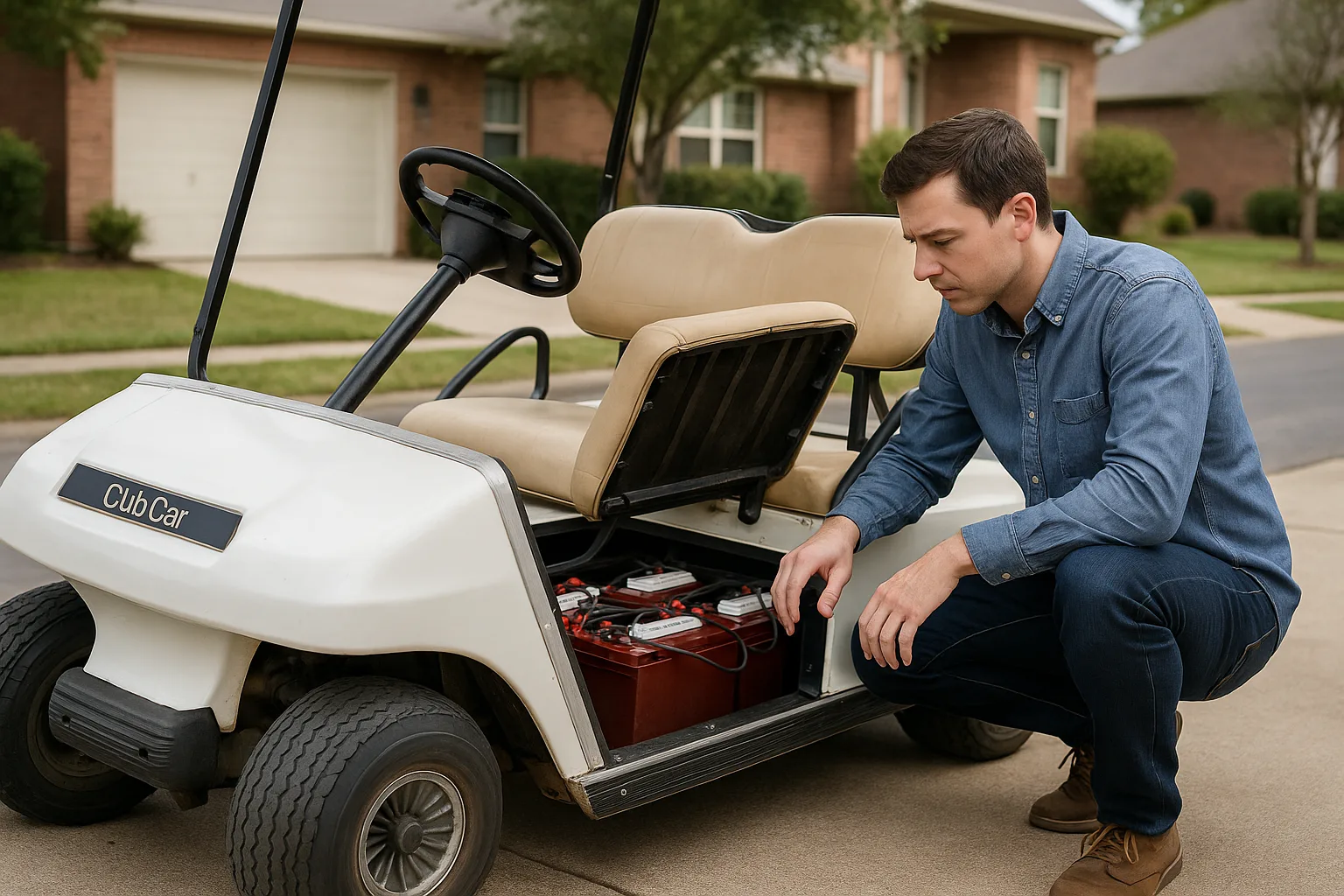
The battery pack is the most expensive component on an electric cart. Inspect the following:
- Terminal condition: look for heavy corrosion, white or blue buildup, or loose connections
- Battery casing: cracks, bulging, or leaking acid are walk-away signs
- Age: ask for the purchase date or check labels; lead-acid packs older than 5 years may need replacement soon
- Brand: reputable brands like Trojan, US Battery, or Duracell hold up better than off-brand alternatives
- Remaining warranty: some lithium packs carry 8 to 10-year warranties that may be transferable
Frame and body
- Check welds and joints for rust, especially on the undercarriage and around the seat mounts
- Look for flaking powder coat, which can indicate rust beneath the surface
- Inspect for dents or body damage that may indicate a hard impact or rollover
Tires
Use the penny test: insert a penny into the tread groove with Lincoln's head pointing down. If you can see the top of his head, the tires need replacement. Also check for dry rot, cracking on the sidewalls, and uneven wear patterns that may suggest alignment issues.
Seats
Check for cracking, tears, water damage, or mold. Seat replacement is a manageable cost, but it's useful negotiating leverage. Sunbaked or heavily cracked vinyl seats signal a cart that lived outdoors without a cover.
Test drive checklist
- Acceleration: should be smooth, not jerky or hesitant
- Sounds: listen for grinding, knocking, or unusual motor noise
- Steering: the cart should track straight without pulling to one side
- Brakes: should stop the cart firmly and evenly
- Suspension: drive over a bump; excessive bouncing or clunking indicates worn shocks
Usage history
Ask whether the cart came from a golf course fleet or private ownership. Fleet carts often have higher cycle counts, inconsistent maintenance, and heavier wear. A private-owner cart with documented service history is generally preferable. On electric carts, ask for the charge cycle count if the controller displays it, as this is the closest equivalent to mileage.
Walk away if you see bulging or cracked battery cases, heavy frame rust at structural welds, a cart that pulls hard to one side and won't correct, or a seller who can't answer basic questions about battery age or service history. Repair costs on these issues often exceed the cart's value.
How golf carts are valued
There is no Kelley Blue Book for golf carts. Valuation is based on comparing similar listings on active marketplaces and factoring in the variables below. The best way to establish fair market value is to research recent sales of comparable carts in your area.
| Valuation factor | Impact on price |
|---|---|
| Age and condition | Primary driver of depreciation |
| Brand (Big 3 vs. budget) | Big 3 command higher resale values |
| Battery age and type | New lithium adds value; old lead-acid subtracts |
| Upgrades and customization | Lift kits, wheels, and audio can add value |
| Maintenance history | Documented service increases buyer confidence |
| Season | Spring and summer prices run higher |
| Local market demand | Varies significantly by region |
Spring and summer are peak buying seasons, which drives asking prices up. If you can wait until late fall or winter, you'll often find motivated sellers and softer prices. Conversely, if you're selling, listing in March or April typically yields the best return.
Customizations like lift kits, aftermarket wheels, stereo systems, and custom paint can add to a cart's appeal, but they rarely return their full cost at resale. Buy a customized cart because you want those features, not as an investment strategy.
Additional costs to budget for
The purchase price is only part of what you'll spend. Factor in these costs when building your total budget.
| Cost item | Typical cost |
|---|---|
| Lead-acid battery replacement | $800 – $1,500 |
| Lithium battery replacement | $2,000+ |
| Basic insurance (annual) | $75/year |
| Comprehensive insurance (annual) | $200 – $300/year |
| Local shipping | $100 – $300 |
| Long-distance shipping | $400 – $700 |
| Daily rental (if testing before buying) | $100 – $150/day |
If you're buying remotely through an online marketplace, shipping is a real line item. Local delivery runs $100 to $300, while long-distance transport can add $400 to $700 to your total cost. Insurance is worth carrying even for recreational use: basic liability coverage starts as low as $75 per year, and comprehensive coverage that protects against theft and damage runs $200 to $300 per year.
Where to buy a golf cart
Each purchase channel has different trade-offs in price, selection, trust, and buyer protection. Understanding your options helps you choose the right path for your situation.
| Channel | Best for | Trade-offs |
|---|---|---|
| Authorized brand dealers | New carts, financing, warranties | Higher prices, limited negotiation |
| Used cart specialty dealers | Inspected used inventory, some warranties | Moderate prices, regional selection |
| Private sellers (Facebook Marketplace, Craigslist) | Best prices, negotiation opportunity | No warranty, buyer beware |
| Online marketplaces (CartMarket) | Broad selection, price comparison, research | May require shipping if buying remotely |
Authorized dealers are the safest path for a new cart and typically offer manufacturer financing. For used carts, specialty dealers offer a middle ground: inspected inventory with some buyer protection, at prices slightly above private-seller listings.
Private sellers offer the best prices but require the most due diligence. Apply the full inspection checklist, ask for battery age and service records, and don't skip the test drive. Online marketplaces are excellent for research and price benchmarking even if you ultimately buy locally.
Financing options
Most buyers pay cash for used carts, but financing is available for new purchases. Common options include:
- Dealer financing through lenders like Sheffield Financial, DLL Group, or Octane
- Manufacturer promotional rates on new cart purchases (check for 0% APR offers)
- Personal loans or credit union financing for used carts
- Rent-to-own programs as an alternative to traditional financing
If you're financing, compare dealer rates against your bank or credit union before committing. For used carts under $5,000, a personal loan or credit union loan often offers better terms than dealer financing.
How to negotiate the price
Unlike car dealerships, golf cart sellers, especially private sellers, often have significant flexibility in their asking price. Use these strategies to negotiate effectively.
- Research comparable listings first. Bring data. If similar carts in your area are listed for less, show the seller those examples.
- Use battery age as leverage. If the lead-acid pack is 4 or more years old, factor in the $800 to $1,500 replacement cost and ask for a corresponding discount.
- Note tire wear and cosmetic issues. These are tangible, documented costs that justify a lower offer.
- Offer to pay cash. Private sellers prefer simplicity. A cash offer with fast closing often closes deals below asking price.
- Don't open too low. An insulting first offer ends negotiations. Start at about 10% to 15% below asking and negotiate from there.
- Be willing to walk away. There are always more carts. A seller who won't budge on a cart with real issues is doing you a favor by letting you go.
Dealers have less flexibility than private sellers but are not immovable. Ask for free delivery, accessories, or an extended warranty instead of a direct price cut. These concessions are often easier for dealers to make than lowering the sticker price.
Frequently asked questions
Is there a Kelley Blue Book for golf carts?
No. There is no official valuation guide for golf carts equivalent to Kelley Blue Book. The best approach is to search active listings on golf cart marketplaces for comparable makes, models, ages, and conditions in your area. That real-market comparison is the most accurate valuation tool available.
Do golf carts hold their value?
Reasonably well compared to many recreational vehicles, especially the Big 3 brands. Club Car, E-Z-GO, and Yamaha carts retain demand and resale value because parts and service are widely available. Budget brands depreciate faster and can be difficult to resell. Lithium electric carts are increasingly holding value well due to their longer battery lifespan.
How do I find out what year my golf cart is?
Check the serial number, usually located on a plate under the seat or on the frame near the battery compartment. Each manufacturer uses a different coding system, but the year is embedded in the serial number. Yamaha, Club Car, and E-Z-GO all publish serial number decoding guides online.
Does lemon law apply to golf carts?
Generally no. Most state lemon laws apply to licensed motor vehicles used on public roads. Golf carts typically fall outside that classification unless they are titled and registered as LSVs. Buyer protections on used carts in particular are limited, which is why a pre-purchase inspection is critical.
What passenger configuration should I buy?
Match capacity to your actual use. Two-passenger carts are the most affordable and maneuverable. Four-passenger carts are the most popular for family and neighborhood use. Six and eight-passenger carts are significantly more expensive and better suited to commercial or resort use. Seating capacity directly affects price, so don't pay for seats you won't use.
Can I buy a golf cart online?
Yes. Online marketplaces like CartMarket let you browse dealer and private-seller inventory nationwide. For local sellers, you can inspect in person before buying. For remote purchases, factor in shipping costs of $100 to $700 depending on distance, and consider requesting a video inspection before committing.