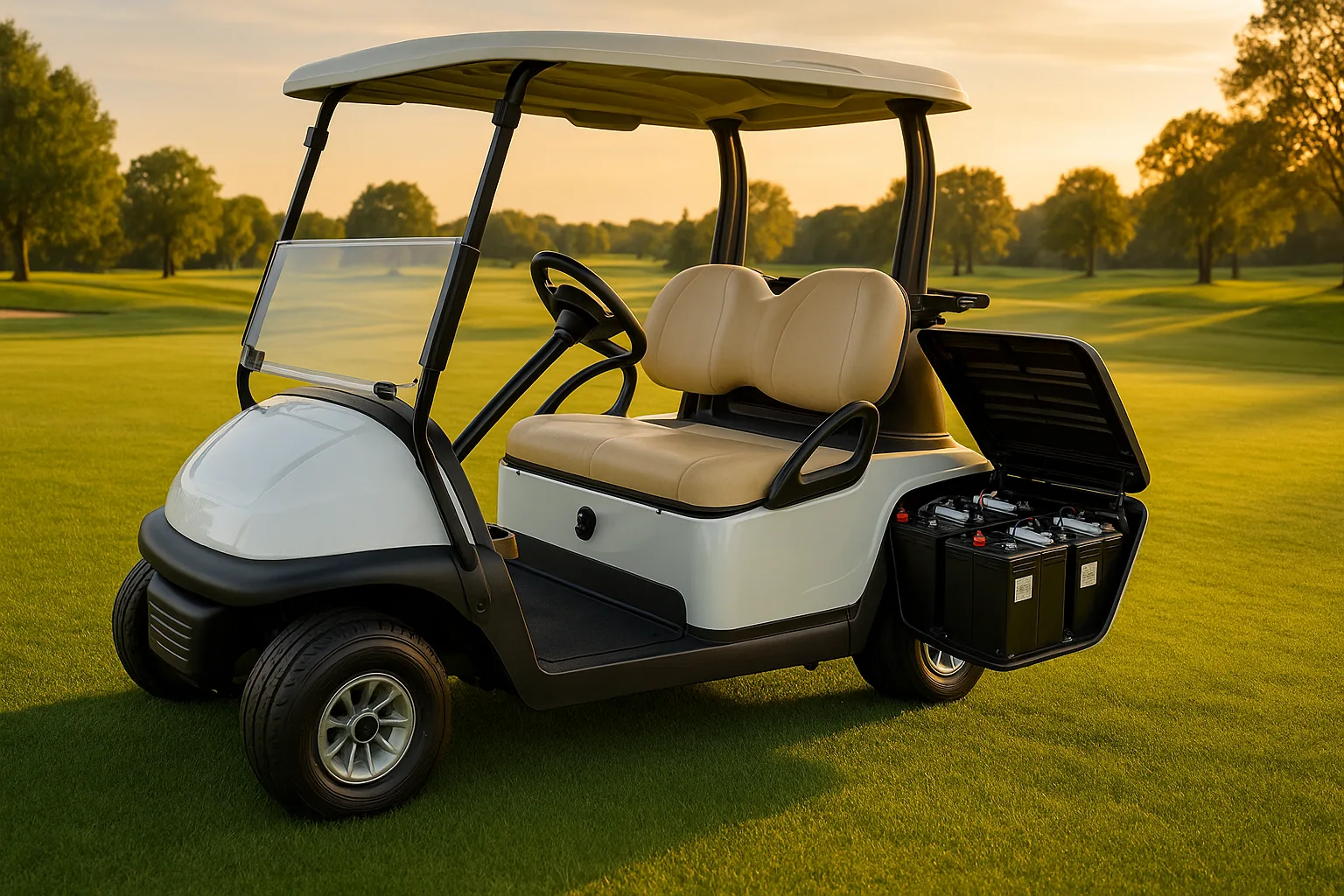
Golf cart battery types explained
Golf cart batteries fall into two main chemistry categories: lead-acid and lithium. Within those categories, there are several subtypes, each with different maintenance needs, performance characteristics, and price points. Understanding the differences helps you choose the right battery for your cart, budget, and usage pattern.
| Battery type | Chemistry | Maintenance | Relative cost | Best for |
|---|---|---|---|---|
| Flooded lead-acid (FLA) | Lead-acid | High (regular watering) | Lowest upfront | Budget-conscious buyers |
| AGM (absorbed glass mat) | Sealed lead-acid | Low (sealed) | Moderate | Low-maintenance lead-acid users |
| Gel | Sealed lead-acid | Low (sealed) | Moderate | Sensitive charging environments |
| LiFePO4 (lithium iron phosphate) | Lithium | None | Highest upfront, lowest long-term | Performance and longevity |
Flooded lead-acid (FLA)
FLA batteries are the traditional standard for golf carts. They are the most widely available and least expensive option upfront, but they require regular maintenance including watering, terminal cleaning, and careful charging. Neglect shortens their lifespan significantly.
AGM and gel batteries
Both AGM and gel batteries are sealed lead-acid variants, meaning they do not require water top-ups. AGM batteries use fiberglass mats to absorb the electrolyte, while gel batteries suspend it in a silica compound. Both are more resistant to vibration and spills than FLA, making them a solid middle-ground option for owners who want lower maintenance without paying lithium prices.
LiFePO4 (lithium iron phosphate)
Lithium iron phosphate is the fastest-growing battery technology in the golf cart market. LiFePO4 batteries are significantly lighter, charge faster, last longer, and require zero maintenance compared to any lead-acid type. They cost more upfront but typically deliver a lower total cost of ownership over time.
Voltage configurations and battery counts
Golf carts run on 36V, 48V, or 72V systems. The system voltage is built by connecting multiple individual batteries in series. The voltage and quantity of individual batteries you need depends entirely on your cart's system voltage.
| System voltage | 6V batteries needed | 8V batteries needed | 12V batteries needed | Common use |
|---|---|---|---|---|
| 36V | 6 | N/A | 3 | Older and legacy carts |
| 48V | 8 | 6 | 4 | Most modern golf carts |
| 72V | 12 | 9 | 6 | High-performance and commercial |
6V vs. 8V vs. 12V individual batteries
The individual battery voltage you choose affects range, weight, and depth of discharge. Here is how each option compares:
| Battery voltage | Range potential | Depth of discharge | Weight | Upfront cost |
|---|---|---|---|---|
| 6V | Longest | Lowest (gentlest on battery) | Heaviest set | Highest |
| 8V | Good balance | Moderate | Moderate | Mid-range |
| 12V | Shortest | Highest (hardest on battery) | Lightest set | Lowest |
6V batteries have the lowest depth of discharge, which means they work each cell less aggressively per charge cycle, resulting in a longer lifespan. 8V batteries are the most popular choice in modern carts, offering a good balance of cost, weight, and runtime. 12V batteries require the fewest units and cost the least upfront, but they discharge more deeply and tend to have the shortest lifespan of the three.
To find your cart's system voltage, count the number of water fill caps on your battery pack and multiply that count by 2. That number is the system voltage. Alternatively, check your owner's manual or the label on the existing batteries.
Lithium vs. lead-acid batteries
Lithium batteries outperform lead-acid batteries in nearly every technical category. The tradeoff is a significantly higher upfront cost. The table below summarizes the key differences to help you evaluate which type makes sense for your situation.
| Metric | Flooded lead-acid | LiFePO4 lithium |
|---|---|---|
| Lifespan (cycles) | Shorter (varies by maintenance) | 4,000 – 10,000+ cycles |
| Lifespan (years) | 4 – 6 years | 5 – 10 years (avg. ~8 years) |
| Weight | Heavy | Up to 5x lighter |
| Runtime per charge | Baseline | Up to 2x more runtime |
| Charging speed | Baseline | Up to 5x faster |
| Maintenance | Regular watering, cleaning | None |
| Depth of discharge (usable) | ~50% | ~80 – 100% |
| Upfront cost (full set) | Lower | $800 – $3,000+ |
| Charger compatibility | Standard lead-acid charger | Requires lithium-compatible charger |
| Safety | Risk of acid spills, sulfation | No acid, no sulfation |
Depth of discharge (DOD) is worth paying close attention to. Lead-acid batteries should not be discharged below about 50% of their capacity without accelerating degradation. Lithium batteries can be safely discharged to 80 to 100% of their rated capacity. This means a lithium battery rated at 100Ah effectively delivers nearly twice the usable energy of a similarly rated lead-acid battery.
For high-frequency users, lithium is almost always the better long-term investment. For occasional or seasonal users who are comfortable with routine maintenance, quality FLA batteries remain a cost-effective option. If you are still deciding between cart types, our golf cart buying guide covers how battery choice fits into the broader purchase decision.
Top lead-acid battery brands
Several well-established manufacturers dominate the lead-acid golf cart battery market. These brands have decades of experience in deep-cycle applications and are widely available through golf cart dealers and battery distributors.
| Brand | Founded | Featured model | Specs |
|---|---|---|---|
| Trojan Battery | 1925 | T-105 | 6V, 225Ah, FLA deep-cycle |
| US Battery Manufacturing | 1926 | US 2000 XC2 | 8V, 216Ah, FLA deep-cycle |
| Crown Battery | 1926 | CR-205 | 8V, 205Ah, FLA deep-cycle |
| Exide Technologies | 1888 | GC-145 | 6V, 145Ah, FLA deep-cycle |
Trojan's T-105 is widely considered the benchmark 6V deep-cycle golf cart battery, with a 225Ah capacity and a reputation built over nearly a century. US Battery and Crown offer popular 8V alternatives for carts that benefit from fewer batteries in the pack. Exide is a more budget-accessible option, though its 145Ah rating is lower than the Trojan and US Battery equivalents.
Budget options from retailers like Costco and Amazon are available but come with quality caveats. These batteries may use lower-grade materials, carry shorter warranties, and may not perform consistently over a full season of heavy use.
Top lithium battery brands
The lithium golf cart battery market has grown rapidly, with several brands now offering drop-in replacement kits for the most common cart models. Prices for a complete lithium setup range from around $800 to over $3,000, depending on voltage, capacity, and brand. For a broader look at how today's top electric carts use these battery systems, see our comparison of the best electric golf carts on the market.
| Brand | Models available | Cycle life | Warranty | Price range |
|---|---|---|---|---|
| Eco Battery | 38V / 51V / 70V, 105Ah | Not specified | 8 years | ~$2,250 – $2,500 |
| Bolt Energy USA | 36V / 48V / 72V, 105Ah | Not specified | 10 years | ~$2,250 – $2,500 |
| Allied Battery | 36V / 48V / 72V, 105Ah | 3,500+ cycles | 8 years | Varies |
| RoyPow | 36V 100Ah, 48V 105Ah, 72V 100Ah | Not specified | Not specified | Varies |
| Dakota Lithium | 36V 110Ah, 48V 96Ah | 6,000 – 10,000 cycles | 11 years | Varies |
| LiTime | 36V / 48V / 51.2V LiFePO4 | Not specified | Not specified | $339.99 – $1,699.99 |
| BigBattery | 36V / 48V / 72V LiFePO4 kits | 4,000 – 6,000+ cycles | 12 years | $650 – $7,710+ |
LiTime
LiTime offers some of the most accessible entry points in the lithium golf cart battery market, with prices starting at $339.99 for a 36V 45Ah unit and reaching $1,699.99 for a 51.2V 150Ah model. Their GC Smart line includes Bluetooth 5.0 monitoring and low-temperature protection. The 48V 100Ah model delivers a continuous 200A output with a 600A peak, making it capable enough for performance applications.
BigBattery
BigBattery focuses on modular kit systems with strong warranties and IP65 waterproofing. Their Eagle 2 modules start at $650 for a single 36V or 48V unit and scale up to full kits. A 48V Essential Golf Cart Kit (100Ah) runs $2,150, while a 72V 3X Raptor 2 Kit reaches $7,710. The Eagle 2 is rated for 4,000+ cycles at 80% depth of discharge, and the Husky 2 is rated for 6,000+ cycles.
| BigBattery model | Voltage / capacity | Cycle life | Price |
|---|---|---|---|
| Eagle 2 (single) | 36V or 48V | 4,000+ cycles | $650 |
| 48V Essential Kit | 48V, 100Ah | 4,000+ cycles | $2,150 |
| Husky 2 PWR (single) | 48V, 5.12 kWh | 6,000+ cycles | $1,850 |
| 2X Husky 2 PWR Kit | 48V, 200Ah | 6,000+ cycles | $4,290 |
| Raptor 2 (single) | 72V, 7.68 kWh | 5,000+ cycles | $2,450 |
| 3X Raptor 2 Kit | 72V | 5,000+ cycles | $7,710 |
Eco Battery and Bolt Energy USA
Eco Battery and Bolt Energy are premium-tier options typically priced around $2,250 to $2,500 for a complete setup. Eco Battery emphasizes its LiFePO4 cell quality, with units approximately five times lighter and one-third the size of comparable lead-acid packs. Bolt Energy backs its batteries with a 10-year warranty and a claimed lifespan of 8 to 12 years, along with a reported range of 30 to 50 miles per charge.
Allied Battery and RoyPow
Allied Battery adds Bluetooth monitoring and active cell balancing, along with an OEM-style dashboard display and an 8-year warranty. RoyPow emphasizes automotive-grade battery management systems (BMS) and a global support network, making it a practical option for buyers who want reliable after-sales service.
Dakota Lithium
Dakota Lithium stands out for its exceptional cycle life rating of 6,000 to 10,000 cycles and an 11-year warranty. Their 36V 110Ah and 48V 96Ah models weigh approximately half as much as comparable lead-acid packs, and the long warranty term is one of the most competitive in the market.
Most lithium golf cart batteries include a built-in battery management system (BMS). The BMS protects against overcharging, over-discharging, short circuits, and temperature extremes. It also ensures the battery communicates properly with your cart's motor and controller.
Battery care and maintenance
Proper maintenance is the single biggest factor in how long lead-acid golf cart batteries last. A well-maintained set can reach the upper end of its 4 to 6 year lifespan; a neglected set may fail within 2 years. Lithium batteries require no regular maintenance beyond keeping the terminals clean.
Watering flooded lead-acid batteries
- Use distilled water only. Tap water contains minerals that accelerate plate corrosion.
- Check water levels after charging, not before. Charging causes the electrolyte to expand.
- Keep the water level between 1/4 and 1/2 inch above the plates.
- Never overfill. Excess electrolyte boils out during charging and corrodes surrounding components.
- Check levels at least once a month during regular use.
Cleaning battery terminals
- Mix baking soda and water into a paste.
- Apply the paste to the terminals and connectors.
- Scrub with a wire brush to remove corrosion buildup.
- Rinse thoroughly with clean water and dry completely.
- Apply a thin coat of petroleum jelly to the terminals to slow future corrosion.
Charging best practices
- Charge after every use, even if you only used the cart briefly.
- Use a charger matched to your battery's voltage system (36V, 48V, or 72V).
- Use an automatic shutoff charger to prevent overcharging.
- Avoid letting lead-acid batteries discharge below 50%.
- Lithium batteries require a lithium-compatible charger. Do not use a lead-acid charger on lithium batteries.
Off-season storage
- Fully charge the battery pack before storing.
- Disconnect the batteries from the cart to prevent parasitic drain.
- Store in a cool, dry location. Avoid freezing temperatures for lead-acid batteries.
- Check charge levels periodically during extended storage (every 4 to 6 weeks for lead-acid).
Signs you need to replace your batteries
Lead-acid batteries typically last 4 to 6 years with proper care. Lithium batteries average around 8 years. Regardless of type, the following symptoms indicate that replacement may be overdue.
| Symptom | What it indicates |
|---|---|
| Reduced range per charge | Capacity degradation; battery no longer holding a full charge |
| Slow or sluggish acceleration | Inability to deliver adequate current under load |
| Longer charge times than usual | Internal resistance increasing; cells deteriorating |
| Battery drains faster than normal | Loss of usable capacity due to sulfation or cell failure |
| Swollen or bulging case | Internal gas buildup; battery is failing and may be unsafe |
| Cracked or leaking case | Physical damage; replace immediately |
| Visible corrosion on terminals | Electrolyte leakage or advanced degradation |
| Cart stalls on inclines | Voltage sag under load; end-of-life indicator |
If you suspect a failing battery but are not sure, a basic voltage check with a multimeter after a full charge can reveal underperforming cells. For flooded lead-acid batteries, a hydrometer test measures electrolyte specific gravity, which is a reliable indicator of cell health. A load tester provides the most definitive assessment.
Never replace just one battery in a lead-acid set. If one battery has failed, the others are likely close behind. Mixing old and new batteries causes the new battery to discharge faster and shortens its lifespan. Replace the full set at the same time.
Converting from lead-acid to lithium
Switching your golf cart from lead-acid to lithium batteries is a straightforward process with the right drop-in replacement kit. Most major lithium brands offer kits designed specifically for Club Car, EZGO, Yamaha, and other popular cart models. A complete kit typically includes the battery modules, a BMS, wiring, and connectors.
The general conversion process works as follows:
- Confirm your cart's system voltage (36V, 48V, or 72V) and select a compatible lithium kit.
- Fully discharge and disconnect the existing lead-acid batteries.
- Remove the old batteries from the battery bay.
- Install the lithium modules using the included wiring harness and connectors.
- Connect the BMS according to the kit instructions. The BMS ensures compatibility with your cart's motor and controller.
- Install a lithium-compatible charger if your existing charger is not compatible.
- Complete an initial charge cycle and test the cart.
Many manufacturers publish installation videos on YouTube, and most drop-in kits are designed to be installed without professional help. However, if you are not comfortable working with electrical systems, a golf cart dealer or service center can complete the installation for you.
Lithium batteries require a lithium-compatible charger. If you are converting from lead-acid, budget for a new charger. BigBattery, for example, sells compatible chargers ranging from $290 for a 36V or 48V model to $480 for a 48V 50A 220V fast charger.
Frequently asked questions
How long do golf cart batteries last?
Flooded lead-acid batteries last 4 to 6 years with proper maintenance. Lithium batteries typically last 5 to 10 years, with an average of around 8 years in real-world use. Cycle life ratings for lithium range from 3,500 cycles on the low end to 10,000+ cycles for premium brands like Dakota Lithium.
How much do golf cart batteries cost?
Lead-acid battery sets vary by brand and configuration but are generally the most affordable upfront option. Lithium battery packs range from $340 to over $7,700 depending on voltage, capacity, and brand. Mid-tier lithium setups from brands like Eco Battery and Bolt Energy typically run $2,250 to $2,500 for a complete pack. Battery costs are one of the most important factors to weigh when thinking about how much a golf cart costs over its lifetime.
Are lithium golf cart batteries worth it?
For frequent users, yes. Lithium batteries deliver up to twice the runtime, charge up to five times faster, and last significantly longer than lead-acid batteries. The higher upfront cost is often offset by lower maintenance expenses and fewer replacement cycles over the cart's lifetime. Occasional users may find quality FLA batteries a more practical choice.
How many batteries does a golf cart need?
The number depends on the system voltage and individual battery voltage. A 48V cart using 8V batteries needs six batteries. The same 48V system configured with 6V batteries needs eight. A 36V system with 6V batteries needs six. Lithium drop-in kits replace the entire pack with one or two compact modules.
What is a BMS and why does it matter?
A battery management system (BMS) is an electronic circuit built into lithium batteries that monitors and manages cell voltage, temperature, and current. It protects against overcharging, over-discharging, short circuits, and extreme temperatures, and ensures the battery communicates correctly with your cart's motor controller. Without a BMS, lithium batteries can be damaged quickly or become unsafe.
How do you water golf cart batteries?
Add distilled water after each charge cycle, not before. Keep the level between 1/4 and 1/2 inch above the battery plates. Never use tap water, and never overfill. Check levels at least once a month during the regular season.
How do cold temperatures affect golf cart batteries?
Cold weather reduces the available capacity of all battery types. Lead-acid batteries are particularly vulnerable to freezing if left discharged in cold storage. Many lithium batteries include low-temperature protection that automatically cuts off charging below a threshold temperature (often around 32°F) to prevent cell damage. If you live in a colder climate, look for lithium batteries with built-in low-temperature cutoff protection and store lead-acid batteries fully charged in a location that stays above freezing.
Can I buy used golf cart batteries?
Used or reconditioned batteries can reduce upfront costs, but they come with meaningful risks. Without knowing the full charge history and cycle count, it is difficult to assess remaining lifespan. If you consider a used set, bring a multimeter, check the resting voltage after a full charge, and ask the seller for any maintenance records. For most buyers, the risk of early failure makes new batteries a better investment.