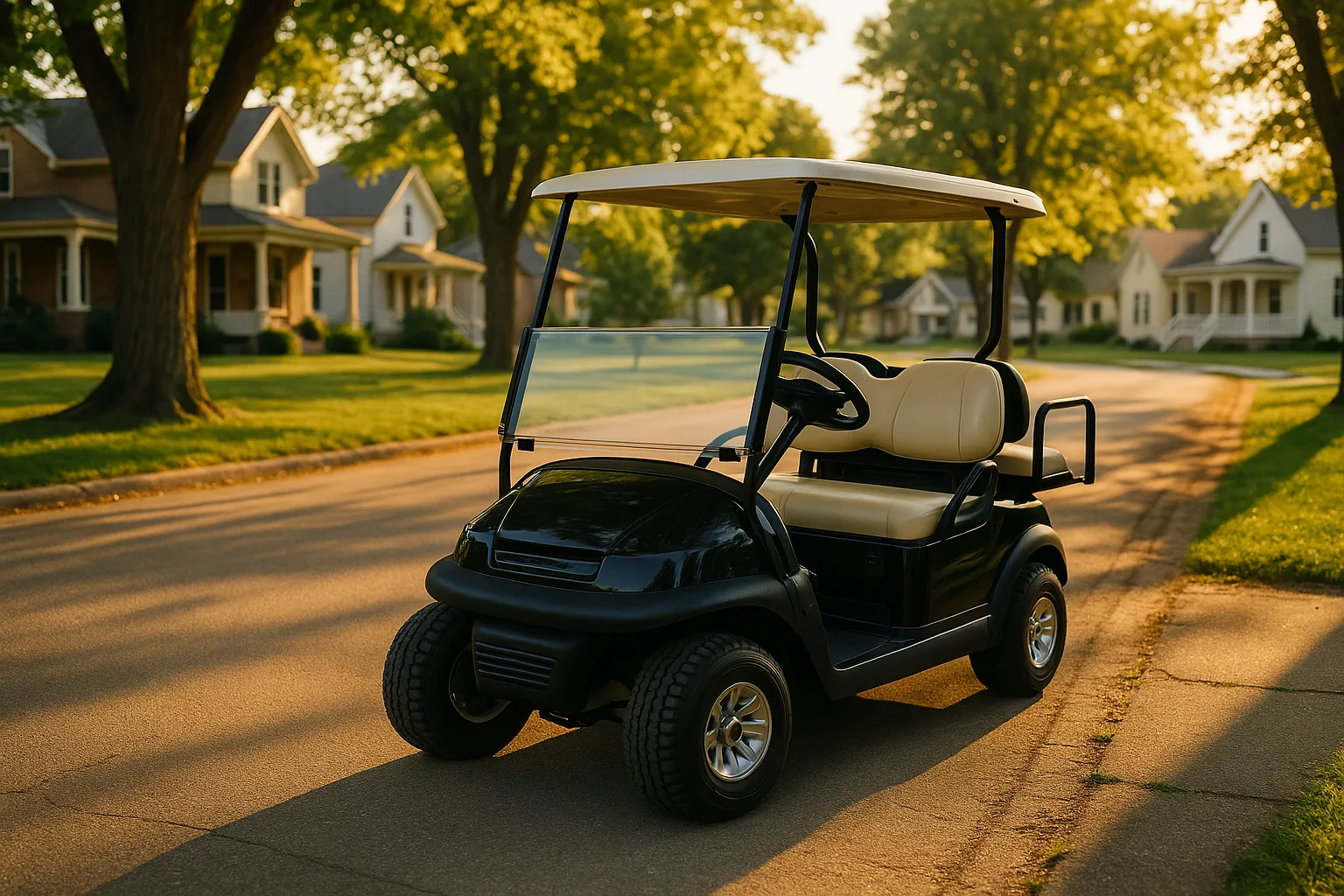
Are golf carts street legal in Iowa?
Golf carts are street legal in Iowa, but only in cities that have passed a local ordinance permitting them. Iowa operates on a two-level regulatory framework: the state sets the baseline rules through Iowa Code 321.247, and individual cities decide whether to allow golf carts on their streets at all. If your city hasn't passed an ordinance, you cannot legally drive a golf cart on public roads there, regardless of how short the trip is.
One important boundary to understand upfront: counties and unincorporated areas do not have the authority to permit golf cart road use. This means rural roads and county roads are off-limits to golf carts, even if your neighbors are doing it.
| Key rule | Details |
|---|---|
| Who sets the baseline? | Iowa Code 321.247 (state law) |
| Who authorizes street use? | Individual cities via local ordinance |
| Can counties authorize use? | No; county and unincorporated roads are prohibited |
| State highways or interstates? | Never permitted |
| Maximum street speed limit | 35 mph (golf carts), 25 mph (LSVs) |
| Operating hours (state baseline) | Sunrise to sunset |
Golf cart vs. low-speed vehicle in Iowa
Iowa law draws a clear line between a golf cart and a low-speed vehicle (LSV), and that distinction affects everything from registration to where you can legally drive. Many people use these terms interchangeably, but they are legally distinct categories with very different requirements.
Golf carts
Under Iowa Code 321.1, a golf cart is a vehicle designed primarily for use on a golf course. Golf carts have no 17-digit Vehicle Identification Number (VIN), cannot be titled, and cannot be registered with the Iowa DOT. They are permitted on city streets only through local ordinances and are subject to the restrictions in Iowa Code 321.247.
Low-speed vehicles (LSVs)
An LSV is a four-wheeled motor vehicle with a top speed greater than 20 mph but not exceeding 25 mph. LSVs must meet Federal Motor Vehicle Safety Standards under 49 CFR 571.500, carry a 17-digit VIN, and be titled, registered, and insured through the Iowa DOT just like any other motor vehicle.
LSVs are treated more like cars than golf carts under Iowa law, which means more paperwork but also more flexibility in some respects.
| Feature | Golf cart | Low-speed vehicle (LSV) |
|---|---|---|
| Primary design purpose | Golf course use | On-road use at low speeds |
| Top speed | Typically under 20 mph | Over 20 mph, max 25 mph |
| VIN required? | No | Yes (17-digit VIN) |
| Iowa DOT title and registration? | No | Yes |
| Insurance required by state? | No (some cities require it) | Yes |
| Federal safety standards apply? | No | Yes (49 CFR 571.500) |
| Max road speed limit to operate | 35 mph | 25 mph |
Thinking about upgrading a golf cart to make it street-legal everywhere? A standard golf cart cannot simply be converted to an LSV by adding equipment. True LSVs are purpose-built to federal safety standards and arrive from the manufacturer with a VIN. Aftermarket upgrades to a golf cart will not reclassify it as an LSV under Iowa law.
Where you can and can't drive in Iowa
Where you're allowed to drive depends heavily on whether you're operating a golf cart or an LSV, and whether your city has an active ordinance. Understanding these boundaries before you head out can save you a fine or worse.
Golf cart road rules
- Only permitted on city streets where a local ordinance exists
- Streets must have a posted speed limit of 35 mph or less
- Cannot be driven on primary road extensions running through cities, but may cross them at intersections
- Never permitted on state highways or interstates
- County roads and unincorporated rural roads are off-limits
- Operating hours are sunrise to sunset under state law (some cities may expand this)
LSV road rules
- Limited to roads with a posted speed limit of 25 mph or less statewide (stricter than many other states, which allow 35 mph roads)
- May cross higher-speed roads at intersections
- Not permitted on interstate highways
- No city ordinance required because LSVs are registered motor vehicles
| Road type | Golf cart | LSV |
|---|---|---|
| City streets (ordinance city, 35 mph or under) | Permitted | Permitted if 25 mph or under |
| City streets (no ordinance) | Not permitted | Permitted if 25 mph or under |
| Primary road extensions through cities | Not permitted (crossing only) | Crossing only |
| County roads | Not permitted | Permitted if 25 mph or under |
| State highways | Never | Never |
| Interstate highways | Never | Never |
Required equipment
Iowa law sets minimum equipment standards for both golf carts and LSVs. Local city ordinances can require more than the state minimums for golf carts, so always check your city's specific rules before heading out.
Golf cart minimums (Iowa Code 321.247)
- Slow-moving vehicle (SMV) emblem displayed on the rear
- Bicycle safety flag
- Adequate brakes in proper working order
Several cities go further than the state baseline. Sioux Center requires headlights and taillights. Washington requires headlights to be on during all operation. Always verify local requirements before driving in a new city.
LSV equipment requirements (49 CFR 571.500)
- Headlights and taillights
- Brake lights and turn signals
- Reflectors
- Windshield
- Rearview mirrors
- Seat belts for each occupant position
- Parking brake
- 17-digit VIN plate
| Equipment item | Golf cart (state minimum) | LSV (federal standard) |
|---|---|---|
| SMV emblem | Required | Not specified separately |
| Safety flag | Required | Not specified separately |
| Brakes | Required | Required (parking brake too) |
| Headlights and taillights | City may require | Required |
| Turn signals and brake lights | City may require | Required |
| Windshield | Not required by state | Required |
| Seat belts | Not required by state | Required |
| Rearview mirrors | Not required by state | Required |
Registration, permits, and fees
Golf carts and LSVs follow completely different registration paths in Iowa. Golf carts are exempt from state registration but often require a local city permit. LSVs go through the Iowa DOT like any other motor vehicle.
Golf cart city permits
Most Iowa cities that allow golf cart street use require operators to obtain a permit through the city clerk's office. The process and fees vary by city because there is no statewide standard. Center Point, for example, requires a city clerk permit as a condition of operating on city streets.
Steps to obtain a golf cart permit typically include:
- Contact your city clerk's office to confirm an ordinance exists and get the current application
- Provide proof of vehicle ownership (bill of sale or similar documentation)
- Show proof of liability insurance if the ordinance requires it
- Pay the permit fee (varies by city; call ahead to confirm current amounts)
- Display the issued permit on the golf cart as directed
Permit fees and renewal schedules vary significantly from city to city. Contact your city clerk directly for current fee amounts. Many Iowa cities that border lakes or have active golf communities post detailed permit information on their municipal websites.
LSV registration with the Iowa DOT
To register an LSV in Iowa, you will need to bring the following to your county treasurer's office:
- Manufacturer's Certificate of Origin (for a new LSV) or a valid title (for a used one)
- Proof of liability insurance meeting Iowa financial responsibility requirements
- A valid Iowa driver's license
- Payment for registration fees
LSV registration fees are calculated based on vehicle weight and list price under Iowa Code 321.109 and 321.115 through 321.124. For current fee tables, visit iowataxandtags.org, which provides an official fee estimator based on your vehicle's specific details.
| Registration item | Golf cart | LSV |
|---|---|---|
| Iowa DOT registration required? | No | Yes |
| Local city permit required? | Often yes (varies by city) | No |
| Title required? | No | Yes |
| Fee basis | City-set (varies widely) | Weight and list price (Iowa Code 321.109, 321.115–321.124) |
| Proof of insurance required? | Only if city ordinance requires | Yes, before registration |
Insurance requirements
Iowa does not require golf cart owners to carry insurance at the state level because golf carts are not registered motor vehicles. However, some city ordinances make liability insurance a condition of obtaining a local permit. Even where insurance isn't legally required, carrying it is strongly advisable.
A collision, property damage incident, or injury involving an uninsured golf cart on a public road could expose you to significant personal liability. Two coverage options worth exploring:
- Homeowners or renters insurance endorsement: Some policies can be extended to cover golf cart liability, especially for on-road use in permitted areas. Check with your current insurer.
- Standalone golf cart policy: Specialty insurers and many major carriers offer dedicated golf cart policies that cover liability, collision, and comprehensive damage. These are often inexpensive and provide more complete protection than a homeowners endorsement.
LSVs are subject to Iowa's financial responsibility law and must carry liability insurance before you can register the vehicle with the Iowa DOT. There is no workaround for this requirement.
Age and license requirements
A valid driver's license is required to operate a golf cart on city streets under Iowa Code 321.247. Iowa issues unrestricted driver's licenses at age 16, which sets the practical minimum age for golf cart street use. Iowa does offer an intermediate license beginning at age 14, but the "valid driver's license" language in the statute effectively means 16 is the floor for unsupervised golf cart operation on public roads.
LSVs require a valid Iowa driver's license, the same as any registered motor vehicle. There is no special license category for LSV operation.
| Operator requirement | Golf cart | LSV |
|---|---|---|
| Valid driver's license required? | Yes | Yes |
| Minimum age (practical) | 16 | 16 |
| Special license class needed? | No | No |
OWI and impaired driving risks
Iowa's OWI law is found in Iowa Code 321J and applies to motor vehicles operated on public roads. Golf carts operating under a local ordinance on city streets are very likely subject to OWI enforcement. Operating a golf cart while impaired on a public street is not a gray area you want to test in practice.
The safest approach is to treat a golf cart on a public road exactly like a car. A citation or arrest for OWI carries serious legal and financial consequences regardless of the vehicle type involved.
Don't assume a golf cart is exempt from Iowa OWI law because it isn't classified as a registered motor vehicle. If you are on a public road under a city ordinance, law enforcement can and does treat golf cart operation the same as car operation for purposes of impaired driving enforcement.
Penalties for driving without authorization
Driving a golf cart on public roads in a city without an authorizing ordinance, or violating the conditions of a city's golf cart ordinance, exposes you to real legal consequences. While Iowa Code 321.247 sets the framework, enforcement and specific fine structures are largely handled at the local level.
Potential consequences include:
- Citation and fine issued by local law enforcement
- Revocation of your city golf cart permit (in cities that issue them)
- Personal liability for any accidents or property damage that occur while operating illegally
- Denial of an insurance claim if the vehicle was being operated in violation of law at the time of an incident
Contact your city clerk or local police department if you are unsure whether your city has an ordinance or whether your planned route complies with its conditions.
Iowa cities with golf cart ordinances
The number of Iowa cities that have passed golf cart ordinances has grown steadily, particularly in communities near lakes, golf courses, and resort areas. Requirements vary considerably from city to city, so confirming your local rules before purchasing a permit or heading out on the road is essential.
| City | Known requirements | Notes |
|---|---|---|
| Sioux Center | Headlights and taillights required | Equipment requirements exceed state minimums |
| Washington | Headlights required during all operation | Lighting required even during daytime |
| Center Point | City clerk permit required | Must obtain permit before operating on streets |
This table reflects a starting point rather than a complete list. Iowa has dozens of cities with active golf cart ordinances. If your city is not listed above, contact your city clerk's office directly to ask whether an ordinance exists and what its current requirements are.
Lake communities and cities with active golf communities are among the most likely to have golf cart ordinances in Iowa. If you're purchasing a golf cart and plan to use it on public roads, confirm your city's ordinance status before you buy.
Frequently asked questions
Can I drive a golf cart on a county road in Iowa?
No. Counties and unincorporated areas in Iowa do not have the authority to authorize golf cart road use. Golf carts are limited to city streets in municipalities that have passed a local ordinance.
Can I drive a golf cart at night in Iowa?
State law limits golf cart operation to sunrise through sunset. Some cities may expand these hours through their local ordinance, particularly if they require headlights and taillights, but the default under Iowa Code 321.247 is daytime only.
Do I need to register my golf cart with the Iowa DOT?
No. Golf carts are exempt from Iowa DOT registration under Iowa Code Chapter 321. However, many cities require a local permit obtained through the city clerk's office as a condition of street use.
Do I need insurance for a golf cart in Iowa?
Iowa does not mandate insurance for golf carts at the state level. Some city ordinances require liability insurance as a condition of the local permit. Regardless of whether it is required, carrying liability coverage is strongly recommended before operating on public roads.
What is the difference between a golf cart and an LSV in Iowa?
A golf cart is designed for golf course use, has no VIN, and cannot be titled or registered. An LSV is a purpose-built four-wheeled vehicle with a top speed between 20 and 25 mph, carries a 17-digit VIN, and must be titled, registered, and insured through the Iowa DOT under federal safety standards (49 CFR 571.500).
Can I convert my golf cart into an LSV in Iowa?
No. Adding lights or other equipment to a standard golf cart will not reclassify it as an LSV under Iowa law. LSVs must be purpose-built to federal safety standards and come from the manufacturer with a VIN. There is no aftermarket conversion path recognized by Iowa law.
Can you get an OWI on a golf cart in Iowa?
Very likely yes. Iowa Code 321J applies to motor vehicles on public roads, and golf carts operating under a city ordinance on public streets are almost certainly subject to OWI enforcement. Treat operating a golf cart on a public road the same way you would treat driving a car.
How fast can a golf cart go on Iowa roads?
The golf cart itself has no state-mandated speed cap, but it can only be operated on streets with posted speed limits of 35 mph or less. In practice, most golf carts top out well below that. LSVs are limited to roads posted at 25 mph or less.
What cities in Iowa allow golf carts on public streets?
Many Iowa cities have passed golf cart ordinances, including Sioux Center, Washington, and Center Point, among others. There is no centralized state list. Contact your city clerk's office to confirm whether your city has an ordinance and what its specific requirements are. For a broader look at how other states handle these rules, see our golf cart laws by state guide.
What should I look for when buying a golf cart for road use in Iowa?
If you're shopping for a golf cart to use on Iowa city streets, review our golf cart buying guide for guidance on what to inspect, how to compare options, and what to budget for. Also consider how golf cart costs vary by type and features before making a purchase decision.