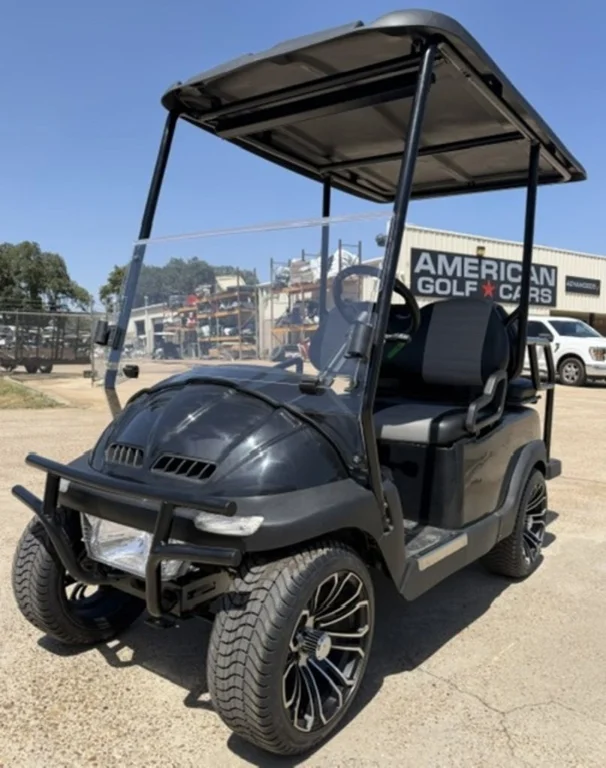
Golf carts vs. low-speed vehicles in North Carolina
Before anything else, North Carolina law draws a hard line between two vehicle types: a standard golf cart and a Low-Speed Vehicle (LSV). Which category your vehicle falls into determines everything, including whether it can be registered, where it can legally travel, and which rules apply to you.
| Feature | Standard golf cart | Low-Speed Vehicle (LSV) |
|---|---|---|
| Top speed | Under 20 mph | 20–25 mph |
| VIN | None | 17-digit VIN required |
| Federal safety compliance | No | Yes (49 CFR 571.500) |
| NC DMV registration | Not eligible | Eligible and required |
| Street legal statewide | No — local ordinance only | Yes — on eligible roads |
| License plate | No state plate | NC license plate issued |
A standard golf cart is designed for golf course use, typically travels well under 20 mph, has no Vehicle Identification Number, and does not meet federal motor vehicle safety standards. The NC DMV cannot title or register a standard golf cart. This is a hard stop, not a paperwork issue.
An LSV is a four-wheeled electric vehicle capable of 20–25 mph, built to comply with federal standard 49 CFR 571.500, and carries a 17-digit VIN from the factory. LSVs can be titled, registered, and plated through the NC DMV just like a conventional car.
Gas-powered vehicles cannot qualify as LSVs under federal and NC definitions. The LSV classification applies to electric four-wheeled vehicles meeting the FMVSS 49 CFR 571.500 standard. If you own a gas golf cart, it is treated as a standard golf cart under NC law regardless of its speed.
Are golf carts street legal in North Carolina?
Golf carts are not street legal by default anywhere in North Carolina. The state operates a two-track system: local ordinances govern golf cart access, while statewide DMV registration governs LSVs. If your city or county has not passed a golf cart ordinance, there is no legal way to drive a standard golf cart on any public road.
| Vehicle type | Who controls road access | Roads allowed | Roads prohibited |
|---|---|---|---|
| Standard golf cart | Local ordinance (city or county) | Posted 35 mph or lower, within jurisdiction | State highways, interstates, controlled-access roads |
| LSV | NC DMV statewide registration | Any public road posted 35 mph or lower | Interstates, controlled-access roads |
The enabling statutes for the local ordinance system are G.S. 160A-300.6 (for municipalities) and G.S. 153A-245 (for counties in unincorporated areas). Cities and counties must actively pass ordinances to allow golf carts on public roads. If no ordinance exists, no road access is permitted.
LSVs operate under a statewide framework once registered. A registered LSV can use any public road in North Carolina with a posted speed limit of 35 mph or lower. Both golf carts and LSVs may cross intersections with higher posted limits when local ordinance or road design permits it. Neither type can use interstates or controlled-access roads.
Understanding local golf cart ordinances
A local golf cart ordinance can regulate a wide range of conditions. NC DOT has published a model ordinance (Guidance Document G-5) that many local governments use as a starting framework, but individual communities vary significantly in what they require.
| Community | Ordinance status | Notable rules |
|---|---|---|
| Duck | Active ordinance | Restricted routes, daylight hours, local registration |
| Carolina Beach | Active ordinance | Local permit required, equipment standards apply |
| Sunset Beach | Active ordinance | Designated roads, driver's license required |
| Pinehurst area | Active ordinance | Golf cart-friendly community, local rules vary |
| Outer Banks communities | Several active ordinances | Varies by town — check locally |
What a local ordinance can regulate includes:
- Local registration requirements (sticker or decal, typically a small annual fee)
- Minimum operator age and driver's license requirements
- Required equipment such as headlights, taillights, mirrors, and reflective markings
- Hours of operation (most ordinances restrict to daylight hours only)
- Specific permitted routes or road restrictions
- Passenger limits
One important boundary: no local ordinance can lower the state minimum operating age of 16. A community can add restrictions, but it cannot permit younger operators on public roads.
To find out if your town or county has an active golf cart ordinance, contact the city or town clerk directly, check your municipality's official website, or search your county government site. Ordinance language can change, so always verify current rules before you drive.
If your community has no ordinance, you have two practical options: advocate for your local government to adopt one, or purchase a purpose-built LSV that qualifies for statewide DMV registration.
Registration, titling, and insurance
Registration requirements differ completely depending on whether you have a golf cart or an LSV. The table below summarizes the key distinctions.
| Requirement | Standard golf cart | LSV |
|---|---|---|
| NC DMV title | Not available | Required |
| NC DMV registration | Not available | Required — same fee as standard private passenger vehicle |
| License plate | None | NC plate issued |
| Local registration | Required by some ordinances (sticker or decal) | Not separately required |
| Liability insurance | Not state-mandated; may be required locally | NC minimum liability coverage required |
| Documentation at purchase | Bill of sale | Manufacturer's Certificate of Origin (new) or existing title |
To register an LSV at an NC DMV office, you will need the Manufacturer's Certificate of Origin (for a new vehicle) or an existing title (for a used one), proof of NC minimum liability insurance, and payment of the registration fee, which is equivalent to the standard private passenger vehicle fee.
Insurance for LSVs is mandatory under North Carolina law. As registered motor vehicles, they must carry at least the state's minimum liability coverage. Golf cart insurance is not required by state statute, but many local ordinances do require it, and it is strongly recommended regardless. A collision involving an uninsured golf cart on a public road can carry significant financial exposure.
If you are buying a used LSV, confirm the seller has a proper title in hand before completing the transaction. A vehicle sold with only a bill of sale and no title may indicate it was originally a standard golf cart, not a factory-built LSV, and that means no DMV registration is possible.
Equipment requirements
LSVs must meet a federally defined equipment list to qualify for registration. Golf cart equipment standards are set entirely at the local level.
| Equipment item | Required for LSV | Required for golf cart |
|---|---|---|
| Headlamps | Yes | Per local ordinance |
| Stop lamps | Yes | Per local ordinance |
| Turn signals | Yes | Per local ordinance |
| Tail lamps | Yes | Per local ordinance |
| Rear reflex reflectors | Yes (red) | Per local ordinance |
| Rearview mirrors | Yes (driver-side exterior plus interior or passenger exterior) | Per local ordinance |
| Parking brake | Yes | Per local ordinance |
| Windshield | Yes | Per local ordinance |
| Windshield wipers | Yes | Per local ordinance |
| Speedometer | Yes | Per local ordinance |
| Seat belts at every seat | Yes | Per local ordinance |
| 17-digit VIN | Yes | Not applicable |
Purpose-built LSVs from the factory come with all required equipment already installed. If you are shopping for a used LSV, physically verify that nothing has been removed or disabled. Missing equipment can prevent registration or result in a failed inspection.
For golf carts, typical local ordinance requirements include headlights, taillights, mirrors, and reflective markings, but requirements vary by community. Always check your specific local ordinance for the complete list.
Converting a golf cart to street-legal status
You cannot convert a standard golf cart into a street-legal LSV as a DIY project. North Carolina law requires that a conversion be performed by a licensed manufacturer, not an individual owner or a local shop.
A legitimate conversion requires:
- Issuance of a 17-digit VIN by the converting manufacturer
- A Manufacturer's Certificate of Origin for the converted vehicle
- Full compliance with NHTSA safety standards
- Compliance with NC statutes and NC Administrative Code
In practice, this process is expensive and complex. The cost of a proper conversion often approaches or exceeds the price of simply buying a purpose-built LSV. Manufacturers such as Bintelli, Advanced EV, and Evolution Electric Vehicles sell factory-built LSVs that arrive registration-ready with all required documentation in hand.
If a seller offers a "converted" golf cart with a street-legal certificate but cannot produce a 17-digit VIN and a proper Manufacturer's Certificate of Origin, do not assume it qualifies for NC DMV registration. Verify with your local DMV office before purchase.
Age and license requirements
The minimum age to operate a golf cart on a public road in North Carolina (under a local ordinance) or to operate a registered LSV on any eligible public road is 16 years old. A valid driver's license is required for both.
| Requirement | Golf cart (local ordinance) | LSV |
|---|---|---|
| Minimum age | 16 (state minimum, cannot be lowered) | 16 |
| Valid driver's license | Yes | Yes |
| Local ordinance age add-ons | May set higher minimums, not lower | Not applicable |
A local ordinance can raise the minimum age above 16 for golf cart operation, but no ordinance can permit operators younger than 16 on public roads. This floor applies regardless of what any private community rule or golf course policy may say about younger operators in off-road contexts.
DWI exposure on public roads
North Carolina's impaired driving laws apply to anyone operating a golf cart or LSV on a public road. You can be charged with DWI on a golf cart. The type of vehicle does not create an exemption from G.S. 20-138.1.
For LSVs, the exposure is clear-cut: as registered motor vehicles, they carry the same DWI liability as any car or truck. For golf carts operating under a local ordinance on a public road, the same standard applies. A public road is a public road regardless of the vehicle's size or speed.
Driving a golf cart or LSV after drinking on a public road in North Carolina carries the same legal consequences as driving any other motor vehicle while impaired, including license suspension, fines, and potential criminal charges. "It's just a golf cart" is not a legal defense.
Private communities and HOA roads
North Carolina's public road laws, including the local ordinance system and LSV registration requirements, apply only to public roads. If you live in a gated community, private development, or HOA neighborhood with private roads, the state's golf cart laws may not govern how you use your cart within that property.
Private communities and HOAs set their own rules for golf cart use on private roads. Many actively permit and even encourage golf cart use without requiring state registration or compliance with public road equipment standards.
However, the moment a golf cart or LSV crosses from a private road onto a public road, all applicable state and local laws immediately apply. If your route involves any public road segment, even briefly, you are subject to the full framework described in this article.
What to look for when buying an LSV in North Carolina
Purchasing a purpose-built LSV is the most straightforward path to legal road use across North Carolina. Before you buy, use this checklist to confirm the vehicle qualifies for NC DMV registration. If you are still weighing your options, our golf cart buying guide covers what to inspect and compare before committing to any purchase.
| Item to verify | Why it matters |
|---|---|
| 17-digit VIN present on vehicle | Required for DMV title and registration |
| Manufacturer's Certificate of Origin (new) or clean title (used) | Required to complete DMV registration |
| Top speed of 20–25 mph | Must fall within the LSV federal definition |
| All required equipment installed and functional | Headlamps, stop lamps, turn signals, mirrors, seat belts, windshield, wipers, speedometer, parking brake |
| Federally compliant (49 CFR 571.500) | Confirms factory LSV status, not a converted golf cart |
| Electric powertrain | Gas-powered vehicles do not qualify as LSVs |
Ask the dealer or seller directly: "Is this vehicle titled as an LSV with a 17-digit VIN?" If they hesitate or cannot produce documentation, treat it as a red flag. A reputable LSV dealer will have all documentation ready before the sale is complete.
Frequently asked questions
Does my golf cart need a license plate in North Carolina?
No. Standard golf carts are not eligible for NC DMV registration and are not issued a state license plate. Some local ordinances require a locally issued registration sticker or decal, but there is no state plate for golf carts. LSVs, by contrast, receive a standard NC license plate upon DMV registration.
Can I drive my golf cart at night in North Carolina?
Most local ordinances restrict golf cart operation to daylight hours only. Check your specific local ordinance for the exact hours permitted. LSVs, as registered motor vehicles with required lighting equipment, can generally operate at any hour on eligible roads.
What happens if I drive a golf cart on a public road without a valid local ordinance?
Driving a golf cart on a public road in a jurisdiction with no enabling ordinance is unlawful. You could face a citation for operating an unauthorized vehicle on a public road. Penalties vary, but the legal exposure is real, and it does not matter how slowly you are traveling or how short the distance is.
What if my town doesn't have a golf cart ordinance?
You have two options. You can engage your local government (city council or county commission) to adopt an ordinance using NC DOT's model framework (Guidance Document G-5) as a starting point. Alternatively, you can purchase a factory-built LSV that qualifies for statewide DMV registration, bypassing the local ordinance system entirely.
Can you get a DUI on a golf cart in North Carolina?
Yes. NC impaired driving law applies to all vehicles on public roads, including golf carts and LSVs. Operating any vehicle while impaired on a public road can result in a DWI charge, regardless of the vehicle's size or speed.
Can I convert my golf cart into a street-legal vehicle?
Not as a DIY project. Conversion requires a licensed manufacturer who can issue a 17-digit VIN and a Manufacturer's Certificate of Origin, along with full compliance with NHTSA and NC standards. The cost and complexity of a proper conversion typically makes purchasing a purpose-built LSV the more practical choice.
What is the minimum age to drive a golf cart on public roads in NC?
The statewide minimum age is 16, and a valid driver's license is required. No local ordinance can permit operators younger than 16 on public roads, though individual ordinances may set a higher minimum age.
How do I find out if my town allows golf carts on the road?
Contact your city or town clerk's office directly, or check your municipality's official website for traffic or vehicle ordinances. You can also search the NC General Assembly website for local government ordinances. When in doubt, call your local government directly — they can confirm whether an active ordinance exists and provide the current rules. If you are curious how other states handle similar questions, see our overviews of Tennessee golf cart laws and Texas golf cart laws for comparison.