Are golf carts street legal in West Virginia?
Golf carts are not street legal in West Virginia under any circumstances. No permit, local ordinance, or municipal opt-in can change that. West Virginia state law draws a hard line: golf carts have zero access to public roads, and that rule is uniform across every city and county in the state.
However, a separate vehicle category called a low-speed vehicle (LSV) is street legal in West Virginia under specific conditions. Understanding the difference between a golf cart and an LSV is the key to knowing what you can and cannot do on public roads.
| Vehicle type | Street legal in WV? | Public road access |
|---|---|---|
| Golf cart | No | None; private property only |
| Low-speed vehicle (LSV) | Yes, with conditions | Municipal roads with posted speed limits of 25 mph or less |
How West Virginia defines golf carts vs. LSVs
West Virginia law makes a clear distinction between these two vehicle types, and the classification is determined by the manufacturer, not the owner.
Under WV Code Section 17A-1-1, a low-speed vehicle is defined as a four-wheeled motor vehicle capable of traveling more than 20 mph but not more than 25 mph on a paved, level surface over one mile. LSVs must also comply with Federal Motor Vehicle Safety Standard 500 (49 CFR 571.500) and carry a manufacturer-assigned 17-digit VIN.
A golf cart, by contrast, is generally a vehicle designed for use on golf courses that does not meet LSV speed and safety standards. The most important distinction: if the Manufacturer's Certificate of Origin (MCO) does not explicitly identify the vehicle as a low-speed vehicle, it cannot be titled or registered as one in West Virginia.
| Feature | Golf cart | Low-speed vehicle (LSV) |
|---|---|---|
| Top speed | Under 20 mph | More than 20 mph, up to 25 mph |
| Federal safety standard | Not required | Must meet 49 CFR 571.500 |
| Manufacturer VIN | Not required | 17-digit VIN required |
| MCO classification | Golf cart | Must say "low-speed vehicle" |
| Street legal in WV? | No | Yes, with conditions |
Where LSVs can and cannot operate
Even if your vehicle qualifies as an LSV, you cannot drive it anywhere you please. West Virginia law limits LSV operation to specific road types and locations.
Where LSVs are permitted
- Public roads within the corporate limits of an incorporated municipality where the posted speed limit is 25 mph or less
- Private roads anywhere in the state, without restriction
- Crossing state routes at traffic-signal-controlled intersections, provided the state route has a posted speed limit of 40 mph or less
Where LSVs are not permitted
- Unincorporated county roads or rural roads outside city limits
- State highways or roads with speed limits above 25 mph
- State routes at non-signalized intersections
- Any public road if the vehicle is not titled and registered
If you live in Morgantown, Charleston, or Huntington, LSV use may be practical on certain low-speed residential streets. However, the moment you leave city limits, you must stop operating your LSV on public roads.
Required equipment for LSVs
To be street legal in West Virginia, an LSV must arrive from the factory equipped with all required safety equipment. Aftermarket additions do not satisfy these requirements and will not change a golf cart's legal classification.
| Required equipment | Notes |
|---|---|
| Headlamps | Factory-installed |
| Tail lamps and stop lamps | Factory-installed |
| Front and rear turn signal lamps | Factory-installed |
| Reflex reflectors | Factory-installed |
| Rearview mirrors | Factory-installed |
| Windshield | Factory-installed |
| Seat belts at every seating position | Factory-installed |
| Horn | Factory-installed |
| Parking brake | Factory-installed |
| 17-digit manufacturer VIN | Must be factory-assigned |
Every item on this list must be factory-installed. You cannot bolt on a windshield, add aftermarket seat belts, or install lights to make your golf cart qualify as an LSV. If it did not come from the factory meeting FMVSS 500 standards, it is still a golf cart under West Virginia law.
Registration and titling your LSV
LSV registration is handled by the West Virginia Division of Motor Vehicles (DMV). Once registered, your LSV receives a standard West Virginia license plate, just like any other motor vehicle.
Step-by-step registration process
- Confirm your MCO: Before anything else, verify that your vehicle's Manufacturer's Certificate of Origin explicitly identifies it as a low-speed vehicle. If it says "golf cart," you cannot register it.
- Obtain insurance: Secure a minimum liability insurance policy that meets West Virginia's standard motor vehicle requirements.
- Complete the application: Fill out the WV DMV title and registration application.
- Gather required documents: Bring your MCO (or out-of-state title if transferring from another state), proof of insurance, completed application, and applicable fees.
- Submit to the DMV: Visit your local WV DMV office to submit documents and pay fees.
- Receive plates: Once approved, you will receive a standard West Virginia license plate to display on your LSV.
While driving on public roads, you must carry your registration card and proof of insurance at all times. West Virginia does not currently appear to require annual safety or emissions inspections for LSVs, but confirm the latest requirements with the WV DMV directly at transportation.wv.gov.
Insurance requirements
LSVs are subject to the same minimum liability insurance requirements as any other registered motor vehicle in West Virginia. You cannot register or legally operate an LSV on public roads without meeting these requirements.
Golf carts used on private property are not subject to state insurance mandates, but carrying liability coverage through a homeowner's or recreational vehicle policy is worth considering, particularly if you use a cart in a community setting or allow others to operate it. For a deeper look at coverage options, see our guide to golf cart insurance.
| Vehicle use | Insurance required? | Typical coverage type |
|---|---|---|
| LSV on public roads | Yes; state minimum liability | Standard auto liability policy |
| Golf cart on private property | No state requirement | Homeowner's or recreational vehicle policy (advisable) |
Driver's license and age requirements
A valid West Virginia driver's license is required to operate an LSV on public roads. No separate LSV endorsement or special permit is needed beyond a standard driver's license.
West Virginia uses a graduated licensing system:
- Learner's permit available at age 15
- Full license at age 17 (with program completion) or age 18 (without a driver's education program)
For golf cart use on private property or golf courses, the state imposes no age or licensing requirements. Individual golf course operators set their own policies regarding minimum age and supervision rules for cart use.
Can you convert a golf cart into a street-legal LSV?
No. West Virginia does not allow golf cart-to-LSV conversions under any circumstances. The WV DMV will not title or register a homemade conversion or retrofitted golf cart, regardless of what equipment has been added.
The reason is straightforward: the legal classification of a vehicle is determined by what its Manufacturer's Certificate of Origin says, not by what equipment is installed on it. Adding lights, mirrors, seat belts, and a windshield to a golf cart does not make it an LSV. There is no inspection process, conversion certification, or workaround available in West Virginia.
If you purchase a used vehicle and the MCO or title says "golf cart," you cannot register it as an LSV in West Virginia, even if it looks identical to a factory-built LSV. Always verify the MCO language before buying.
Factory-built LSV options and pricing
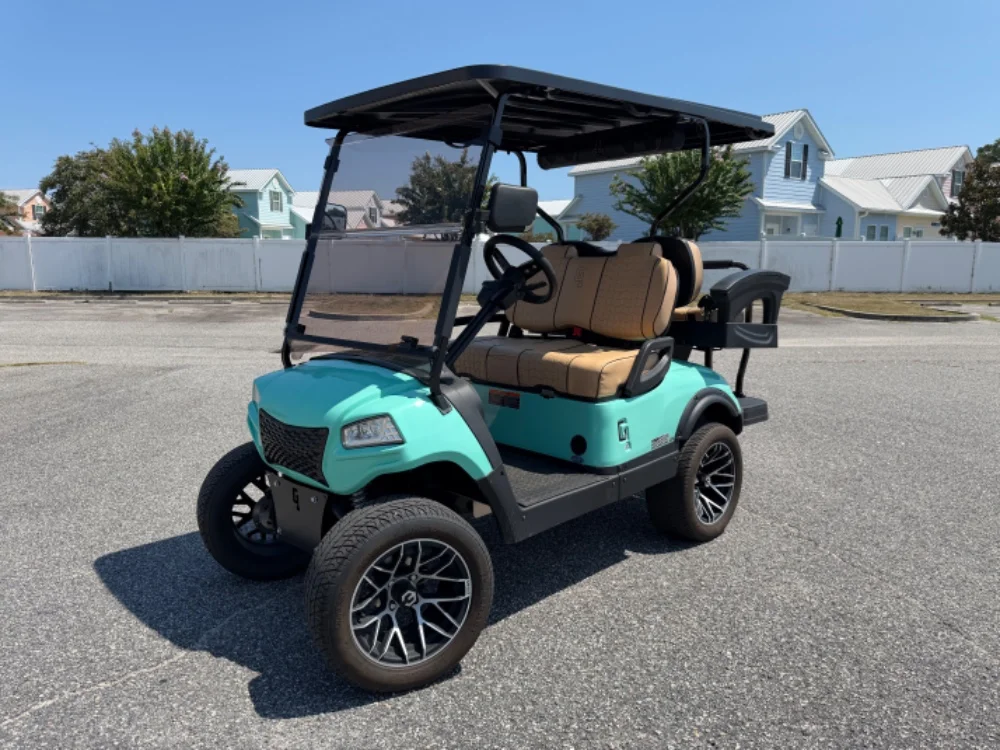
If you want a street-legal vehicle in West Virginia, you must purchase a factory-built LSV from a manufacturer that produces vehicles compliant with FMVSS 500 and issues proper MCOs. Several major manufacturers offer qualifying models.
| Brand | Model | Approximate price range |
|---|---|---|
| Club Car | Onward LSV | $12,000 – $16,000+ |
| E-Z-GO | Liberty LSV | $11,000 – $15,000+ |
| Yamaha | Drive2 PTV LSV | $10,000 – $14,000+ |
These vehicles come with the correct 17-digit VIN, a compliant MCO identifying them as low-speed vehicles, and all factory-installed safety equipment required under FMVSS 500. Prices vary based on configuration, accessories, and dealer location. Electric and gas-powered versions are available across most brands and are treated identically under West Virginia law; the fuel type does not affect street-legal classification. If you're still weighing your options, our golf cart buying guide covers what to inspect and compare before purchasing.
Penalties for illegal golf cart operation
Operating a golf cart on a public road in West Virginia is a violation of state traffic law. Citations can include fines and vehicle impoundment. Because golf carts are not registered motor vehicles, there is no insurance or title to present during a traffic stop, which compounds the legal exposure.
West Virginia's DUI statute under Chapter 17C, Article 5 applies to vehicles operated on public roads. Since golf carts have no lawful access to public roads, a DUI scenario involving a golf cart on private property is legally distinct from operating on a public road. That said, operating any motorized vehicle on a public road while impaired, including an unlawfully operated golf cart, can result in DUI enforcement.
Do not assume that driving a golf cart on a quiet neighborhood street is a low-risk activity in West Virginia. The prohibition is statewide and absolute, and enforcement can include traffic citations, fines, and impoundment.
Golf carts on private property and in communities
West Virginia law places no restrictions on golf cart use on private property. This creates practical flexibility for resort communities, gated neighborhoods, lake communities, campgrounds, and agricultural properties across the state.
In the eastern panhandle and mountain resort areas, private community roads are common. If a road is genuinely private and not publicly maintained, golf cart use is generally permitted without registration or licensing requirements. However, if a private road connects to or crosses a public road, the rules change immediately.
Homeowners associations (HOAs) and resort operators may impose their own rules regarding cart use, speed limits, age restrictions, and liability waivers. These rules exist independently of state law and are worth reviewing before purchasing a cart for community use.
West Virginia state parks and campgrounds may permit golf cart use within their grounds under private property rules, but individual park policies vary. Contact the specific park or facility to confirm their rules before bringing a cart.
How West Virginia compares to neighboring states
West Virginia takes a stricter stance than most of its neighbors. Several surrounding states allow municipalities to permit golf carts on certain public roads through local ordinances, something West Virginia explicitly does not allow.
| State | Golf carts on public roads? | Local ordinance option? |
|---|---|---|
| West Virginia | No | No |
| Virginia | Limited; local option | Yes |
| Kentucky | Limited; local option | Yes |
| Ohio | Limited; local option | Yes |
| Pennsylvania | Very limited | Restricted |
| Maryland | No broad access | Limited |
If you move to West Virginia from a state where your golf cart was street legal under a local ordinance, that authorization does not transfer. You will need to evaluate whether your vehicle qualifies as an LSV under West Virginia law or limit its use to private property. For a broader look at how rules differ across the country, see our golf cart laws by state guide. If you're specifically coming from Pennsylvania, the Pennsylvania golf cart laws page covers what applied there in detail.
Frequently asked questions
Can I drive my golf cart on the street in West Virginia?
No. Golf carts are prohibited from all public roads in West Virginia with no exceptions. There is no permit system, no local ordinance pathway, and no seasonal allowance.
What makes a vehicle an LSV instead of a golf cart?
The vehicle must travel more than 20 mph but not more than 25 mph on a paved, level surface over one mile, comply with FMVSS 500, carry a manufacturer-assigned 17-digit VIN, and have an MCO that explicitly identifies it as a low-speed vehicle.
Can I drive my LSV outside city limits?
No. LSVs may only operate on public roads within the corporate limits of an incorporated municipality on roads with posted speed limits of 25 mph or less. Outside city limits, LSV operation is restricted to private roads.
Can an LSV cross a state highway?
Yes, but only at a traffic-signal-controlled intersection where the state route has a posted speed limit of 40 mph or less.
Can I convert my golf cart into a street-legal LSV in West Virginia?
No. West Virginia does not recognize conversions. The vehicle's MCO must classify it as a low-speed vehicle from the manufacturer. Aftermarket modifications do not change the vehicle's legal classification.
Do I need an annual inspection for my LSV?
West Virginia does not currently appear to require annual safety or emissions inspections for LSVs. Confirm the latest requirements with the WV DMV before operating.
Can you get a DUI on a golf cart in West Virginia?
Because golf carts cannot legally be on public roads, a DUI scenario on private property is legally distinct. However, operating any motorized vehicle on a public road while impaired can result in DUI enforcement under Chapter 17C, Article 5.
What insurance do I need for my LSV?
LSVs must carry the same minimum liability insurance as any other registered motor vehicle in West Virginia. Golf carts on private property are not subject to state insurance mandates, though personal liability coverage is advisable.
Can minors operate golf carts on private property?
West Virginia imposes no state-level age or licensing requirement for golf cart use on private property. Individual property owners, golf courses, and community operators set their own age policies.
What if my LSV exceeds 25 mph?
A vehicle capable of exceeding 25 mph does not qualify as an LSV under West Virginia law. It would need to meet the requirements for standard motor vehicle registration, which carries different titling, inspection, and equipment standards.
I'm moving to West Virginia with an LSV registered in another state. What do I need to do?
You will need to retitle and register the vehicle in West Virginia. Bring your out-of-state title, proof of insurance, and a completed WV DMV application. If the out-of-state title identifies the vehicle as a low-speed vehicle and the vehicle meets West Virginia's requirements, registration should be straightforward. Verify the specific steps with the WV DMV.
For official guidance, visit the West Virginia Division of Motor Vehicles at transportation.wv.gov or reference the West Virginia Legislature's code at code.wvlegislature.gov.