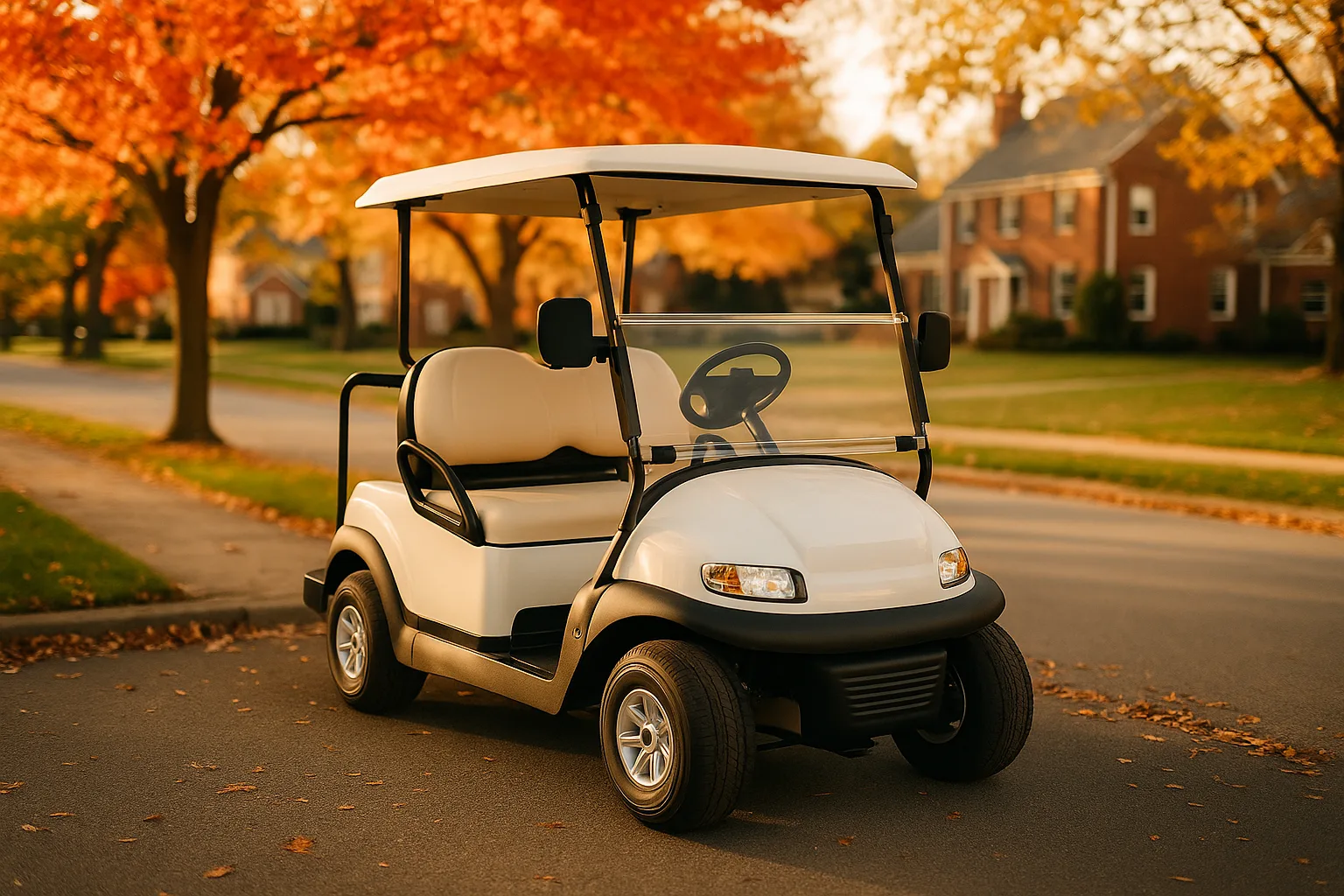
Pennsylvania golf cart laws at a glance
Pennsylvania is one of the more restrictive states in the country when it comes to golf cart road use. The rules are governed primarily by Title 75 of the Pennsylvania Consolidated Statutes and Act 57 of 2017, and they draw a hard legal line between two very different vehicle types: golf carts and Neighborhood Electric Vehicles (NEVs). Where you can drive, what equipment you need, and whether you need a license all depend on which category your vehicle falls into.
| Topic | Golf cart | NEV / Low-Speed Vehicle |
|---|---|---|
| Top speed | Under 20 mph | 20 – 25 mph |
| PennDOT registration | Not eligible | Required |
| Roads permitted | 35 mph or less (one-mile limit near golf course) | 25 mph or less |
| Minimum operator age | 12 (16 at designated crossings without adult) | 16 with valid driver's license |
| Driver's license required | No | Yes |
| DUI laws apply | Yes, on public roads | Yes |
Golf cart vs. NEV: the key distinction
The single most important thing to understand about Pennsylvania golf cart laws is the difference between a golf cart and a Neighborhood Electric Vehicle. These two vehicles look similar but are treated entirely differently under Pennsylvania law.
A golf cart is a low-speed vehicle designed primarily for on-course use. It typically tops out well under 20 mph and has no federal safety certification. Because golf carts lack a manufacturer-assigned 17-digit Vehicle Identification Number (VIN), PennDOT cannot register or title them.
An NEV is a four-wheeled electric vehicle with a top speed between 20 and 25 mph that must comply with federal safety standard 49 CFR 571.500. The 17-digit VIN is the practical dividing line. If your vehicle has one, it may qualify as an NEV. If it does not, it is a golf cart under Pennsylvania law, regardless of how it looks or how it was marketed.
| Feature | Golf cart | NEV |
|---|---|---|
| Top speed | Under 20 mph | 20 – 25 mph |
| Federal safety certification | No | Yes (49 CFR 571.500) |
| 17-digit VIN | No | Yes |
| PennDOT registration eligible | No | Yes |
| Example brands | Standard Club Car, E-Z-GO RXV | Denago, Bintelli, E-Z-GO Express |
You cannot convert a standard golf cart into a street-legal NEV in Pennsylvania. Manufacturer documentation and original federal certification cannot be replicated after the fact. If street access matters to you, buy a factory-built NEV from the start.
Road access rules for golf carts and NEVs
Pennsylvania allows very limited public road use for golf carts and imposes tighter NEV road restrictions than most other states. Knowing exactly where each vehicle type is and is not permitted can save you from a citation or impoundment.
Golf cart road access under Act 57
Act 57 of 2017 created two narrow exceptions that allow golf carts on public roads:
- The one-mile rule: A golf cart may travel up to one mile on roads posted at 35 mph or less, but only when traveling to or from a golf course. This is not a general permission to cruise neighborhood streets.
- Designated crossings: A golf cart may cross a public road at a 90-degree angle at intersections officially designated by local authorities.
Outside of these two exceptions, golf carts are not permitted on public roads. Interstates, freeways, US highways, and any controlled-access road are completely off-limits regardless of circumstances.
NEV road access
Registered NEVs may operate on roads with posted speed limits of 25 mph or less. This is notably more restrictive than the 35 mph threshold used in many other states. NEVs may also cross at intersections where the speed limit exceeds 25 mph, but they cannot travel along those roads.
Like golf carts, NEVs are prohibited from interstates, freeways, US highways, and controlled-access roads.
| Road type | Golf cart permitted | NEV permitted |
|---|---|---|
| 35 mph or less (near golf course, within one mile) | Yes | Only if posted at 25 mph or less |
| 25 mph or less (general) | Only under Act 57 exceptions | Yes |
| Designated crossings | Yes (crossing only) | Yes (crossing only, if above 25 mph) |
| Interstate / freeway / US highway | No | No |
Municipal authority and local ordinances
Pennsylvania does not give municipalities broad authority to expand golf cart road access through local ordinance. Local governments can officially designate crossing points, but they cannot override the one-mile golf course limitation or create general golf cart travel zones. This is a significant difference from many other states, where a single township ordinance can open up miles of roads to golf cart traffic. For a broader comparison of how states handle these rules, see our guide to golf cart laws by state.
Private community roads are a different matter. Rules on private property, including gated communities, resorts, campgrounds, and private estates, are set by the property owner, not the state. If you live in a private community, check with your HOA or property management rather than relying on state law.
Equipment requirements
Equipment standards in Pennsylvania depend entirely on whether you are operating an NEV or a golf cart. The two categories are treated very differently.
NEV equipment under 49 CFR 571.500
To be registered in Pennsylvania, an NEV must meet the federal equipment standard at 49 CFR 571.500. Required equipment includes:
- Headlamps
- Stop lamps
- Turn signal lamps
- Tail lamps
- Reflex reflectors
- Rearview mirrors
- Windshield
- Seat belts at every seating position
- Parking brake
- 17-digit VIN
Factory-built NEVs from brands like Denago, Bintelli, and E-Z-GO's street-legal models come equipped to meet this standard. NEVs are also subject to Pennsylvania's annual state safety inspection on the same schedule as passenger vehicles.
Golf cart equipment
There is no statewide equipment checklist for golf carts, since they are not registered through PennDOT. However, designated crossing locations may post their own local signage and equipment requirements. If you are operating under the Act 57 one-mile exception, local law enforcement will still expect your golf cart to be operated safely.
Practical safety items worth having on a golf cart used near public roads include slow-moving vehicle triangles or flags, headlights and taillights for visibility, and a functioning horn.
| Equipment item | Required for NEV | Required for golf cart |
|---|---|---|
| Headlamps | Yes | No statewide requirement |
| Stop lamps | Yes | No statewide requirement |
| Turn signals | Yes | No statewide requirement |
| Seat belts | Yes (all seats) | No statewide requirement |
| Windshield | Yes | No statewide requirement |
| 17-digit VIN | Yes | Not applicable |
| Annual safety inspection | Yes | No |
Registration, titling, and insurance
NEV registration
NEVs must be registered and titled through PennDOT and receive Pennsylvania license plates. To register a new NEV, you will need the Manufacturer's Certificate of Origin along with proof of insurance. For a used NEV, you will need the existing title transferred to your name before registration. NEVs go through the same annual safety inspection process as standard passenger vehicles.
Golf cart registration
PennDOT does not title, register, or plate golf carts. There is no registration pathway for them and no workaround through any state agency.
Insurance
Mandatory Pennsylvania auto insurance requirements do not technically apply to golf carts since they cannot be registered. However, liability coverage is strongly advisable. If you cause an accident while operating a golf cart on a public road, you could face personal liability with no coverage to back you up.
Options for golf cart insurance include standalone golf cart policies offered by several specialty insurers and personal liability extensions through a homeowner's or renter's insurance policy. Coverage terms vary, so confirm with your insurer whether your policy covers public road incidents or only private property use.
NEVs, as registered motor vehicles, require standard Pennsylvania auto insurance like any other car.
Age and licensing rules
Pennsylvania sets different age minimums depending on the vehicle type and the specific road situation.
| Situation | Minimum age | License required |
|---|---|---|
| Golf cart under Act 57 one-mile exception | 12 years old | No |
| Golf cart crossing a higher-speed road at a designated crossing | 16 years old (or accompanied by an adult if younger) | No |
| NEV operation | 16 years old | Yes, valid PA driver's license |
The age 12 minimum for golf cart use under the one-mile exception is relatively permissive, but the crossing rule is stricter. Any operator under 16 must be accompanied by an adult when crossing a road with a higher speed limit at a designated intersection.
DUI laws and legal exposure
Pennsylvania's DUI statutes apply to golf cart operators on public roads. You do not need to be driving a registered motor vehicle to be arrested for impaired driving. If you are operating a golf cart on a public road while impaired, law enforcement can and will treat that as a DUI offense.
NEVs are registered motor vehicles and are fully subject to all Pennsylvania traffic laws, including DUI statutes, speed limits, traffic signals, and right-of-way rules.
Operating a golf cart on a public road while impaired can result in a DUI arrest, even though the cart itself is not registered. The road, not the vehicle, triggers DUI jurisdiction.
Beyond DUI exposure, operating a golf cart outside of the Act 57 exceptions can result in citations and potential impoundment. Pennsylvania does not publish a specific fine schedule for golf cart violations at the state level, so penalties are assessed under broader vehicle and traffic code provisions. Contact PennDOT or a local traffic attorney for current penalty specifics in your county.
Golf cart use on private property
Pennsylvania golf cart laws apply to public roads. On private property, the rules are set entirely by the property owner or community association, not the state.
Common private-property settings where golf carts are widely used in Pennsylvania include:
- Gated residential communities and HOAs
- Campgrounds and RV parks
- Farms and agricultural properties
- Resorts and private recreation areas
- Large private estates
If you live in or frequent a planned community, check the community's governing documents or contact the HOA directly. Some communities have their own internal rules about golf cart equipment, speed limits on internal roads, and age minimums that go beyond what state law requires. Because those internal roads are private, the community has full authority to set and enforce those rules.
If your community's roads are private and not dedicated to public use, state golf cart road access laws do not apply. Confirm road status with your HOA or property management if you are unsure.
Frequently asked questions
Are golf carts street legal in Pennsylvania?
Only in very limited circumstances. Under Act 57 of 2017, a golf cart may travel up to one mile on roads posted at 35 mph or less when going to or from a golf course, and may cross public roads at officially designated intersections. General street use is not permitted.
What is the one-mile rule for golf carts in Pennsylvania?
Golf carts may travel up to one mile from a golf course on public roads posted at 35 mph or less. The rule applies only when the trip is specifically to or from the golf course. It does not authorize general neighborhood travel.
Can my municipality pass a golf cart ordinance to expand road access?
No. Pennsylvania does not give municipalities broad authority to override state golf cart restrictions through local ordinance. Local governments can designate official crossing points, but they cannot expand the one-mile golf course rule or create general golf cart travel zones.
Can I convert my golf cart into a street-legal NEV?
No. There is no conversion program in Pennsylvania. NEV status requires manufacturer-assigned documentation and original federal safety certification under 49 CFR 571.500, which cannot be added after the fact. If you want a street-legal vehicle, you need to purchase a factory-built NEV. Our golf cart buying guide covers what to look for when evaluating street-legal options.
Does an NEV require a state inspection in Pennsylvania?
Yes. Registered NEVs go through Pennsylvania's annual state safety inspection on the same schedule as standard passenger vehicles.
Can you get a DUI on a golf cart in Pennsylvania?
Yes. Pennsylvania DUI laws apply to any operator of a vehicle on a public road, including golf carts operating under the Act 57 exceptions. Operating while impaired can result in arrest even though the cart itself is not registered.
Do I need insurance on a golf cart in Pennsylvania?
Mandatory auto insurance does not apply to golf carts since they cannot be registered. However, liability coverage is strongly recommended. Options include standalone golf cart insurance policies and liability extensions through a homeowner's or renter's policy. Confirm with your insurer whether coverage extends to public road incidents.
What is the minimum age to drive a golf cart on a public road in Pennsylvania?
Age 12 under the Act 57 one-mile exception. At designated crossings on higher-speed roads, the operator must be at least 16 or accompanied by an adult.
Can I drive a golf cart in a 55+ or retirement community in Pennsylvania?
It depends on whether the community's roads are private or public. If the roads are privately owned and not dedicated to public use, state golf cart road laws do not apply and the community sets its own rules. If the roads are public, standard Pennsylvania restrictions apply.
What equipment does an NEV need to be registered in Pennsylvania?
Under 49 CFR 571.500, NEVs must have headlamps, stop lamps, turn signals, tail lamps, reflex reflectors, rearview mirrors, a windshield, seat belts at every seating position, a parking brake, and a 17-digit VIN. Factory-built electric golf carts from brands like Denago, Bintelli, and E-Z-GO's street-legal lineup come equipped to meet this standard.