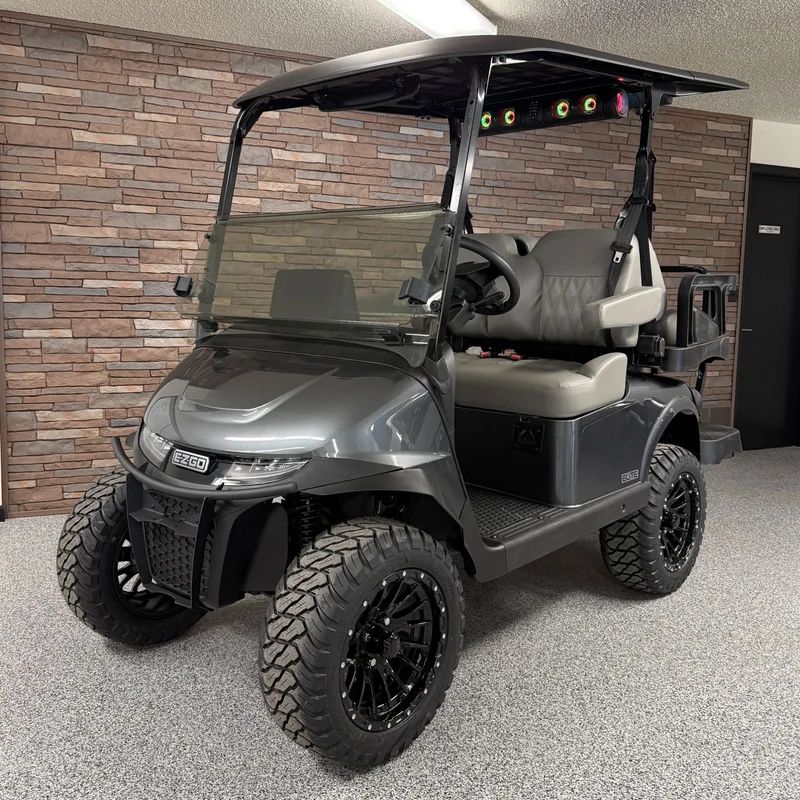
How fast do golf carts go?
Most standard, unmodified golf carts travel between 12 and 14 mph. Modern models fresh off the lot often reach 17 to 25 mph, and street-legal Low Speed Vehicles (LSVs) are legally capped at 25 mph. At the extreme end, custom-built performance carts can hit 50 mph, and the world record stands at a remarkable 119 mph.
| Golf cart type | Typical top speed |
|---|---|
| Standard unmodified cart | 12 – 14 mph |
| Modern stock cart | 17 – 25 mph |
| Street-legal LSV | 20 – 25 mph |
| Modified/upgraded cart | 19.5 – 23 mph |
| Custom high-performance cart | up to 50 mph |
| World record | 119 mph |
Where your cart falls in that range depends on whether it's gas or electric, how old it is, what modifications have been made, the terrain you're driving on, and local speed regulations. This guide breaks down every factor so you know exactly what to expect, what's legal, and what's possible.
Speed by golf cart type
Not all golf carts are built for the same purpose, and their speed ranges reflect that. A powered push caddie designed to follow you down a fairway moves at a walking pace, while a street-legal LSV needs to keep up with neighborhood traffic.
| Cart type | Top speed | Primary use |
|---|---|---|
| Powered push caddie | 3 – 5 mph | On-course bag carrying |
| Standard electric course cart | 12 – 15 mph | Golf courses, resorts |
| Standard gas cart | 15 – 19 mph | Courses, private property |
| Modified/upgraded cart | 19.5 – 23 mph | Private property, communities |
| Street-legal LSV | 20 – 25 mph | Public roads (posted ≤35 mph) |
Golf courses typically cap cart speed at 15 mph using a governor. This isn't just a courtesy rule: it protects turf, reduces accident risk, and is enforced mechanically. With more than 150,000 golf cart-related incidents recorded between 2007 and 2017, speed management on courses is taken seriously.
Gas vs. electric golf cart speed
Here's a common myth worth busting: gas golf carts are not inherently faster than electric ones. Both types average 12 to 14 mph in standard, unmodified form. The real differences come down to how they deliver power, not how much top speed they produce.
| Feature | Electric | Gas |
|---|---|---|
| Unmodified top speed | 12 – 14 mph | 12 – 14 mph |
| Acceleration feel | Instant torque, zippy | Slower to accelerate |
| Power consistency | Drops as battery drains | Consistent throughout use |
| Hill performance | Good with 48V+ | Reliable on inclines |
| Max stock speed (modern) | up to 25 mph | up to 19 mph |
Electric carts deliver torque instantly, which makes them feel faster off the line. Gas carts build power more gradually but maintain consistent output from a full tank to empty. For electric carts specifically, speed can drop noticeably once the battery falls below 50% charge, with some riders losing 3 to 6 mph late in a round.
If you use an electric cart regularly, keeping the battery above 50% charge is the single most practical way to maintain consistent speed throughout your ride. Proper golf cart battery maintenance also plays a key role in sustaining peak performance.
Voltage and electric cart speed (36V vs. 48V vs. 72V)
Higher voltage does not directly mean higher top speed. What it does mean is better torque, faster acceleration, improved hill-climbing ability, and longer range. This is one of the most commonly misunderstood specs in golf cart shopping.
| Voltage | Top speed impact | Key advantages |
|---|---|---|
| 36V | Baseline | Standard performance, lower cost |
| 48V | Similar top speed to 36V | Faster acceleration, better range, stronger on hills |
| 72V | More horsepower and torque; top speed varies | High-performance feel; some 36V models still faster in outright top speed |
Modern 48V lithium-ion models are where the most notable speed gains show up. Newer carts running 48V with lithium batteries can hit 25 mph stock. EZGO's 72V platform adds significant horsepower and torque, but some 36V and 48V carts still outpace it in outright top speed.
If speed is your priority, focus on the motor, controller, and tire specification rather than chasing the highest voltage number.
Top speeds of popular golf cart models
Most major brands cluster around 19 mph for their standard consumer models, with newer electric models pushing higher. Here's how the most popular carts compare.
| Model | Power type | Top speed |
|---|---|---|
| E-Z-GO Valor | Gas and electric | 19 mph |
| E-Z-GO Express 4 | Gas and electric | 19 mph |
| Club Car Onward 4 Passenger | Gas and electric | 19 mph |
| Yamaha Drive 2 PTV | Gas and electric | 19 mph |
| Yamaha Drive 2 Adventurer Sport | Gas | 14.9 mph |
| Evolution Classic 4 PLUS | Electric | 25 mph |
| Denago EV Rover | Electric | 25 mph |
The Evolution Classic 4 PLUS and Denago EV Rover represent the new wave of electric carts that arrive street-legal-ready and at the LSV speed ceiling. If you're buying for use in a planned golf cart community or neighborhood, these models are worth prioritizing over standard 19 mph options.
What affects golf cart speed?
Even a cart rated for 19 mph may not hit that number in real-world conditions. Multiple factors chip away at performance, and understanding them helps you get the most out of any cart.
| Factor | Speed impact |
|---|---|
| 4 passengers plus bags | 2 – 4 mph slower |
| Steep hills or inclines | 5 – 8 mph slower |
| Battery below 50% charge | 3 – 6 mph slower |
| Wet or soft terrain | 2 – 4 mph slower |
| Worn or underinflated tires | Reduced traction, lower effective speed |
| Mud or debris on undercarriage | Added drag, minor speed loss |
| Cold weather (electric carts) | Reduced battery efficiency, noticeable speed drop |
Cold temperatures deserve special attention for electric cart owners. Battery chemistry slows in cold conditions, which reduces available power and cuts top speed, sometimes significantly. If you store or use your cart in a colder climate, expect slower performance in winter months compared to summer benchmarks.
How to make a golf cart faster
There are reliable ways to push your cart beyond its factory limits. The right approach depends on whether you have an electric or gas cart, how much speed you want to gain, and your budget. Below is a breakdown of the most effective modifications, with estimated speed gains and costs.
| Modification | Cart type | Expected speed gain | Approx. cost | Difficulty |
|---|---|---|---|---|
| Speed chip (EZGO older/36V) | Electric | up to 19 mph | $30 – $80 | Low |
| Speed code (Club Car, code 4) | Electric | ~19.5 mph | $50 – $150 | Low to moderate |
| Larger tires (8" to 24") | Both | 3 – 5 mph | $200 – $600 | Moderate |
| Controller upgrade | Electric | 2 – 4 mph | $150 – $400 | Moderate |
| Motor upgrade | Electric | needed above 19 mph ceiling | $300 – $900 | High |
| Speed magnet | Electric | 2 – 4 mph | $20 – $60 | Low |
| High-speed gear set | Gas | 2 – 5 mph | $150 – $350 | Moderate |
| Performance clutch | Gas | 2 – 4 mph | $200 – $500 | Moderate |
| Engine swap or tuning | Gas | varies widely | $500 – $2,000+ | High |
Electric cart modifications
For EZGO owners with older or 36V models, a speed chip is a physical device that overrides the speed controller's factory cap. Club Car uses a software-based equivalent called a speed code, numbered 1 through 5. Code 4 brings most Club Car carts to approximately 19.5 mph; code 5 exists but is rarely available.
If you want to break through the 19 to 19.5 mph ceiling that software changes create, you'll need a motor upgrade. Combining a motor upgrade with larger tires and a speed code can push an electric cart to 23 to 25 mph.
Speed magnets trick the cart's sensor into reading a lower speed, which effectively bypasses the cap. They work, but they also disable accurate speed monitoring. Use with caution, especially on public or shared paths.
Gas cart modifications
For gas carts, the most accessible upgrades are a high-speed gear set and a performance clutch. The clutch allows the engine to reach a higher RPM before the drivetrain engages, which translates directly to more top speed. A torque converter installation can complement both upgrades.
For serious speed gains, an engine swap or carburetor upgrade is the path forward, though costs and complexity rise significantly. Professional installation is strongly recommended for engine-level work.
Tire upgrades (both types)
Swapping standard 8-inch tires for 24-inch tires is one of the simplest ways to add speed to any cart, electric or gas. Larger tires cover more ground per revolution, effectively raising your top speed by 3 to 5 mph without touching the drivetrain. This modification pairs well with almost every other upgrade on the list.
Street-legal golf carts and LSV requirements
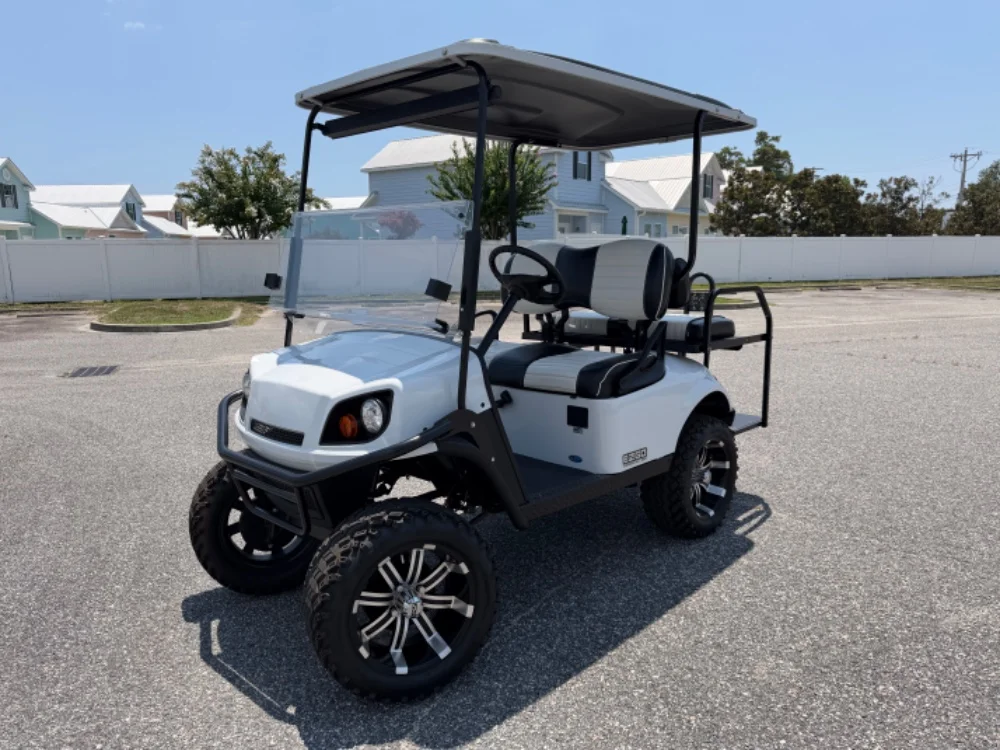
To legally drive a golf cart on public roads, it must qualify as a Low Speed Vehicle (LSV). LSVs are federally defined as vehicles with a top speed between 20 and 25 mph. That 25 mph ceiling is a legal cap, not just a design limit.
| Requirement | Details |
|---|---|
| Minimum top speed | 20 mph |
| Maximum top speed (LSV cap) | 25 mph |
| Headlights and taillights | Required |
| Brake lights | Required |
| Turn signals | Required |
| Windshield | Required |
| Seatbelts | Required |
| Rearview mirror | Required |
| Allowed roads | Public roads posted at 35 mph or under (varies by state) |
LSVs are typically allowed on public roads with posted speed limits of 35 mph or less, though exact thresholds vary by state and municipality. Golf cart communities, planned neighborhoods, and campgrounds often have their own internal rules that differ from public road regulations.
If you want to drive faster than 25 mph on public roads, a standard golf cart or LSV won't get you there legally. Vehicles exceeding 25 mph fall under different federal classifications with significantly stricter safety and registration requirements.
Laws vary considerably across states. Some require LSV registration and insurance; others do not. Some municipalities allow golf carts on roads up to 45 mph with a permit, while many do not. Always check your golf cart laws in your state before taking a cart onto public roads.
Frequently asked questions
Are gas golf carts faster than electric?
Not necessarily. Both types reach similar top speeds in standard, unmodified form at 12 to 14 mph. Electric carts often feel faster due to instant torque, while gas carts offer more consistent power delivery. Modern electric golf carts can reach 25 mph stock, which currently edges out most stock gas models.
Is a 48V golf cart faster than a 36V cart?
Not in outright top speed. A 48V cart accelerates more quickly, handles hills better, and runs longer on a charge, but the top speed difference is minimal. The motor and controller have more influence on top speed than voltage does.
How fast is a 72V golf cart?
A 72V cart offers more horsepower and torque than 36V or 48V models, but it isn't necessarily faster in top speed. Some 36V and 48V carts actually reach higher top speeds. The 72V advantage shows most on hills and when carrying heavy loads.
Can you get a golf cart to go 35 mph?
Mechanically, yes. Modified carts and specialty builders can reach that range. Legally, it's more complicated. LSVs are capped at 25 mph, and a cart exceeding that threshold no longer qualifies as an LSV. It must then meet federal motor vehicle safety standards to operate on public roads, which most golf-cart-based builds cannot satisfy. Custom-built performance carts from specialty manufacturers can reach 50 mph, but they exist outside the LSV classification entirely.
What is the fastest golf cart ever?
The world record for the fastest golf cart is 119 mph, set on a closed course with a heavily modified vehicle. This is purely a performance record and has no connection to road-legal or course-legal speed limits.
What is the difference between a speed chip and a speed code?
A speed chip is a physical device installed on EZGO carts, particularly older and 36V models, that overrides the electronic speed controller's factory cap. A speed code is a software-based setting used on Club Car carts, uploaded via a programming device. Both achieve a similar outcome by raising the speed ceiling, but through different methods for different brands.
How much does it cost to make a golf cart faster?
Entry-level modifications like speed chips or speed magnets cost as little as $20 to $150. A full upgrade combining larger tires, a controller, and a motor upgrade can run $700 to $1,500 or more, depending on parts and whether you hire a professional installer.