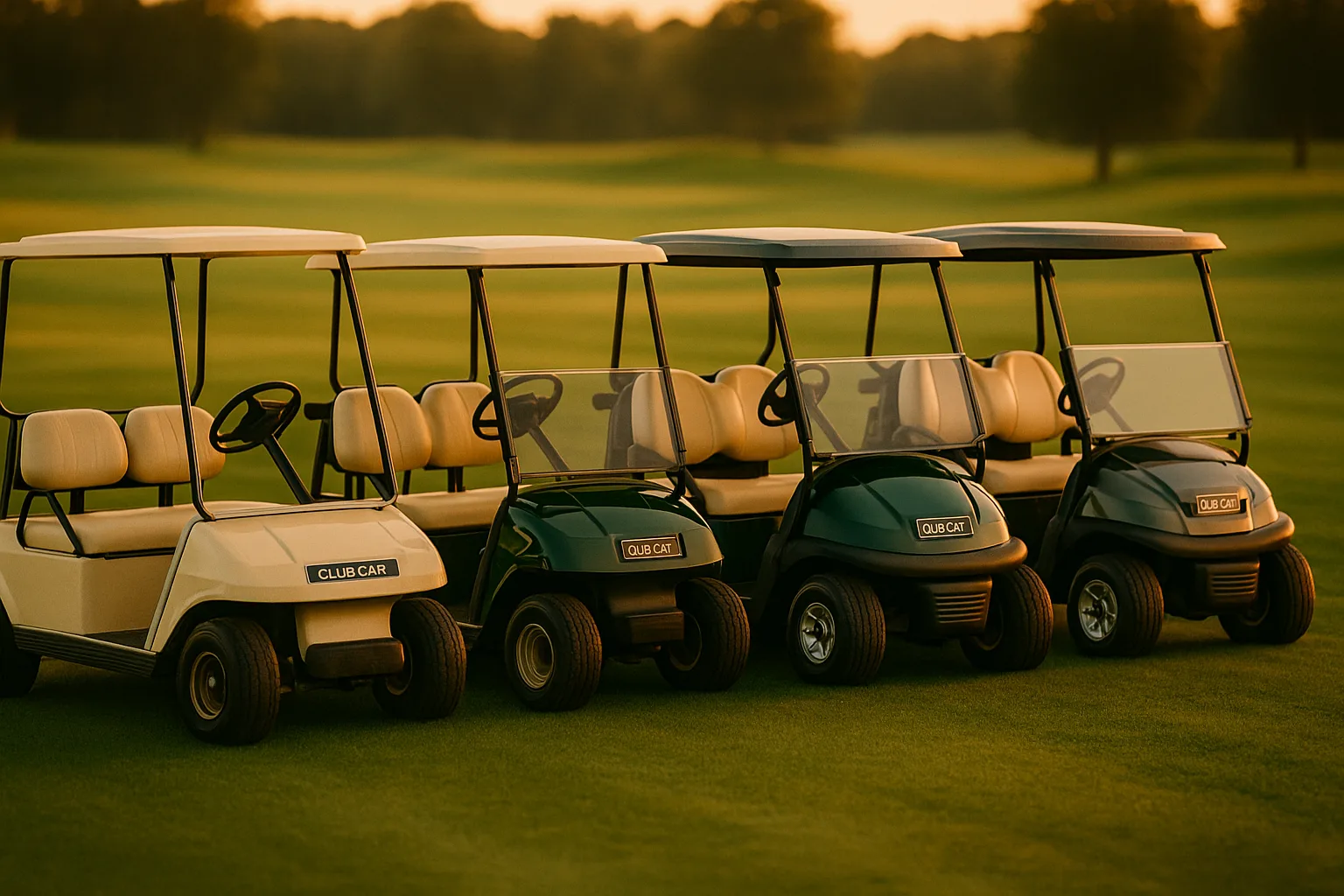
Club Car DS: the golf cart that defined an era
The Club Car DS ran for 24 years, from 1980 to 2004, and became one of the most recognizable golf carts ever built. Its boxy aluminum frame, durable suspension system, and reputation for long-term reliability made it the flagship model for Club Car and the workhorse of golf courses across the country. Today, the DS remains one of the most searched and traded golf carts in the used market, with a passionate owner community and a thriving aftermarket parts ecosystem.
| Model / data point | Detail |
|---|---|
| DS production years | 1980 – 2004 |
| Production run length | 24 years |
| Frame material | Aluminum (rust-resistant) |
| Available powertrains | Gas and electric |
| Typical used DS price | $5,500 – $8,000 |
| Successor model | Club Car Precedent (2004) |
Whether you're researching Club Car history, tracking down a used DS, or trying to identify the year of a cart you already own, this guide covers the full story, from the company's 1958 founding through the DS's 24-year production run and the current model lineup that followed it.
Club Car company origins (1958–1979)
Club Car was founded in 1958 in Houston, Texas, originally operating under the name Landreth Machine. The company's early focus was gasoline-powered golf buggies, which were just beginning to gain traction on American golf courses. A 1962 relocation to Augusta, Georgia marked a turning point, putting the company closer to the golf culture of the American South and setting the stage for significant growth.
| Milestone | Year / detail |
|---|---|
| Founded as Landreth Machine | 1958, Houston, TX |
| Relocated to Augusta, GA | 1962 |
| Aluminum frame innovation | 1970s |
| Club Car Caroche introduced | 1970 |
| Caroche production ended | 1980 |
| Current headquarters | Evans, GA |
The most important engineering development of this era was the introduction of the aluminum frame in the 1970s. At a time when most competitors were building carts with steel frames prone to rust and corrosion, Club Car's aluminum chassis was lighter, longer-lasting, and far better suited for daily outdoor use on golf courses.
This innovation debuted on the Club Car Caroche, produced from 1970 to 1980. The Caroche was the company's first mass-produced electric cart and introduced the forward/reverse switch that became standard across the industry. Its quiet electric operation and rust-resistant frame gave Club Car a genuine competitive advantage and laid the engineering foundation for the DS that would follow.
Club Car DS history and design
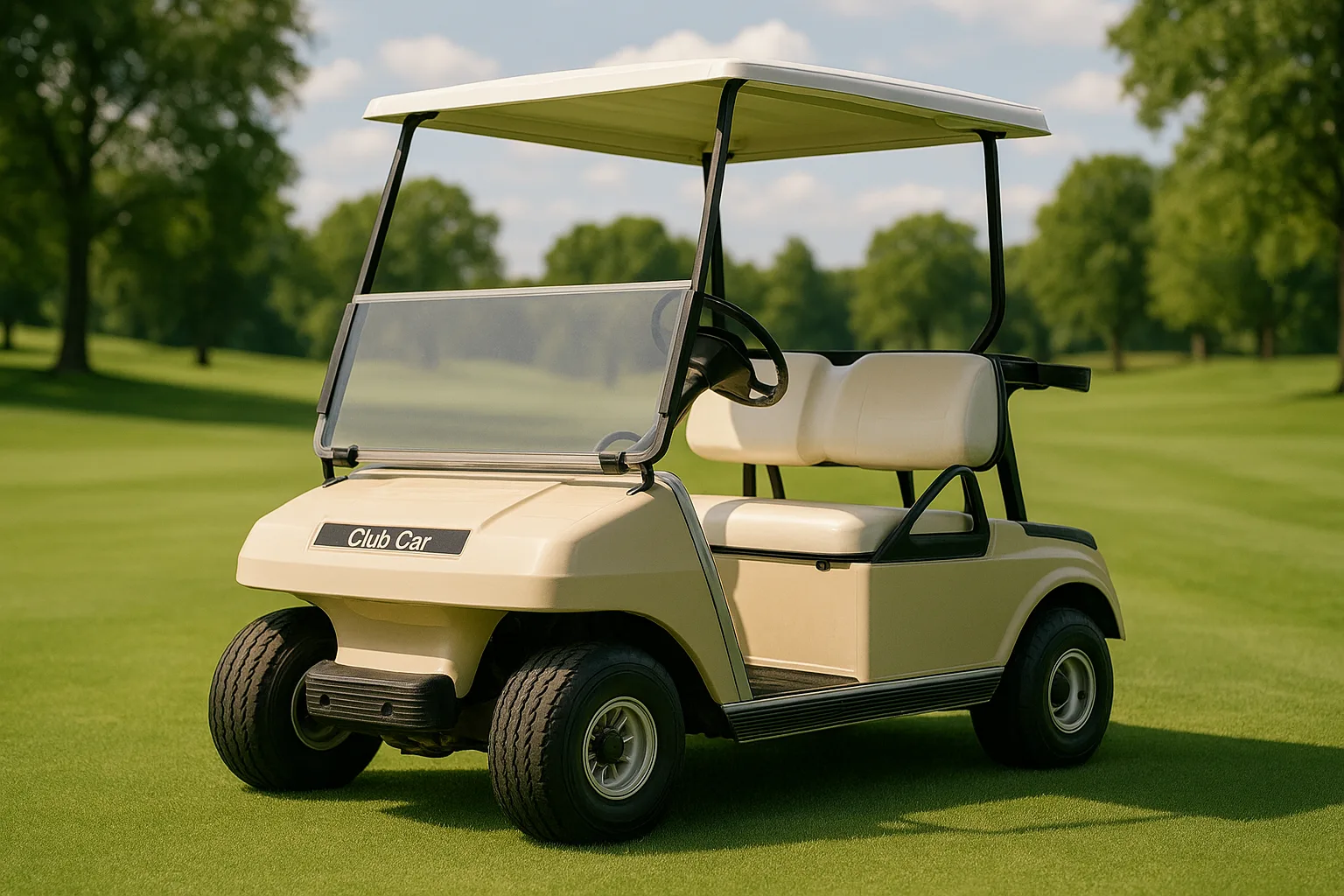
The Club Car DS launched in 1980 as the direct successor to the Caroche. It retained the aluminum frame and built on it with a more refined suspension system, one of its defining features at launch. The suspension gave the DS a noticeably smoother ride than competing carts of the era, an important selling point for both golf courses and private buyers.
| DS feature | Detail |
|---|---|
| Launch year | 1980 |
| Retirement year | 2004 |
| Frame | Aluminum, rust-resistant |
| Body style | Boxy, upright profile |
| Suspension | Independent front suspension (key differentiator at launch) |
| Powertrains | Gas (Kawasaki and FE engine variants) and electric (36V and 48V systems) |
| Primary market | Golf course fleets and private buyers |
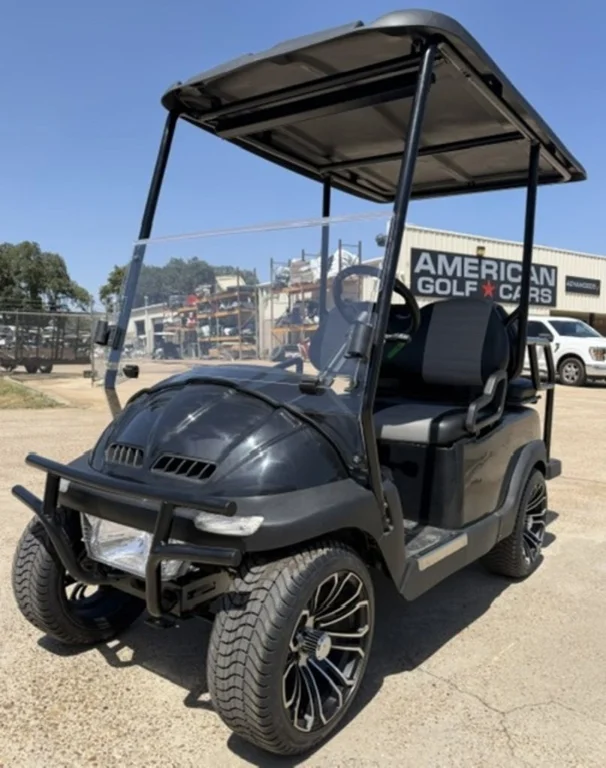
The DS's boxy appearance became its visual trademark. While later models would adopt more streamlined, consumer-friendly styling, the DS leaned into function over form: flat body panels, a simple roofline, and a layout optimized for golf course use. That straightforward design made it easy to repair, customize, and source parts for, which is a big reason the cart remains popular decades after production ended.
Gas vs. electric DS variants
The DS was produced in both gas and electric configurations throughout its production run. Electric models were more common in golf course fleet applications, where charging infrastructure was already in place. Gas models were popular for utility use and buyers who needed range beyond what early battery systems could provide.
- Electric DS models used 36-volt battery systems in earlier production years, with many later models upgraded to 48-volt systems as battery technology improved. The 48-volt setup delivers better torque and range.
- Gas DS models ran Kawasaki engines in earlier years and later transitioned to FE series engines. These are generally easier to work on and still have strong parts availability today.
When shopping for a used DS, confirming whether it is gas or electric is the first identification step, as maintenance costs, upgrade paths, and parts sourcing differ significantly between the two.
DS era-by-era changes
While the DS maintained its core design throughout its production run, there were meaningful changes across three broad eras that buyers and historians should understand.
Early DS (1980–1988): These carts featured the original suspension geometry and 36-volt electrical systems on electric models. Body panels were thicker and heavier compared to later production years. Early DS carts are durable but can be harder to find compatible modern parts for, particularly on the electrical side.
Mid-era DS (1989–1996): This period saw refinements to the front end geometry, updated controller technology on electric models, and incremental improvements to seat cushioning and dashboard layout. The mid-era DS is widely considered the sweet spot for used buyers: old enough to be affordable, new enough to have better electrical compatibility.
Late DS (1997–2004): Later DS models incorporated 48-volt systems on electric variants and updated engine options on gas models. The bodywork became slightly more refined without departing from the classic DS profile. These carts are the closest to the Precedent in terms of parts interchangeability and are the most common DS models in today's used market.
If you're buying a used DS, late-era models (1997–2004) offer the best combination of durability, parts availability, and compatibility with modern aftermarket upgrades. Mid-era models (1989–1996) are solid value picks if the battery bank or engine has been recently serviced.
How to identify your DS year
The most reliable way to identify the production year of a Club Car DS is by locating the serial number and cross-referencing it with Club Car's model directory. The serial number is stamped on a plate located on the driver's side of the frame, beneath the seat or on the forward section of the frame near the battery compartment.
| Serial number section | What it tells you |
|---|---|
| First two letters | Model type (e.g., "A" series for DS) |
| Next four digits | Model year and production sequence |
| Remaining digits | Unit production number |
Club Car changed its serial number format multiple times over the DS production run. For carts built between 1981 and 1998, the first two characters typically identify the model series. Starting in 1999, Club Car shifted to a format where the first four digits of the serial number encode the model year directly.
If you're unable to decode the serial number from the plate alone, Club Car's official model type directory (available through their website and authorized dealers) allows you to look up your specific cart by serial number. Authorized Club Car dealers can also run a VIN-style lookup to confirm production year and original specification.
Before buying a used DS, always ask for the full serial number and verify the production year before agreeing on a price. Older DS models (pre-1989) may require hard-to-source electrical components, which affects both value and ongoing maintenance costs.
DS transition to the Precedent (2004)
Club Car replaced the DS with the Precedent in 2004. The transition reflected changing buyer expectations, particularly in the growing personal and neighborhood electric vehicle market, where aesthetics and modern features had become competitive factors alongside durability.
| Feature | Club Car DS | Club Car Precedent |
|---|---|---|
| Production years | 1980 – 2004 | 2004 – 2018 |
| Body style | Boxy, utilitarian | Rounded, consumer-focused |
| Frame | Aluminum | Rustproof aluminum (upgraded alloy) |
| Drive system | Standard drive | Excel Drive System |
| Suspension | Independent front | Improved independent front |
| Aftermarket support | Extremely strong | Strong |
The Precedent introduced Club Car's Excel Drive System, which delivered smoother acceleration and more consistent speed control compared to the DS. The frame material was upgraded to a more refined rustproof aluminum alloy, and the overall body design shifted toward a rounder, more car-like profile that appealed to personal buyers and resort properties.
Golf courses that ran DS fleets largely transitioned to the Precedent through the mid-2000s, with many courses running mixed fleets during the overlap period. The DS did not disappear from courses overnight; some operators kept DS fleets well into the 2010s due to their durability and low operating costs.
What the Precedent did not improve, at least from the perspective of the enthusiast community, was the DS's simplicity. The DS is mechanically straightforward in a way the Precedent is not, which is part of why the DS remains a favorite platform for DIY builds and custom golf cart projects.
DS legacy: used market, aftermarket, and community
The Club Car DS has one of the strongest aftermarket ecosystems of any golf cart platform. Lift kits, custom body panels, performance motors, upgraded controllers, and specialty wheels designed specifically for the DS are widely available from major aftermarket suppliers. The DS's long production run and massive fleet deployment on golf courses means millions of units exist in the used market, keeping parts supply healthy.
| Popular DS upgrade | Approximate cost |
|---|---|
| Lift kit (3" to 6") | $150 – $500 |
| Motor upgrade (electric) | $300 – $800 |
| Controller upgrade | $200 – $600 |
| Custom wheels and tires | $400 – $1,200 |
| New battery bank (electric) | $600 – $1,500 |
Common DS problems that used buyers should know about include solenoid wear on electric models (a relatively inexpensive fix), battery bank degradation on older 36-volt systems, and controller failures on mid-era carts that were never upgraded. Gas DS models may show carburetor wear and fuel line deterioration, both of which are straightforward repairs.
The DS's used market value holds up well relative to its age. A clean, running DS in good condition typically trades between $5,500 and $8,000, with customized or recently restored examples pushing higher. Carts with degraded battery banks or engine issues sell at significant discounts and are popular project cart purchases.
When evaluating a used DS, budget for a battery bank replacement on any electric model older than five years. A fresh 48-volt lithium conversion can cost $1,200 to $2,000 but dramatically improves range and eliminates ongoing maintenance compared to traditional lead-acid packs. See our guide to golf cart batteries for a full breakdown of types, care, and replacement costs.
Full Club Car model timeline
The DS was the centerpiece of Club Car's lineup for nearly a quarter century, but the company has continued to innovate since the Precedent's 2004 launch. Here is the full Club Car model timeline from the Caroche through the current lineup.
| Model | Years | Key feature |
|---|---|---|
| Caroche | 1970 – 1980 | First mass-produced electric Club Car; aluminum frame; forward/reverse switch |
| DS | 1980 – 2004 | Flagship model; improved suspension; gas and electric variants; 24-year run |
| Precedent | 2004 – 2018 | Excel Drive System; updated aluminum alloy; rounded consumer styling |
| Tempo | 2018 – present | Precedent successor; Visage Fleet Management system; pace-of-play tracking |
| Onward | Current | 2, 4, and 6-passenger; gas, electric, and HP Li-Ion; lifted and non-lifted |
| Carryall | Current | Utility and commercial; 4x2 and 4x4; 800 to 1,900 lb payload |
| Cru | Current | 6-passenger; NEV certified; open-air; removable center table |
| V4L | Current | Budget lifted 4-passenger; Precedent body style |
Club Car Tempo
The Tempo succeeded the Precedent in 2018 and added the Visage Fleet Management system as its headline feature. Visage enables golf courses to track pace of play, monitor battery levels in real time, and push digital content like yardage information and course maps directly to carts. It is Club Car's most technology-forward fleet offering.
Club Car Onward
The Onward is Club Car's primary personal-use model and is sold in 2, 4, and 6-passenger configurations. Buyers can choose between gas, electric, and HP Li-Ion powertrains, as well as lifted and non-lifted versions. It is the most customizable Club Car model sold new and competes directly with the LSV and personal-use market served by brands like EZGO and Yamaha. If you're comparing options across brands, our comparison of Evolution vs. E-Z-GO golf carts covers how competing platforms stack up for personal buyers.
Club Car Carryall
The Carryall series serves commercial and utility applications, with 4x2 and 4x4 configurations available. Payload capacity across the lineup runs from 800 to 1,900 pounds, making it suitable for everything from resort maintenance to industrial campus use. It is Club Car's heaviest and most work-focused product line. For buyers evaluating utility-focused carts across brands, our guide to the best utility golf carts covers the leading options in this category.
Club Car Cru
The Cru is a 6-passenger, open-air cart certified as a Neighborhood Electric Vehicle (NEV), allowing it to operate on roads posted up to 35 mph in most states. Its removable center table makes it a popular choice for resort and hospitality applications. The NEV certification is what sets it apart from standard 6-passenger configurations. If you plan to use any Club Car on public roads, check our golf cart laws by state guide for street-legal requirements in your area.
Club Car ownership and pricing
Club Car is currently owned by Platinum Equity, which acquired the company in 2021 for $1.7 billion. Prior to that acquisition, Club Car operated as a division of Ingersoll-Rand. The company's headquarters remains in Evans, Georgia, with manufacturing operations also located in Wujiang, China, serving the Asia-Pacific market.
| Buyer type | Typical price range |
|---|---|
| New Club Car (any current model) | $9,500 – $25,000 |
| Most common new price range | $13,000 – $16,000 |
| Used Club Car (general) | $5,500 – $8,000 |
| Used Club Car DS (good condition) | $5,500 – $8,000 |
| Used DS (project or parts condition) | $1,500 – $3,500 |
Club Car models range in weight from approximately 600 pounds for personal carts to 1,800 pounds for heavy-duty Carryall configurations. The DS falls in the mid-range for its era, with electric models typically weighing more than gas variants due to the battery bank. For a broader view of what you should expect to spend across the new and used market, see our golf cart cost guide.
Frequently asked questions
What years did Club Car make the DS?
Club Car produced the DS from 1980 to 2004, a 24-year run that made it one of the longest-running golf cart models in history. It was replaced by the Precedent in 2004.
How do I find out what year my Club Car DS is?
Locate the serial number plate on the driver's side of the frame, typically beneath the seat or near the battery compartment. For DS models built from 1999 onward, the first four digits of the serial number encode the model year. For older models, cross-reference the serial number with Club Car's official model directory or contact an authorized Club Car dealer for a lookup.
What is the difference between a Club Car DS and a Precedent?
The DS has a boxy, utilitarian body style and a simpler mechanical layout. The Precedent uses Club Car's Excel Drive System for smoother acceleration, an updated aluminum alloy frame, and a more rounded, consumer-friendly design. The DS is generally considered easier to work on and customize, while the Precedent offers a more refined ride and a more modern feature set.
Is the Club Car DS gas or electric?
The DS was produced in both gas and electric variants throughout its production run. Electric models used 36-volt systems in early years and 48-volt systems in later production. Gas models used Kawasaki and FE series engines depending on the production era.
How much is a used Club Car DS worth?
A used DS in good running condition typically sells for $5,500 to $8,000. Carts with worn battery banks or mechanical issues sell for considerably less, often in the $1,500 to $3,500 range, making them popular project and restoration candidates.
Who owns Club Car now?
Club Car is owned by Platinum Equity, which acquired the company in 2021 for $1.7 billion. The company is headquartered in Evans, Georgia.
Where are Club Car golf carts made?
Club Car manufactures its golf carts in Evans, Georgia, for the North American market. Carts sold in the Asia-Pacific region are manufactured in Wujiang, China.
How much does a new Club Car cost?
New Club Car models are priced from $9,500 to $25,000, with most buyers spending in the $13,000 to $16,000 range depending on model, configuration, and powertrain choice.
Are Club Car DS parts still available?
Yes. The DS has one of the strongest aftermarket parts ecosystems of any golf cart platform. OEM and aftermarket parts for both gas and electric DS models are widely available through Club Car dealers and third-party suppliers. The cart's long production run and large installed base ensure that parts supply remains healthy.