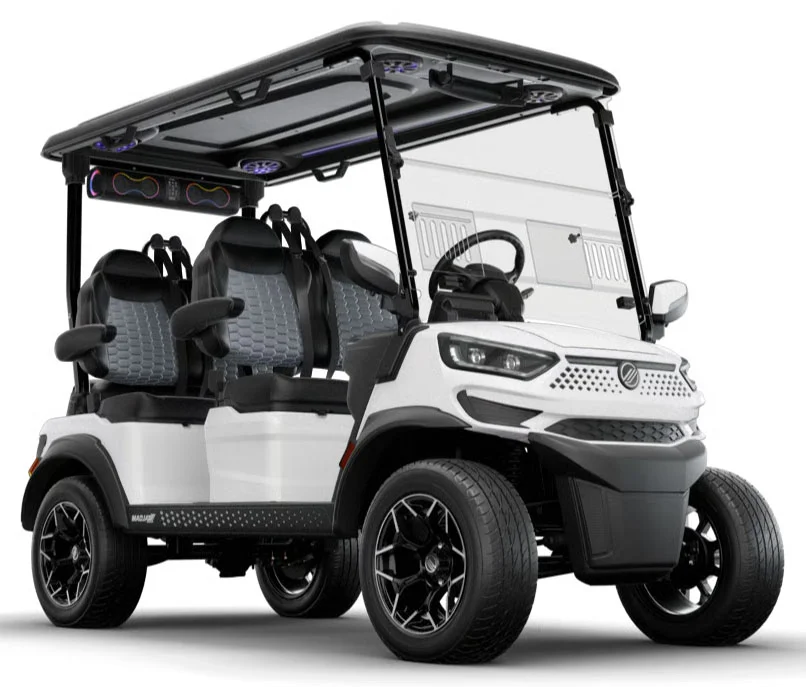
Golf carts vs. low-speed vehicles in New Jersey
Standard golf carts are not street legal in New Jersey under any circumstances. No local ordinance, permit, or registration workaround changes this. The only vehicle that can legally travel on New Jersey public roads in this category is a low-speed vehicle (LSV), and the rules governing LSVs are strict, specific, and set at the state level.
Understanding the distinction between a golf cart and an LSV is the foundation of everything else in New Jersey golf cart law. These are two legally separate categories of vehicle, and conflating them is the most common mistake buyers make.
| Feature | Standard golf cart | Low-speed vehicle (LSV) |
|---|---|---|
| Public road access | Not permitted | Permitted on roads 35 mph or under |
| Top speed | Typically under 20 mph | Greater than 20 mph, not more than 25 mph |
| Power source | Gas or electric | Electric only |
| VIN required | No | Yes, 17-digit manufacturer-assigned VIN |
| Registration required | No | Yes, through NJ MVC |
| Insurance required | No (private property only) | Yes, standard NJ auto insurance |
| Driver's license required | No (private property) | Yes, valid NJ license, minimum age 18 |
Under New Jersey statute NJSA 39:4-31.1, an LSV is defined as a four-wheeled, electric-powered vehicle with a top speed greater than 20 mph and not more than 25 mph, built to comply with federal safety standards under 49 CFR 571.500. A standard golf cart does not meet this definition regardless of how it is modified.
Are golf carts street legal in New Jersey?
Standard golf carts are not street legal in New Jersey, period. There is no municipal pathway that allows a town to authorize unregistered golf carts on public roads. Even if a neighboring state or nearby community permits golf cart use on local streets, New Jersey does not. For a broader look at how other states handle this, see our guide to golf cart laws by state.
Only factory-built electric LSVs with a manufacturer-assigned 17-digit VIN can be driven on public roads in New Jersey. A vehicle converted from a gas golf cart, a modified electric golf cart, or any vehicle without a factory VIN does not qualify as an LSV and cannot be registered or legally driven on public roads.
Gas and diesel-powered vehicles cannot qualify as LSVs in New Jersey. Even if a gas-powered vehicle meets every other LSV specification, the electric-only requirement disqualifies it entirely. There is no conversion pathway.
Where LSVs can and cannot be driven
LSVs may be driven on New Jersey public roads with posted speed limits of 25 mph or less by default. Municipalities, counties, or the New Jersey Department of Transportation (NJDOT) can authorize LSV use on roads with posted speed limits up to 35 mph, but this requires explicit authorization. LSVs cannot be driven on any road with a posted speed limit above 35 mph under any circumstances.
| Road type | LSV permitted? |
|---|---|
| Roads posted at 25 mph or less | Yes |
| Roads posted at 26–35 mph (with authorization) | Yes, if municipality, county, or NJDOT has authorized it |
| Roads posted above 35 mph | No |
| Interstate highways | No |
| Limited-access highways | No |
| Private property and golf courses | Yes (golf carts and LSVs both permitted) |
Municipalities also have the authority to ban LSVs entirely within their jurisdiction, even on roads where they would otherwise be permitted under state law. This makes local verification essential before purchasing an LSV for use in a specific town.
Required equipment for LSVs
Under NJSA 39:4-31.2, LSVs must be equipped with a specific set of safety features to qualify for registration and road use. A vehicle missing any of these does not meet the legal definition of an LSV and cannot be registered through the New Jersey MVC.
| Required equipment | Notes |
|---|---|
| Headlights | Functional, front-facing |
| Taillights | Functional, rear-facing |
| Turn signals | Front and rear |
| Brake lights | Separate from taillights |
| Reflectors | Required per federal standard |
| Rearview mirror(s) | At minimum, interior rearview |
| Seat belts | Every seating position |
| Parking brake | Functional |
| Windshield | Required |
| 17-digit VIN | Manufacturer-assigned, die-stamped on body, frame, or motor |
| Electric power only | Gas or diesel disqualifies the vehicle |
These requirements come directly from federal safety standards under 49 CFR 571.500 and are incorporated into New Jersey law. A golf cart with added lights and seat belts does not become an LSV. The vehicle must be factory-built as an LSV by a recognized manufacturer to receive a qualifying VIN.
Registration, titling, and inspection
LSVs must be titled and registered through the New Jersey Motor Vehicle Commission (MVC). The process closely mirrors standard motor vehicle registration. Owners will need to bring the manufacturer's certificate of origin (MCO), proof of insurance, and valid identification to an MVC agency to complete the title and registration.
Documents typically required for LSV registration include:
- Manufacturer's certificate of origin or existing title (if purchasing used)
- Proof of New Jersey auto insurance meeting state minimums
- Valid New Jersey driver's license
- Completed MVC title and registration application
- Payment for applicable registration and title fees
LSVs are exempt from New Jersey's standard vehicle inspection program, so there is no annual inspection requirement once the vehicle is registered. LSVs certified by the Commissioner of the New Jersey Department of Environmental Protection (NJDEP) are also exempt from state sales tax, which can represent meaningful savings on the purchase price.
If you are purchasing a used LSV already registered in New Jersey, the seller should provide the existing NJ title. Bring this along with proof of insurance to your local MVC agency to complete the transfer.
Insurance requirements
LSVs operated on public roads in New Jersey must carry standard New Jersey auto insurance. Proof of insurance must be in the driver's possession at all times while operating on public roads. The state minimum coverage requirements are:
| Coverage type | Minimum required |
|---|---|
| Bodily injury per person | $35,000 |
| Bodily injury per accident | $70,000 |
| Property damage | $25,000 |
Standard golf carts used exclusively on private property, golf courses, or within gated or planned communities have no state insurance requirement. However, many community associations and private developments impose their own rules, so confirming with your HOA or community management is always advisable.
Age and license requirements
Under NJSA 39:4-31.3, a valid New Jersey driver's license is required to operate an LSV on any public road. The minimum age to drive an LSV in New Jersey is 18 years old, which is higher than most states where the typical minimum is 16. While driving, operators must carry their driver's license, registration, and proof of insurance at all times.
There is no minimum age requirement for operating a standard golf cart on private property, though property owners, golf courses, and community associations may impose their own age restrictions.
LSVs at the Jersey Shore
Shore communities are where LSV use is most visible and most common in New Jersey. The combination of low-speed residential streets, seasonal traffic, and compact beach-town layouts makes LSVs practical in these areas. However, rules vary significantly from one municipality to the next, and not all shore towns welcome LSVs on their streets.
| Shore community | LSV considerations |
|---|---|
| Long Beach Island (LBI) | Multiple boroughs; rules vary by specific municipality within LBI |
| Avalon | Popular for LSV use; confirm current local ordinances before purchasing |
| Stone Harbor | Adjacent to Avalon; check borough-specific rules |
| Cape May | Historic district and beach-area roads may have additional restrictions |
| Wildwood and North Wildwood | Busy resort area; verify local ordinances on road access for LSVs |
Because municipalities can both authorize LSV use on roads up to 35 mph and ban LSV use entirely, the only reliable way to know what is permitted in a specific shore town is to contact the local police department or town clerk directly. Do this before purchasing an LSV for use in a particular community.
Seasonal residents and summer renters should verify LSV rules in their specific shore community each year. Local ordinances can change, and what was permitted last summer may have been revised.
Penalties for violations
Driving an unregistered golf cart on a public road in New Jersey is not a minor issue. Because standard golf carts are not legally permitted on public roads under any circumstances, operating one on a public street exposes the driver to motor vehicle violations, potential fines, and in some cases more serious consequences depending on the circumstances.
| Violation | Potential consequence |
|---|---|
| Driving unregistered golf cart on public road | Motor vehicle summons, fines, vehicle impoundment |
| Operating LSV without registration | Fines and potential impoundment |
| Operating LSV without insurance | Fines, license suspension, registration revocation |
| Operating LSV while impaired (DUI/DWI) | Full DUI prosecution under NJSA 39:4-50; same as any motor vehicle |
| Using gas-powered vehicle as LSV | Vehicle does not qualify for registration; treated as unregistered |
New Jersey DUI and DWI laws apply fully to LSVs operated on public roads because LSVs are registered motor vehicles. There is no legal gray area. Even a standard golf cart driven while impaired on a public road can result in impaired driving charges. Do not assume that a slower, smaller vehicle provides any protection from these laws.
What street-legal LSVs cost
Factory-built LSVs from recognized manufacturers typically cost more than standard golf carts because they must meet federal safety standards and include all required equipment from the factory. Entry-level models from brands like Club Car and Polaris GEM generally start in the range of $8,000 to $12,000. Higher-end or extended-range models can reach $15,000 or more. For a detailed breakdown of what affects pricing across the broader golf cart market, see our guide on how much a golf cart costs.
| LSV category | Typical price range |
|---|---|
| Entry-level LSV (2-passenger) | $8,000 – $12,000 |
| Mid-range LSV (4-passenger) | $12,000 – $15,000 |
| Premium or extended-range LSV | $15,000+ |
| Used LSV (already registered in NJ) | $4,000 – $9,000 depending on age and condition |
Eligible LSVs may be exempt from New Jersey sales tax if certified by the NJDEP Commissioner. This can reduce the effective purchase cost by several hundred to over a thousand dollars depending on the vehicle price. Confirm eligibility with the dealer before finalizing the sale.
Golf cart use in private communities
Many New Jersey residents live in planned communities, retirement communities, or gated developments where golf carts circulate internally on private roads or paths. In these settings, the state registration and insurance requirements that apply to public roads generally do not apply, because the roads are private property.
That said, individual communities set their own rules, and many require:
- A community-issued permit or registration sticker
- Proof of personal liability coverage (sometimes available as a homeowner's policy rider)
- Minimum age requirements for operators
- Restrictions on cart modification or speed
If your community's internal paths connect to or cross public roads, even briefly, the public road rules apply for that portion of the trip. A standard golf cart cannot legally cross a public street, even for a few feet.
Frequently asked questions
Can I convert a gas golf cart into a street-legal LSV in New Jersey?
No. New Jersey requires LSVs to be electric only and to carry a manufacturer-assigned 17-digit VIN die-stamped from the factory. There is no conversion process that produces a qualifying VIN, and gas-powered vehicles are disqualified regardless of all other modifications. A converted golf cart cannot be registered as an LSV in New Jersey. If you are weighing power source options for a new purchase, our comparison of gas vs. electric golf carts covers the key differences.
Can my town allow golf carts on local streets?
No. New Jersey law does not give municipalities the authority to permit unregistered standard golf carts on public roads. Towns can authorize LSV use on roads with posted speed limits up to 35 mph, but they cannot create a separate local exception for standard golf carts.
Can my town ban LSVs entirely?
Yes. Municipalities have the authority to prohibit LSV operation within their jurisdiction even on roads where they would otherwise be permitted under state law. This is one reason why confirming local rules before purchasing is essential.
Do LSVs need to pass the New Jersey vehicle inspection?
No. LSVs are exempt from New Jersey's standard vehicle inspection program. Once registered, there is no annual inspection requirement.
Are gas-powered LSVs allowed in New Jersey?
No. New Jersey law requires LSVs to be electric only. A gas or diesel-powered vehicle cannot qualify as an LSV and cannot be registered as one through the MVC, regardless of whether it meets other LSV specifications.
What shore towns allow LSVs?
Several Jersey Shore communities, including Avalon, Stone Harbor, and various municipalities on Long Beach Island, are areas where LSV use is common. However, rules vary by specific borough or township and can change. Contact the local police department or town clerk to confirm current local ordinances before purchasing.
Can you get a DUI on a golf cart in New Jersey?
Yes, in practice. LSVs are registered motor vehicles, so DUI and DWI laws under NJSA 39:4-50 apply fully. Standard golf carts driven while impaired on a public road can also lead to impaired driving charges, even though they should not be on public roads in the first place. There is no legal distinction that protects a driver simply because their vehicle is smaller or slower.
What is the minimum age to drive an LSV in New Jersey?
18 years old. This is higher than most states, where 16 is the typical minimum. A valid New Jersey driver's license is required regardless of age.
What insurance do I need for an LSV in New Jersey?
Standard New Jersey auto insurance meeting state minimums is required: $35,000 bodily injury per person, $70,000 bodily injury per accident, and $25,000 property damage. Proof of insurance must be carried while operating on public roads.
Can out-of-state visitors bring their LSV to New Jersey?
Out-of-state visitors may operate their properly registered and insured LSV in New Jersey, but they are still subject to all New Jersey road access rules, including speed limit thresholds and local municipal restrictions. If visiting a shore town, confirm local LSV rules with the municipality before driving on public roads. Residents of neighboring states may also want to review the rules for Pennsylvania golf cart laws or Massachusetts golf cart laws depending on their home state.